

Christian Nationalists insist their fear of Islam is about freedom, democracy, or some vague concern about “Western values.” They tell the story as if Islam is an external threat pressing in on a fragile civilization that must be defended with flags, laws, and loud certainty.
That story collapses under even light attention.
The fear is not about Islam taking over America. It is about Islam revealing something America’s Christian nationalist movement no longer has.
Coherence.
It is hard to preach “Christian values” with a straight face when your church divides over whether to stack the communion cups, pass them row by row, use pre-sealed plastic chalices, or replace the entire ritual with a video bumper and a worship set that sounds like a Coldplay audition.
It is hard to claim moral authority when every decade produces another schism, rebrand, and doctrinal civil war over things that would have baffled the desert fathers.
Islam exposes this instability not by attacking Christianity, but by quietly continuing to exist as a disciplined civilization.
A Religion That Still Knows What It Is
Islam does not survive because everyone agrees. It survives because it knows what it is doing.
Across continents, cultures, and political systems, Muslims orient their bodies toward prayer at the same times each day. They fast together. They mark sacred time together. They submit to rhythms that are older than any modern nation-state.
This does not require uniformity of thought. It requires shared practice.
Christian Nationalism, by contrast, is not anchored in shared spiritual discipline. It is anchored in shared outrage. It is reactive rather than formative. It depends on enemies to define itself because it no longer has a stable center.
When outrage fades, the movement fractures.
Islam does not need a branding consultant to remind it who it is every election cycle.
The Embarrassment of Discipline
One of the quiet reasons Christian Nationalists fear Islam is that Islam asks more of its adherents than a voting record and a Facebook post.
Prayer is not optional.
Fasting is not symbolic.
Submission is not metaphorical.
The body is involved whether the ego approves or not.
This is deeply uncomfortable for a movement that has trained itself to distrust discipline unless it looks like dominance.
Christian Nationalism prefers slogans because slogans cost nothing.
Discipline costs comfort.
It requires showing up when no one is watching.
It requires submitting opinion to practice.
It requires accepting that God is not impressed by certainty.
Islam never pretended the ego was the point.
Christian Nationalism built a theology around protecting it.
Mysticism Without Panic
Here is where the fear sharpens.
Islam possesses one of the most refined mystical traditions on the planet, and it did not have to exile it to survive.
Sufism did not emerge as a rebellion against Islam. It emerged as a deepening of it. A science of attention. A rigorous path of remembrance. A discipline that works on breath, body, ethics, silence, and love.
This terrifies Christian Nationalism because Christian Nationalism does not know what to do with direct encounter with God.
Mysticism destabilizes empire.
A person who knows how to sit in silence, regulate the breath, remember God in the body, and see through the illusions of power is not easily mobilized for culture war theatrics.
Christianity once knew this. The early monastic movement understood that empire and inner transformation do not coexist easily. The mystics were tolerated only when they stayed quiet or died conveniently.
Islam did not make that mistake.
It integrated mysticism into its civilization rather than banishing it to the margins and selling it back later in sanitized form.
The Fragility of Christian Nationalism
Christian Nationalism cannot sustain mysticism because mysticism does not need nationalism.
“If God can be encountered directly, you do not need empire.”
That truth sits at the center of every authentic contemplative tradition, and it is poison to movements built on fear, control, and spectacle.
Christian Nationalism requires mediators.
Politicians.
Pastors with platforms.
Approved enemies.
Approved narratives.
Mysticism bypasses all of that.
A mystic does not need permission to pray.
A mystic does not need a nation to feel secure.
A mystic does not confuse dominance with holiness.
This is why Christian Nationalism feels constantly threatened. Not because Islam is violent or expansionist, but because Islam has retained the spiritual technologies Christianity in the West has largely abandoned.
Projection as Survival Strategy
Watch the accusations closely.
They call Islam “legalistic” while outsourcing morality to courts, police, and political power.
They call Islam “oppressive” while demanding conformity enforced by law.
They call Islam “backward” while mistaking nostalgia for faith.
This is projection, not analysis.
Christian Nationalism accuses Islam of what it fears about itself: rigidity without depth, authority without transformation, law without love.
But Islam has the one thing Christian Nationalism lacks.
Practice.
Not belief as performance.
Not identity as brand.
Practice that reshapes the human being.
The Real Threat
Islam is threatening to Christian Nationalism because it demonstrates that religion can still function as a complete way of life without collapsing into a political tantrum every four years.
It shows that faith does not need constant enemies to survive.
That God does not require national enforcement.
That discipline can exist without authoritarian panic.
That mysticism can deepen tradition rather than destroy it.
Christian Nationalism is not defending Christianity.
It is defending its own hollowness.
A Closing Word from the Monastery of Reality
Christian Nationalism does not fear Islam because Islam is weak.
It fears Islam because Islam is coherent.
It fears a religion that can hold prayer, law, poetry, mysticism, and daily life together without needing to cosplay empire.
It fears a tradition where God is not reduced to a campaign prop or a cultural mascot.
Blessed be the ones who confuse dominance with faith.
May they one day encounter a God who does not need their protection.
Blessed be the disciplined, the mystics, the ones who pray when no one is watching.
They already know what empire fears most.
And may we remember that when religion needs nationalism to survive, it has already confessed its own emptiness.
One Last Thing for the Brave, the Fed-Up, and the Spiritually Belligerent
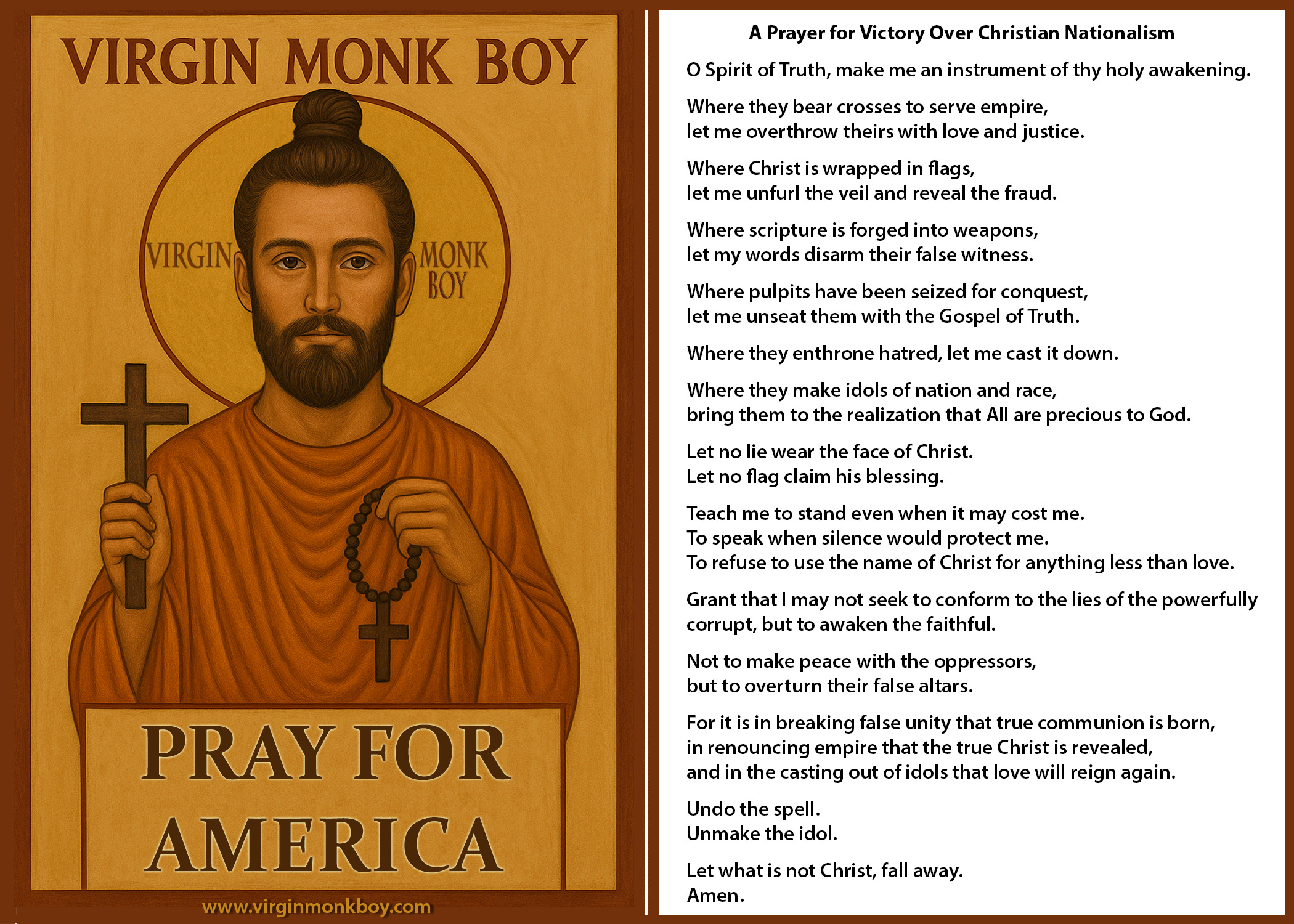
If this roast stirred something in you, take a look at the card designed for the exact moment a Christian Nationalist starts lecturing you about “biblical truth” while clutching a flag and a conspiracy theory.
It’s a prayer card — not just for you, but for them.
A small, sacred interruption.
A pocket-sized reset button for people who confuse the Gospel with their voter registration.
Keep the Scrolls Unrolling
The Virgin Monk Boy Scrolls is a free publication.
If these words steady you, challenge you, make you laugh, or help you breathe deeper, here are three simple ways to support the work.
Share the Scrolls
Passing a link forward is how more wandering souls stumble into the monastery. Word of mouth is the whole engine.
Become a Supporting Member
Paid members unlock the Virgin Monk Boy Book Of Hours, Whispers from the Silence, and the ability to start threads and share their own Substacks in the private chat.
Tip with a coffee
A one time gift of holy caffeine that fuels both the monk and the Magdalene movement. ☕🔥

Your presence alone already helps.
Your support keeps the lantern lit for everyone else.
This is beautiful. And it rings especially true since just last night, I caught up with an old friend over dinner. He comes from a historically-Orthodox Ukrainian family but was raised in a nondenominational evangelical church in the Chicago area. We had dinner at an Ethiopian restaurant, and in the course of the conversation, it became apparent that my friend didn’t really know what or where Ethiopia was, had no idea about its Christian history, had no idea there had ever been Christianity in Africa or the Middle East (?!?) before modern, white Christian’s began to evangelize there, knew almost nothing about Eastern Orthodoxy despite knowing that his grandparents practiced it, and had no idea any Christian scriptures had originally been written in any language other than Greek. I, his rabbinical seminarian friend, knew a hundred times more about NT and early Christianity than he did, and he is a very faithful Christian who prays every day. But the scaffolding of his Christianity is impoverished historically and ritually. Eastern Christianity, Islam, and Judaism are so much richer. Though I will observe that none of them has been totally shielded from toxic nationalism by the richer ritual life or scholasticism.
Have you heard of Safi Kaskas, VMB? He is a Muslim Scholar and provides a rich interfaith dialog for Jewish, Islamic & Christian practitioners. Very encouraging.