

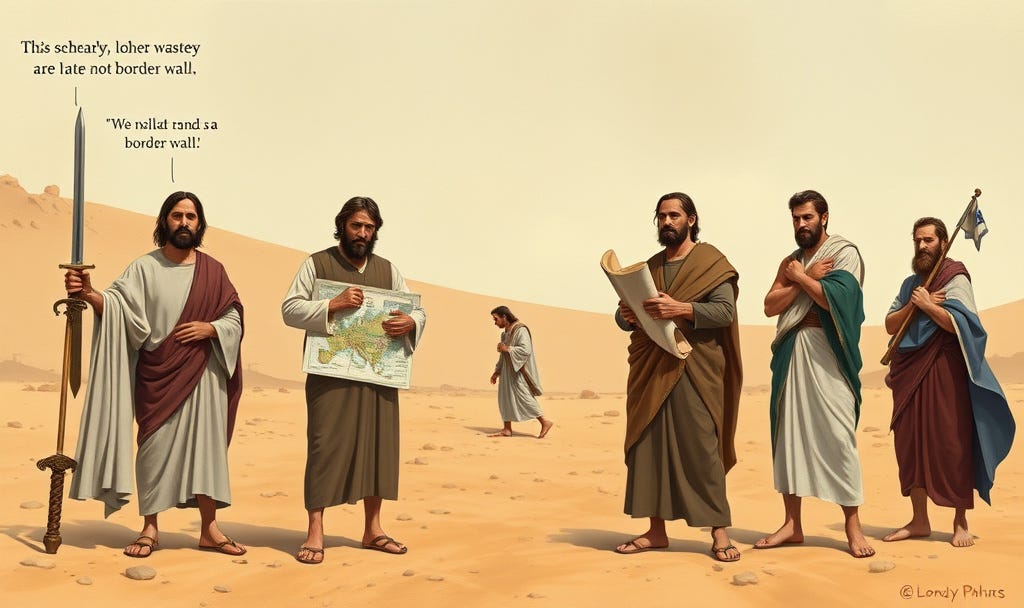
Satire Alert:
This piece is satire. Please remove any swords, flags, or laminated talking points before proceeding.
No one expects to wake up arguing with an apostle.
And yet here we are.
Somewhere between a comment section, a church parking lot, and a very confident Facebook post, the disciples have returned. Not as unarmed mystics or confused fishermen, but as fully upgraded ideological archetypes, each carrying a distinct theological posture, a preferred grievance, and a deep conviction that Jesus would absolutely agree with them if he had access to better media.
They still follow Jesus. Sort of.
They just prefer the parts where he sounds decisive, corrective, or vaguely threatening to the wrong people.
This field guide exists to help identify which apostle you are currently dealing with. Not for debate purposes. Debate is useless. This is for personal safety, spiritual orientation, and knowing when to slowly place your coffee down and back away without making eye contact.
Observe carefully. Each apostle believes he is defending the faith. Each is certain the problem is everyone else. And every one of them is sharpening something he insists he won’t use.
Peter, the Prepared
Peter is sharpening a sword.
Not because he plans to use it. He has already been told, very clearly, that using it will result in public embarrassment, divine disappointment, and a severed ear incident he will never live down.
Still, he sharpens.
Peter is the Prepper Apostle, patron saint of “peaceful but ready.” He believes faith is strongest when reinforced with steel, storage buckets, and a deep emotional attachment to personal defense metaphors. He sharpens the sword because it feels responsible. Leadership-adjacent. Like a man who would absolutely open-carry into the Upper Room if the zoning laws allowed it.
Peter insists he trusts God. He just doesn’t trust anyone else.
Andrew, the Gatekeeper
Andrew is arranging stones into a perimeter.
This was not suggested by Jesus, but Andrew insists the implication was obvious. “Fishers of men,” after all, requires controlled entry points.
Andrew is the Border Apostle. Compassion is fine, he explains, as long as it is orderly, vetted, and does not inconvenience anyone already inside the circle. He spends a great deal of time deciding who qualifies as “neighbor” and very little time loving them.
Andrew does not hate outsiders. He simply believes love works best with a waiting list.
James the Greater, the Furious
James is pacing.
He is furious about Rome. Furious about taxes. Furious about census data. Furious about roads he secretly uses but deeply resents paying for.
James is the Anti-Government Apostle, except for the parts of government that protect his property, enforce his values, and maintain the infrastructure he relies on daily. He is certain Jesus hated bureaucracy, ignoring the fact that Jesus spent most of his ministry arguing with bureaucrats instead of calling for their execution.
James wants liberation. He just means his.
John, the Problematic Soft One
John is sitting quietly, writing poetry about love.
Everyone distrusts him.
John is the Soft Apostle, which in modern terms makes him suspicious. He talks too much about compassion. He never seems interested in punishment. He refuses to participate in culture wars and keeps insisting fear is not a spiritual gift.
People worry about John. He keeps quoting Jesus without qualifying it.
Philip, the Explainer
Philip has a chart.
Philip is the Apologetics Apostle. He believes the Gospel would spread faster if people simply accepted his PowerPoint. He has graphs proving Jesus was not socialist, not pacifist, and absolutely pro-self-defense if you squint hard enough and ignore most of the text.
When asked why the apostles were unarmed, Philip says historical context, which he uses to excuse everything except mercy.
Bartholomew, the Flag Bearer
Bartholomew has wrapped himself in a flag he does not recognize.
Bartholomew is the Christian Nation Apostle. He is certain Jesus came to restore something. He is not sure what exactly, but it involves dominance, nostalgia, and a version of history that never happened.
When reminded that Jesus was executed by the state, Bartholomew explains that this state is different. This one is holy. Obviously.
Matthew, the Accountant
Matthew is counting money.
Matthew is the Free Market Apostle. He insists Jesus admired efficiency. The feeding of the five thousand could have been avoided with better logistics. Charity is fine, he says, but only if it is voluntary and preferably tax-deductible.
Grace, given freely, makes Matthew nervous. It sets a dangerous precedent.
Thaddeus, the Watchman
Thaddeus has built a watchtower.
Thaddeus is the End Times Apostle. He sees signs everywhere. Wars. Rumors of wars. Suspicious clouds. He owns several timelines of Revelation and none of them agree.
He believes being armed is a spiritual discipline, because the apocalypse might begin during brunch.
Simon the Zealot, the Honest One
Simon is polishing nothing.
Simon is the Violence Is the Point Apostle. He does not bother with theological justification. He simply believes force clarifies things. He keeps asking Jesus when the uprising starts.
Jesus keeps changing the subject to forgiveness.
Simon hears none of it.
Thomas, the Inconvenient
Thomas is staring at an AR-15 someone insists belongs in the story now.
“I’m not saying I don’t believe,” Thomas says carefully. “I’m just saying I would like to see the receipts. Who issued it. Under what covenant. And why none of us were told.”
Thomas is the Facts and Evidence Apostle, which makes him deeply inconvenient. He points out that Jesus explicitly rejected armed defense, healed the enemy, and told Peter to stop.
No one answers Thomas.
Jesus, Looking Tired
Jesus returns from prayer, surveys the scene, and rubs his temples.
He does not lecture. He does not confiscate the sword. He does not argue policy.
He simply says, “Put it down.”
And the problem is not that they cannot hear him.
The problem is that they have already decided which version of Jesus makes them feel safest.
Blessed be the ones who mistake fear for faith, for they will eventually tire of being afraid.
Blessed be the peacemakers who keep being called naive, for they are the only ones still paying attention.
Blessed be Thomas and his inconvenient questions, for reality survives scrutiny better than ideology.
May the swords be set down, the fantasies disarmed, and the Christ who refused violence be allowed back into his own story.
And may the Kingdom come without needing to be enforced at gunpoint.
One Last Thing for the Brave, the Fed-Up, and the Spiritually Belligerent
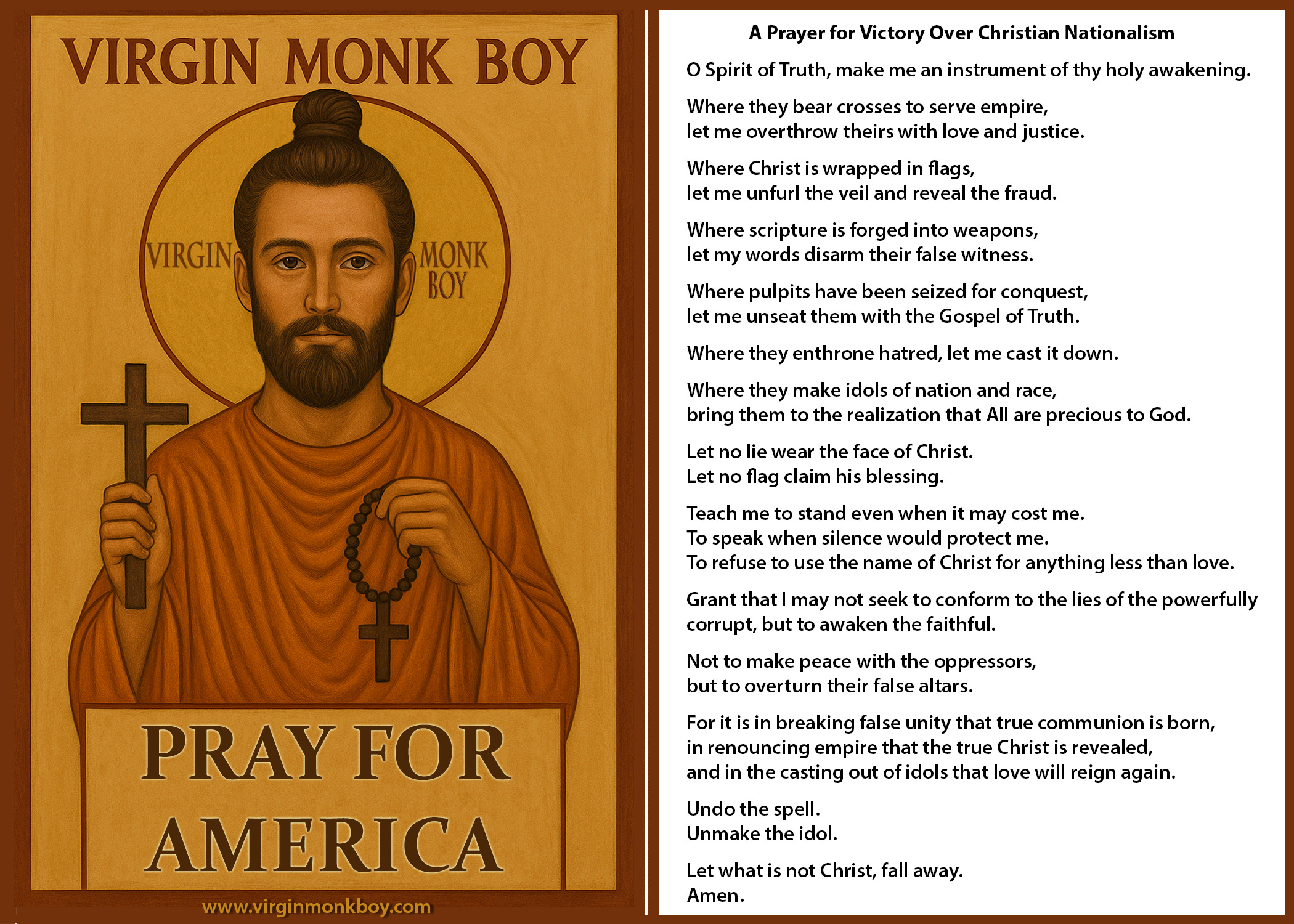
If this satire stirred something in you, take a look at the card designed for the exact moment a Christian Nationalist starts lecturing you about “biblical truth” while clutching a flag and a conspiracy theory.
It’s a prayer card — not just for you, but for them.
A small, sacred interruption.
A pocket-sized reset button for people who confuse the Gospel with their voter registration.
Keep the Scrolls Unrolling
The Virgin Monk Boy Scrolls is a free publication.
If these words steady you, challenge you, make you laugh, or help you breathe deeper, here are three simple ways to support the work.
Share the Scrolls
Passing a link forward is how more wandering souls stumble into the monastery. Word of mouth is the whole engine.
Become a Supporting Member
Paid members unlock the Virgin Monk Boy Book Of Hours, Whispers from the Silence, and the ability to start threads and share their own Substacks in the private chat.
Tip with a coffee
A one time gift of holy caffeine that fuels both the monk and the Magdalene movement. ☕🔥

Your presence alone already helps.
Your support keeps the lantern lit for everyone else.
You've taken the apostles and made them tangible to people like me. Funny because it's close to true, no?
This made me laugh really, really hard. Thanks for that! Also … it wreaks of truth. Again, I say, thanks.