
The Abler Soul: The Hidden Third Presence in Every Deep Relationship
Why real love creates something beyond “you and me”

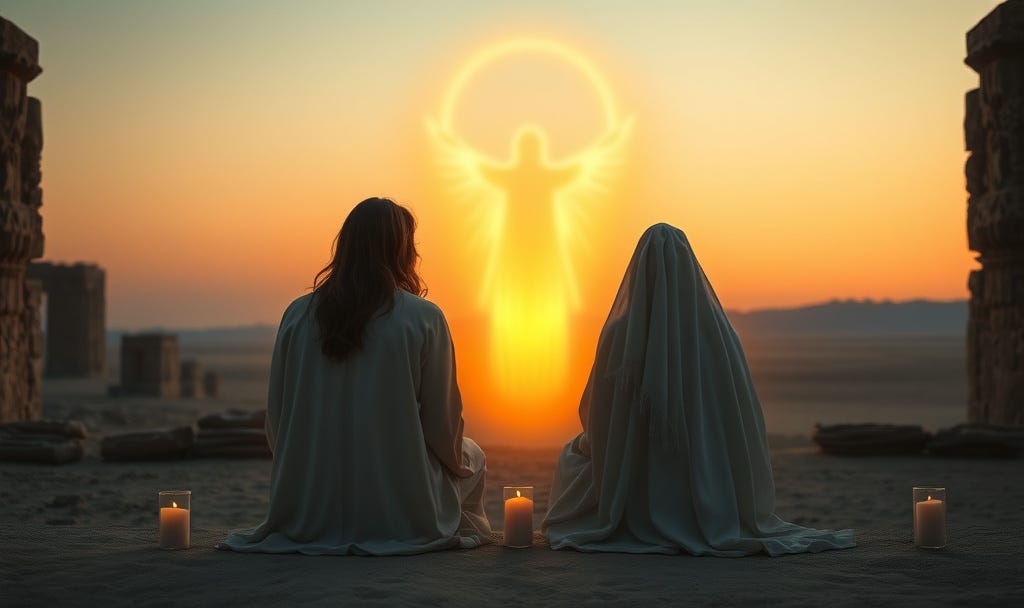
This reflection is inspired by Through Holy Week with Mary Magdalene, guided by the teachings of Cynthia Bourgeault. In that series, Holy Week is not treated as a courtroom drama about guilt and acquittal, but as an initiation into conscious love. When Mary Magdalene is restored to her rightful place at the foot of the cross, the meaning of crucifixion shifts decisively. What had long been framed as cosmic bookkeeping is revealed instead as love demonstrating its own inner logic to the end.
When Love Becomes Larger Than Two People
Some relationships feel bigger than the two people inside them.
Not bigger in the dramatic sense. Not bigger because they are obsessive, cinematic, or emotionally chaotic. Bigger because something alive begins to form between the two people. A shared field. A third presence. A kind of interior architecture neither person fully owns, but both participate in.
Most people recognize this intuitively before they ever have language for it.
You see it in couples who have been together for decades and somehow radiate a strange steadiness around them. You see it in friendships where silence itself becomes intimate. You see it when someone dies physically and yet remains mysteriously present in the inner life of the beloved. You see it when two people become accountable not merely to each other’s emotions, but to each other’s becoming.
The Third Presence Between Beloveds
This is what the mystical tradition points toward with the idea of the “abler soul.”
Drawing from the poet John Donne, Bourgeault describes the abler soul as the third reality created when love “interinanimates two souls.” It is neither one partner nor the other, but the shared consciousness that emerges when two people surrender into a deeper field of love together.
That distinction matters because the modern world is deeply suspicious of surrender.
We are trained to hear surrender as weakness, dependency, loss of boundaries, emotional fusion, or self-erasure. We have become so psychologically alert to unhealthy attachment that we often lack categories for sacred attachment. If someone remains inwardly connected to a beloved after death, modern culture tends to interpret that as inability to “move on.” If two people profoundly shape one another’s souls, we immediately worry about codependency.
This Is Not Codependency
But the abler soul is not codependency.
Codependency collapses personhood. The abler soul deepens it.
Codependency says:
“I need you in order to survive.”
The abler soul says:
“We are becoming more fully ourselves together inside something larger than either of us.”
One contracts consciousness. The other expands it.
Bourgeault makes an important clarification in the transcript. The abler soul is not created through two weaknesses clinging to each other. It forms through a shared surrender into the “highest possibility” for both people. In conscious love, beloveds begin holding the image of each other’s sacred becoming.
That is why certain relationships feel so transformative.
The beloved sees something in you that you cannot fully see yourself.
Not your performance.
Not your defenses.
Not your carefully managed persona.
Something deeper.
And when someone sees you at that level, something in you begins trying to become worthy of what has been seen.
Mary Magdalene and the Love That Sees Clearly
This is why Bourgeault connects the abler soul so closely with Mary Magdalene and Jesus. She suggests that whatever the exact historical nature of their relationship, the tradition itself continues testifying to a unique intimacy between them. Not merely emotional intimacy, but the intimacy of mutual recognition. “The capacity to look at one another and see the real person.”
That line cuts deeper than modern romantic mythology.
Most relationships are built around projection. We fall in love with the role someone plays in our emotional ecosystem. We love how they stabilize us, validate us, mirror us, distract us, rescue us, or desire us. But conscious love moves differently. It is concerned not merely with emotional gratification, but with spiritual transfiguration.
This is why Mary Magdalene standing at the cross matters so much in Bourgeault’s interpretation. She is not portrayed as collapsing into hysteria or possessive panic. Something steadier is operating there. Something capable of remaining present in the fire of loss without abandoning love.
Staying Present When Love Hurts
And this becomes one of the central teachings of the entire transcript: the ability to stay present.
Again and again, Bourgeault returns to this theme. The spiritual task is not to avoid pain, but to remain conscious within it. To sit inside longing, grief, shame, yearning, fear, and heartbreak without immediately fleeing into reaction, distraction, or defense.
That staying power is what allows love to deepen beyond personality.
Most of us spend enormous energy trying to avoid the primordial ache at the center of human existence. We armor ourselves against vulnerability. We manage intimacy carefully. We turn relationships into negotiations of safety and control.
The Ache Beneath the Ache
But beneath all those strategies is what Bourgeault calls “the naked yearning.” The ache to know and be known. The longing that cannot be completely satisfied even by the deepest human intimacy because, as she says, “it’s yearning all the way down.”
That phrase changes the entire conversation.
The ache is not evidence that love has failed.
The ache belongs to the structure of reality itself.
Drawing from the Islamic mystical tradition, Bourgeault quotes the saying: “I was a hidden treasure and I longed to be known.” In this understanding, creation itself emerges from divine longing, from the movement toward self-disclosure through love. Human yearning is not separate from God’s yearning. It is participation in it.
And suddenly relationships become more than emotional arrangements.
They become places where eternity presses into time.
Love That Refuses to Die
This is why the abler soul transcends death.
One of the most radical sections of the transcript challenges modern grief culture directly. Bourgeault speaks about widows and widowers becoming “dual citizens,” bridging realms through love. She argues that deep love fashions “a castle of immortality” in which beloveds continue to meet even after physical death.
Modern psychology often treats ongoing connection with the dead as something to outgrow. Closure becomes the goal. Severance becomes the marker of health.
But the contemplative tradition sees another possibility.
If love participates in eternity, why would death erase it?
Bourgeault tells story after story of elderly people quietly admitting that their beloved continued visiting them inwardly for decades after death. Not as hallucination. Not as denial. But as continuity of love across realms.
The abler soul is “trans-realmic by nature,” she says.
That phrase alone deserves contemplation.
Because it means conscious love is not merely psychological.
It is ontological.
Something real is born between people when they love deeply enough. Something that belongs not merely to time, but also to eternity.
Presence as the Practice
And this has enormous implications for spiritual practice.
Bourgeault repeatedly insists that our task is not to force spiritual advancement, optimize ourselves, or climb some imaginary ladder toward God. We already begin from the center. We are already flowing from source. The real work is learning how to remain present.
Yielded.
Curious.
Available.
Not squandering the present moment trying to perfect a future one.
This is where conscious love becomes a path of awakening.
Not because relationships magically solve loneliness. Not because beloveds complete each other like sentimental mythology claims. But because conscious love teaches people how to remain open to reality without collapsing into fear.
The abler soul forms whenever two people become committed to that deeper field together.
It forms through honesty.
Through presence.
Through surrender.
Through learning to bear the ache without fleeing it.
The Hidden Life Between Two Souls
And perhaps this is why some relationships carry such unusual gravity.
They are no longer functioning only on the horizontal axis of personality, chemistry, and social roles. They have become windows into eternity itself.
Not perfect.
Not painless.
Not free from heartbreak.
But permeated by a deeper life.
A third presence breathing quietly between two souls.
Keep the Scrolls Unrolling
The Virgin Monk Boy Scrolls is a free publication.
If these words steady you, challenge you, make you laugh, or help you breathe deeper, here are three simple ways to support the work.
Share the Scrolls
Passing a link forward is how more wandering souls stumble into the monastery. Word of mouth is the whole engine.
Become a Supporting Member
Paid members unlock the Virgin Monk Boy Book Of Hours, Whispers from the Silence, and the ability to start threads and share their own Substacks in the private chat.
Tip with a coffee
A one time gift of holy caffeine that fuels both the monk and the Magdalene movement. ☕🔥

Your presence alone already helps.
Your support keeps the lantern lit for everyone else.
This is the closest thing that comes to helping me understand & embrace what is still present between myself & a best friend who ended his life almost 4 years to this day. He couldn’t take the pain of Long Covid anymore & intimately bearing witness to that & a partner with LC only different symptoms, we were the only ones who really know what the other was going thru. What you wrote so deeply touches what I experienced with him as a partner in a friendship that knew no bounds despite a 3 decades age difference. Shared a birthday - maybe that’s why our souls connected so deeply - & even as I’m not lying around mourning, I still have friends telling me to “move on” & “let it go” when i talk about him as if he were here. Because to me, he is. 💞
This third presence is 'real'! My first marriage could not have produced this, ever. What the emotional security and love of the second union gave us, was time to be who we really were after disastrous marriages. He left this earthly world 3 years ago, suddenly. I feel guilty that I haven't been broken by it. True love endures all...