

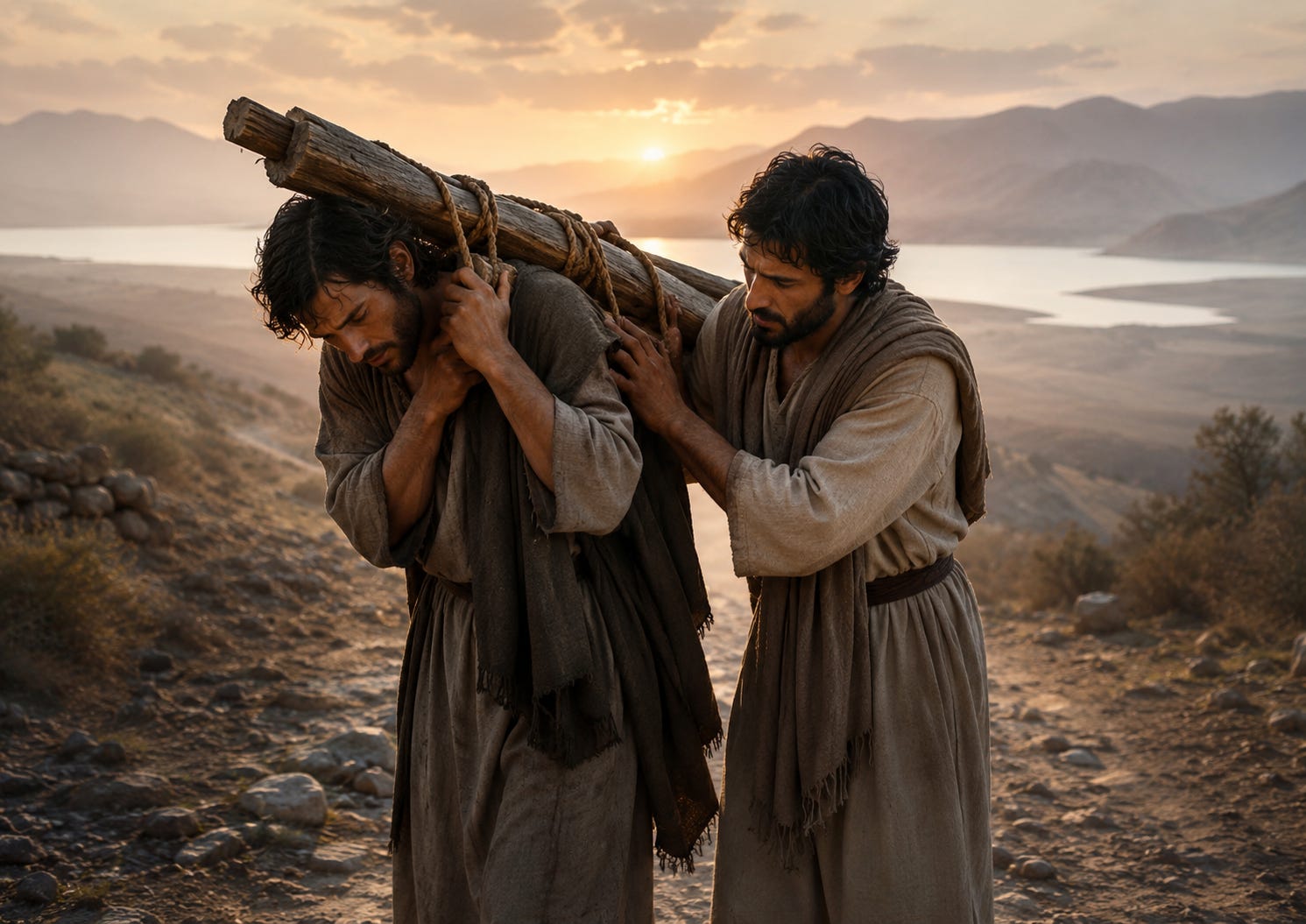
This reflection is inspired by Through Holy Week with Mary Magdalene, guided by the teachings of Cynthia Bourgeault. In this series, Holy Week is not treated as a courtroom drama about guilt and acquittal, but as an initiation into conscious love. When Mary Magdalene is restored to her rightful place at the foot of the cross, the meaning of crucifixion shifts. What had long been framed as cosmic bookkeeping begins to look like something far more dangerous and beautiful: love carrying what love did not cause.
When Love Steps In
Most of us have seen substituted love before, even if we never called it that.
A parent takes the night shift beside a hospital bed so someone else can sleep. A friend sits with the person everyone else is tired of hearing from. A spouse absorbs the weight of a diagnosis, not by fixing it, because nobody can fix it, but by refusing to let the beloved carry it alone. Someone takes the blame that will cost them less than it would cost the fragile person beside them. Someone quietly pays the bill, makes the call, takes the hit, holds the room, shields the child, stays awake.
None of this is glamorous while it is happening. It usually looks like exhaustion, bad coffee, uncomfortable chairs, and the very unromantic smell of institutional carpet. But something holy is happening there. One person is stepping into the weight another person cannot bear alone.
That is the beginning of substituted love.
Not sentiment. Not pity. Not “thoughts and prayers” tossed across the room like stale dinner rolls. Substituted love means I will carry this with you, and if necessary, I will carry some of it for you.
The Burden Is Real
This is where the idea gets serious.
Substituted love does not pretend the burden disappears. That would be religious magic, and religious magic is usually just denial wearing nicer shoes. Bourgeault is very clear that there is still something to be carried. Pain is real. Heaviness is real. The conditions of this world are real. Bodies break. People leave. Time takes things. Love gets asked to live in a realm where everything precious is vulnerable to loss.
That is the part a lot of theology has handled badly. It keeps trying to explain the burden by finding someone to blame. Adam did it. Humanity sinned. God was offended. A payment was required. Somebody broke the cosmic furniture, and now the divine landlord is angry about the deposit.
But that whole framework starts to feel too small when you have actually lived a little.
The burden is deeper than bad behavior. Sin matters, but underneath sin there is heartbreak, fear, sorrow, shame, exhaustion, and the terrible density of being human in a world that keeps asking more of the heart than the heart knows how to hold. We are not just guilty creatures trying to get our record cleared. We are breakable creatures trying not to collapse.
Substituted love begins there.
Voluntary Or It Is Not Love
The key word is voluntary.
The moment substituted love is demanded, coerced, guilted, manipulated, or assigned by someone with a Bible and a control issue, it stops being love and becomes extraction. Christianity has produced plenty of that too. People told to suffer silently. Women told to carry everybody’s emotional furniture. Children told to honor abuse. The vulnerable told that their endurance is holy while everyone else benefits from their silence.
That is not substituted love.
That is religiously decorated harm.
Real substituted love cannot be forced because love cannot be forced. It rises freely from the heart’s recognition that the other is not finally separate from oneself. It says yes because love has become large enough to share the weight. Not because someone demanded sacrifice as proof of loyalty. Not because suffering is good in itself. Not because God enjoys watching people get crushed in slow motion.
Love steps in because the burden is there, and because the beloved matters.
That distinction changes everything.
Can We Actually Carry Each Other?
The modern mind does not like this idea very much because modern individualism has trained us to imagine the self as a sealed container. Your pain is your pain. My pain is my pain. Your healing is your healing. My boundary is my boundary. Some of that language is necessary, especially for people who were raised to confuse love with self-erasure. Boundaries can be mercy. Boundaries can be sanity. Boundaries can be the first honest thing a person has done in years.
But taken too far, the sealed-self model becomes another prison.
We know, in actual life, that we affect one another far more deeply than our theories admit. Someone’s calm can steady a room. Someone’s panic can infect it. A beloved’s courage can give us courage we did not have alone. A friend’s faithfulness can hold us together when our own faith has packed a suitcase and left no forwarding address. We are not isolated marbles clacking around in a jar. We interpenetrate.
That is why another person’s love can help us bear what we could not bear alone.
Not because they magically remove our suffering, but because love changes the field in which suffering is held.
The Interpenetration Of Souls
Bourgeault’s language around the abler soul helps here. In deep conscious love, two souls do not simply stand across from each other exchanging emotional goods and services. They create a third reality, a shared field, something neither person owns and both can surrender into.
This is not codependency. Codependency shrinks people. The abler soul enlarges them. Codependency says, “I need you to be okay so I can be okay.” Conscious love says, “I will hold the image of your deepest becoming even when you cannot see it.” That is a completely different universe.
Substituted love grows out of that kind of interpenetration. When souls are joined deeply enough in love, one person’s strength can become available to another. One person’s steadiness can shelter another. One person’s willingness can make room for another person to survive the hour they could not survive alone.
This is why Mary Magdalene matters at the cross. She is not merely watching an execution. She is participating in a field of conscious love that does not collapse when the body collapses. She remains present in the place where love is being stretched to its furthest edge.
The Shape Of Christ’s Love
Seen this way, Christ’s work is not divine bookkeeping. It is substituted love in its most complete form.
Jesus enters the burden from the inside. He does not wave at human heartbreak from a safe heavenly balcony. He takes on flesh, density, limitation, grief, betrayal, pain, and death. He steps into the place where the burden is heaviest and lines it with love from within.
That does not mean suffering suddenly becomes pleasant or that death is now adorable. Please. The cross is not a decorative wall hanging for people with excellent lighting. It is what happens when love refuses to abandon the human condition, even at the point where the human condition becomes unbearable.
This is why the idea is radical. Not because God needed someone to bleed before mercy could function. That is not mercy. That is a payment processor with incense. The radical idea is that love can enter the burden so completely that the burden itself becomes permeated with love.
Not erased.
Carried.
The Highest Form Of Love
Substituted love is the highest form of love because it costs the self without annihilating the self. It does not collapse into martyrdom theater. It does not perform suffering for applause. It does not rush around rescuing people in order to feel needed. It simply becomes willing to bear reality with another person.
That kind of love is rare because it requires freedom. You cannot offer yourself if you do not belong to yourself. You cannot carry another’s burden if you are secretly trying to purchase affection, avoid abandonment, or prove your holiness to the invisible committee in your head.
But when love is free, it can do astonishing things.
It can stand near the cross. It can sit across from the tomb. It can enter the ache without turning bitter. It can hold the beloved’s becoming when the beloved has forgotten it. It can say, “This is too much for you alone, so it will not be yours alone.”
That is not weakness.
That is the inner logic of Christ.
Love does not merely feel compassion from a distance. Love crosses the distance. Love enters the weight. Love carries what it did not cause because the beloved is worth the carrying.
And maybe that is the most radical idea in Christianity: not that God demands suffering, but that God enters it, bears it, and teaches the human heart how to do the same without losing its tenderness.
Keep the Scrolls Unrolling
The written publication is free for everyone to read.
Paid supporting members unlock the custom Virgin Monk Boy voiceover readings, the Virgin Monk Boy Book Of Hours, Whispers from the Silence, and private chat perks like starting threads and sharing their own Substacks.
Share the Scrolls
Passing a link forward is how more wandering souls stumble into the monastery. Word of mouth is the whole engine.
Tip with a coffee
A one time gift of holy caffeine that fuels both the monk and the Magdalene movement. ☕🔥

Your presence alone already helps.
Your support keeps the lantern lit for everyone else.
This feels deeply true.
Love is not proven by explaining suffering from a safe distance. Love crosses the distance.
It sits beside the bed. It keeps vigil. It carries what it did not cause. It refuses to let the beloved disappear inside the burden.
From where I sit, that is the difference between mercy and theory.
Theory says, “Here is why you are suffering.”
Mercy says, “You will not carry this alone.”
This was a fascinating reflection. What stood out to me is the idea that love is not merely an emotion or a moral ideal, but something that transforms through participation. The deepest expressions of love seem to involve voluntarily carrying what could have been avoided for the sake of another's flourishing. Whether understood theologically or psychologically, that kind of love has the power to interrupt cycles of fear, resentment, and separation. Thank you for such a thoughtful piece.