
Mary Magdalene and Jesus: A Relationship the Church Couldn’t Explain
What “conscious love” reveals about their connection beyond tradition

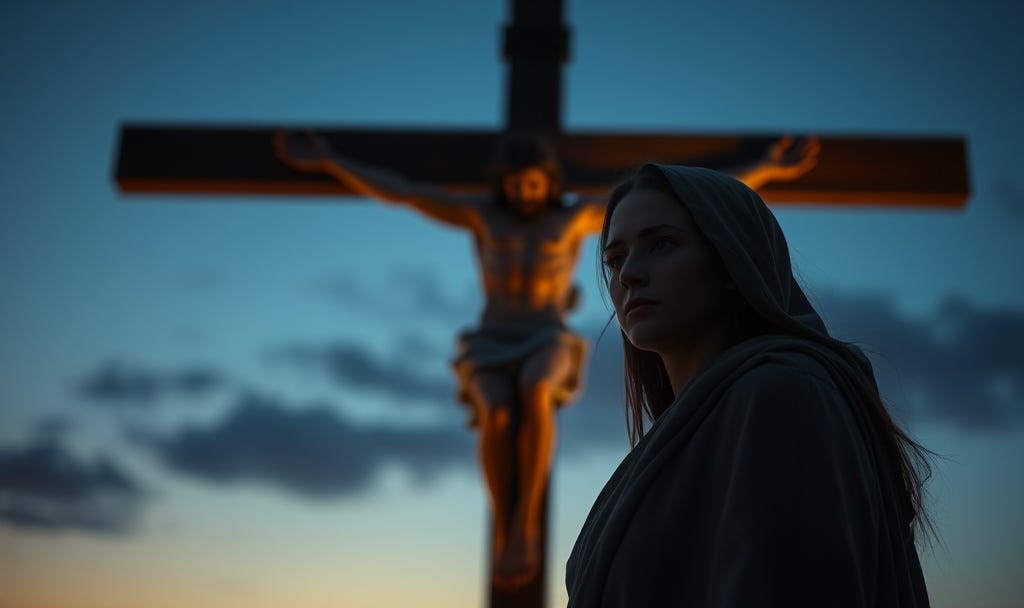
This reflection is inspired by Through Holy Week with Mary Magdalene, guided by the teachings of Cynthia Bourgeault. In that series, Holy Week is not treated as a courtroom drama about guilt and acquittal, but as an initiation into conscious love. When Mary Magdalene is restored to her rightful place at the foot of the cross, the meaning of crucifixion shifts decisively. What had long been framed as cosmic bookkeeping starts to look more like love refusing to abandon itself, even when it costs everything.
And once you see that, the question people keep nervously whispering about Jesus and Mary Magdalene stops sounding outrageous.
It starts sounding like the wrong question asked in the wrong language.
Why This Question Keeps Coming Back
Let’s be honest.
If the Church had done a clean job explaining Mary Magdalene, nobody would still be arguing about her.
But here we are. Centuries later. Still circling.
Not because people are obsessed with scandal, but because something doesn’t add up. You don’t get that kind of gravitational pull around a character who was just a footnote. You don’t get that kind of presence from someone who was merely “forgiven and sent on her way.”
She shows up too often. Too close. Too steady.
And instead of asking why, the tradition mostly tried to manage the discomfort. Rebrand her. Soften her. Reduce her to something explainable.
Because the alternative was admitting they were looking at a form of intimacy they didn’t have a category for.
Conscious Love Isn’t What You Think
The problem starts with the word love.
We’ve turned it into either romance or politeness. Either chemistry or charity. Either “I want you” or “I’ll be nice to you.”
Conscious love is neither of those.
It’s not needy. It’s not transactional. And it’s definitely not tame.
It’s voluntary. Fiercely voluntary. The kind of love that chooses to step into another person’s reality without being forced, without being owed, without needing a return. The kind of love that can carry weight simply because it refuses to walk away.
That’s not romance.
That’s fire with awareness.
And once you start looking through that lens, the relationship between Jesus and Mary Magdalene stops looking like a rumor and starts looking like a revelation people didn’t know how to name.
The Real Intimacy: Being Seen Without Flinching
Here’s the part nobody says out loud.
The deepest form of intimacy is not touch.
It’s being seen without someone trying to fix you, manage you, or quietly downgrade you in their mind.
Mary Magdalene is remembered as someone who “loved much.” Not someone who behaved perfectly. Not someone who checked all the religious boxes. Someone who had range. Depth. History.
And somehow, in the presence of Jesus, that didn’t disqualify her.
It clarified her.
That kind of seeing doesn’t shrink a person. It ignites them. It calls something forward that was already there, waiting for permission to exist.
That’s intimacy.
Not ownership. Not control. Not even emotional closeness in the way we usually think about it.
Recognition.
Where Religion Panics
This is usually where things start to get uncomfortable.
Because once love stops being manageable, institutions get nervous.
It’s much easier to divide love into categories. Sacred vs human. Pure vs impure. Acceptable vs dangerous. Keep everything in its proper box so nobody gets confused.
But the mystics have always said the same thing.
That division is the confusion.
Love doesn’t split itself into neat theological compartments. It starts in desire, in longing, in raw human ache, and then… if you don’t choke it off… it transforms. Not by rejecting what it started as, but by passing through it.
That’s the trajectory.
And Mary Magdalene becomes the walking contradiction to every system that tries to sanitize that process.
The Third Thing Nobody Talks About
There’s an older idea that barely survived into modern conversation.
That when two people love in this deeper way, something else forms.
Not just a bond. Not just connection.
A third presence.
Call it an “abler soul.” A shared field. A living current between them that neither person controls but both participate in.
Not codependency. Not merging into a blur.
Something cleaner than that. Stronger than that.
A space where love itself becomes the center, instead of either individual trying to be the center.
Now read the Gospels again.
Not like a detective. Like someone paying attention.
And ask yourself if that’s what you’re seeing.
The Cross Changes Everything
Most people read the crucifixion as a tragedy to be mourned or a transaction to be explained.
Mary Magdalene doesn’t.
She stays.
Not because she’s overwhelmed. Not because she’s clinging. Not because she has nowhere else to go.
She stays because she can.
Because this kind of love doesn’t collapse under pressure. It doesn’t need the situation to improve in order to remain present.
That’s the part that gets missed.
Anyone can love when things are working.
Conscious love remains when everything falls apart and refuses to turn it into a personal crisis.
Standing at the cross is not emotional breakdown.
It’s spiritual capacity.
So What Does This Demand From Us?
This is where it stops being interesting and starts being inconvenient.
Because this kind of love isn’t something you admire from a safe distance.
It dismantles you.
It asks you to drop the performance.
It asks you to stop negotiating every interaction for safety and control.
It asks you to remain present when leaving would be easier and more socially acceptable.
And worst of all, it asks you to let love change form inside your own life instead of freezing it at the stage where it feels comfortable.
Most people don’t want that.
They want love that feels good. Predictable. Contained.
Mary Magdalene stands as the opposite of that.
Not as a scandal. Not as a symbol to argue about.
As proof.
That love can start in the human, pass through the fire, and come out the other side as something the mind can’t categorize but the heart immediately recognizes.
And that’s the part the Church couldn’t explain.
Not because it wasn’t there.
But because it can’t be explained without asking people to actually live it.
Keep the Scrolls Unrolling
The Virgin Monk Boy Scrolls is a free publication.
If these words steady you, challenge you, make you laugh, or help you breathe deeper, here are three simple ways to support the work.
Share the Scrolls
Passing a link forward is how more wandering souls stumble into the monastery. Word of mouth is the whole engine.
Become a Supporting Member
Paid members unlock the Virgin Monk Boy Book Of Hours, Whispers from the Silence, and the ability to start threads and share their own Substacks in the private chat.
Tip with a coffee
A one time gift of holy caffeine that fuels both the monk and the Magdalene movement. ☕🔥

Your presence alone already helps.
Your support keeps the lantern lit for everyone else.
I got chills when I read this. That third presence, when two people love like this...it makes so much sense! I've never seen it explained this way. Thank you.
"Anyone can love when things are working.
Conscious love remains when everything falls apart and refuses to turn it into a personal crisis.
Standing at the cross is not emotional breakdown.
It’s spiritual capacity."
This hit me so deeply this morning. As I stand at the cross of yet another medical breakdown issue with my husband, you gave me a new lens. Thank you.