

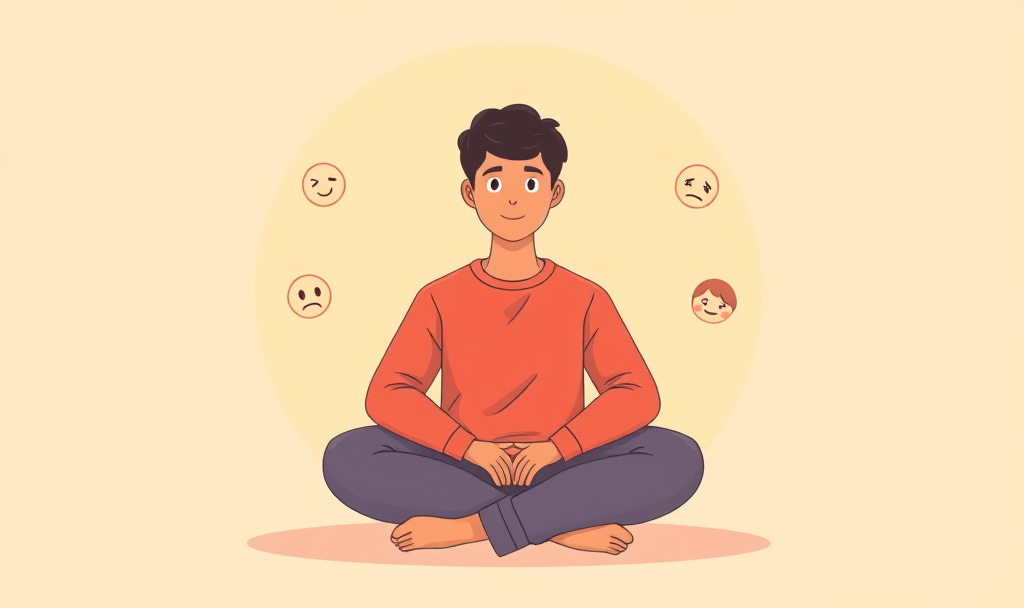
This post grows out of the same soil as “Stop Chasing Feelings. Start Sourcing from Being.” It draws again from the audio course Practicing Living Presence: Discovering the Mind of Christ Within, particularly the material that weaves together Kabir Helminski’s clarity around being with Cynthia Bourgeault’s insistence that maturity in the spiritual life means learning where to stand when everything inside you is moving. The question underneath this chapter is deceptively simple. If emotions are constantly changing, what exactly are we standing on when we say “this is who I am”?
The Quiet Way We Turn Feelings into Identity
Most of us answer that question without ever noticing we are answering it. We identify ourselves with whatever state happens to be loudest at the moment. I am happy. I am anxious. I am angry. I am inspired. I am crushed. These are not just descriptions of experience. They quietly become claims of identity. And once that happens, the nervous system locks into the ancient pain-pleasure loop. We chase what feels good, we resist what hurts, and we oscillate endlessly between the two, mistaking intensity for aliveness and relief for freedom.
Why Emotional States Are Unstable Ground
The problem is not that emotions exist. The problem is that emotions are unstable ground. They are weather, not climate. They move, they peak, they collapse, and they give way to something else. No emotional state, no matter how exalted, has ever stayed. Ecstasy fades. Motivation burns out. Even grief eventually changes texture. When identity is built on what cannot remain, insecurity becomes inevitable. The self must constantly defend, prolong, justify, or relive its preferred state, because without it, it does not know who it is.
What the Inner Tradition Sees Differently
This is where the inner tradition parts ways with both modern psychology and pop spirituality. The goal is not to eliminate emotion, nor to replace “negative” feelings with “positive” ones. The goal is to relocate identity. Equanimity is not indifference. It is not numbness. It is not the flattening of affect or the suppression of grief, anger, or joy. Equanimity is what emerges when the center of gravity drops beneath the emotional field into being itself.
Being as the Ground Beneath Every State
Being is not a mood. It does not rise or fall. It does not need to be improved, stimulated, or maintained. It is the silent continuity underneath every state. When Helminski says that happiness and unhappiness are both superficial, he is not dismissing them. He is putting them in their proper place. They are experiences within consciousness, not the seat of consciousness itself. When Paul speaks of a peace that passes understanding, he is pointing to this same ground. Not a pleasant feeling, but a stability that does not depend on conditions.
Why Equanimity Can Feel Threatening at First
The reason equanimity feels threatening at first is because the ego survives by emotional attachment. It defines itself by intensity. If I am my anger, then my anger gives me coherence. If I am my sadness, then my sadness gives me depth. If I am my joy, then joy gives me worth. To loosen identification feels like annihilation. But what actually dissolves is not life. It is the false assumption that life requires constant emotional reinforcement to exist.
Learning to Hear the Difference Between “I Feel” and “I Am”
One of the most practical shifts on this path is learning to hear the difference between “I feel” and “I am.” “I feel angry” is an observation. “I am angry” is an identity claim. The first allows space. The second collapses it. The inner tradition trains the observer not to judge emotions, but to refuse to enthrone them. Anger can be present without becoming king. Grief can move through without being named the truth of who you are.
What Equanimity Actually Does to Feeling
Equanimity does not mean you stop caring. In fact, it is the opposite. When identity is no longer fused to emotional weather, emotions can be felt more fully, not less. Grief can be honored without drowning in it. Joy can be enjoyed without clinging. Anger can be listened to without obeyed. The difference is that something deeper is holding the experience. There is a witness that does not need to defend itself against what is arising.
Three Signs You’re Clinging to a Feeling as Identity
So how do you recognize when you are clinging to a feeling as self-definition?
The first sign is language. Notice how often your inner narrative uses emotional states as nouns rather than experiences. “This is just who I am.” “I’m an anxious person.” “I’m not a happy person.” These sound like self-knowledge, but they are actually contracts with impermanence. Begin gently translating identity statements back into experiential ones. Not to correct yourself harshly, but to introduce truth. This is not denial. It is accuracy.
The second sign is urgency. When a feeling feels like it must be expressed, resolved, justified, or fixed immediately in order for you to be okay, identity has likely fused with state. Equanimity introduces patience. It allows the system to feel without panicking. If you cannot let an emotion exist without acting from it, chances are high that you are standing on it.
The third sign is narrative amplification. Emotions naturally come with energy. Identity feeds that energy with story. The story explains why the feeling is right, permanent, or defining. Watch how quickly the mind rushes in to give a feeling a biography. This is not something to suppress. It is something to see. Seeing alone begins to loosen the knot.
A Simple Question That Reorients the Center
A simple practice is to pause and ask, without drama, “What is aware of this feeling?” Do not answer conceptually. Let the question turn attention backward. Even briefly, you may notice a subtle shift. The feeling is still there, but it is no longer alone. That shift is the beginning of equanimity. It does not require effort. It requires honesty.
Sliding Identity Without Forcing It
Another practice is to experiment with sliding your identity, as Beatrice Bruteau described. Notice when the sense of “I” is lodged in an emotion. Then, without forcing, let it rest for a moment in the bare sense of being. Not “I am angry,” not “I am calm,” but simply “I am.” This is not a mantra. It is a recognition. Even a second is enough. Over time, those seconds begin to string themselves together.
Freedom Beneath the Pain-Pleasure Cycle
None of this means that life becomes flat. In fact, life becomes more textured. Emotional states stop being verdicts and start being information. They come, they speak, they pass. You remain. This is the freedom hidden beneath the pain-pleasure cycle. Not the absence of feeling, but the end of emotional tyranny.
The irony is that when you stop chasing happiness, happiness becomes less desperate. When you stop fearing sadness, sadness becomes less threatening. Equanimity does not cancel joy. It frees it from demand. It allows joy to be joy, not proof that life is working.
You are not your mood. You never were. Moods are visitors. Being is home.
Keep the Scrolls Unrolling
The Virgin Monk Boy Scrolls is a free publication.
If these words steady you, challenge you, make you laugh, or help you breathe deeper, here are three simple ways to support the work.
Share the Scrolls
Passing a link forward is how more wandering souls stumble into the monastery. Word of mouth is the whole engine.
Become a Supporting Member
Paid members unlock the Virgin Monk Boy Book Of Hours, Whispers from the Silence, and the ability to start threads and share their own Substacks in the private chat.
Tip with a coffee
A one time gift of holy caffeine that fuels both the monk and the Magdalene movement. ☕🔥

Your presence alone already helps.
Your support keeps the lantern lit for everyone else.
Follow (or troll) Virgin Monk Boy
Recommended Reading
(As an Amazon Associate, I earn from qualifying purchases. These recommendations support the scrolls at no extra cost to you.)
Out of the 12-Step world we get the saying "Feelings aren't facts." And, we are invited to, maybe, set a 15 minute timervand just sit in our "dis-ease."
In other languages, it isn't possible to say I am sad. I think of my high-school French classes. That would mean that I am the persona of sadness. One always has sadness or hunger. It is English that allows us to confuse what we might "have" with what we "are."
Thank you for this important lesson and distinction today. Most of us never really listen to ourselves. Verbs are action words, as we were all taught in school. Again, most of us never realize that they actually activate what we say. This part of us is God-like in relation to creativity, as we all are part of God. To make ourselves into our moods is NOT to our benefits. So, it definitely IS important to make the feeling distinctions. 😊 Perhaps the real problem is that most of us were never taught that we bring into being what we say.