
Holy Saturday Matters: What Happens Between Death and Resurrection
The missing spiritual teaching in Christianity’s most silent day

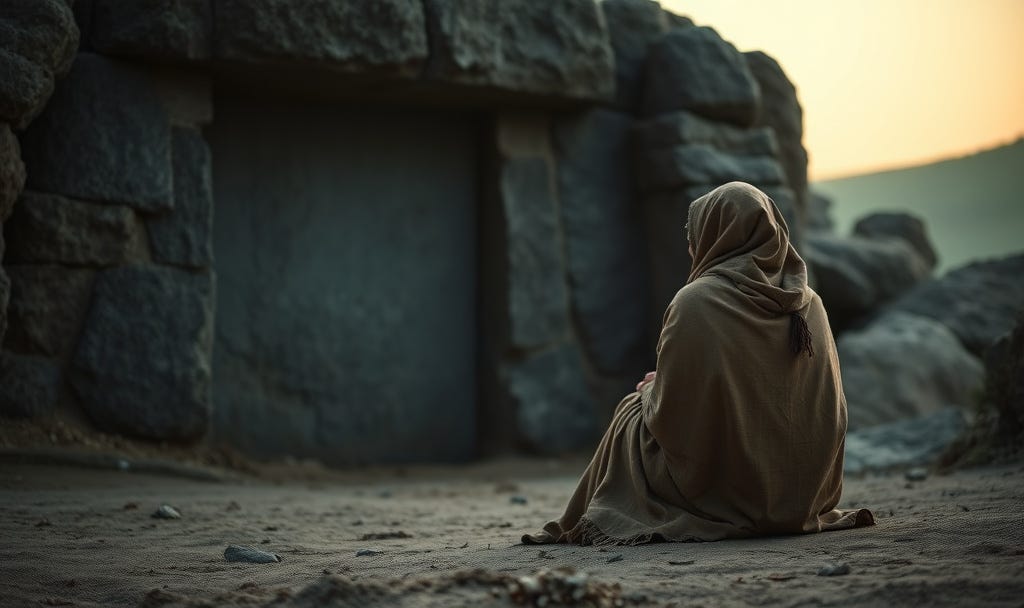
This reflection is inspired by Through Holy Week with Mary Magdalene, guided by the teachings of Cynthia Bourgeault. In this series, Holy Week is not treated as a courtroom drama about guilt and acquittal, but as an initiation into conscious love. And no day in that initiation is easier to neglect than Holy Saturday. Good Friday has the cross. Easter has the empty tomb. Holy Saturday has the second vigil, the sealed stone, and Mary Magdalene sitting across from the tomb with nothing left to do but love.
The Vigil We Forgot
Most Christians know the first vigil.
That is the one everybody remembers: the watch from Maundy Thursday into Good Friday, the garden, the betrayal, the drowsy disciples failing at basic friendship while Jesus sweats blood and asks them to stay awake. It has drama. It has pathos. It has enough human failure in it to keep preachers employed until the Second Coming.
But Bourgeault points to another vigil, a quieter one, almost hidden in plain sight. After the body is taken down, after Joseph of Arimathea wraps it in linen, after the stone is rolled to the door of the tomb, the Gospel gives us that small devastating image: Mary Magdalene and the other Mary are there, sitting opposite the tomb.
That is the second vigil.
Not the vigil before death, but the vigil after death. Not the vigil of dread, but the vigil of aftermath. It is the watch kept when the thing has already happened and nobody can undo it. The body is buried. The beloved is hidden. The movement has collapsed. Rome is still Rome. The disciples are scattered somewhere offstage, probably having a committee meeting about fear, denial, and whose fault this all is.
And Magdalene sits across from the stone.
The Tomb Before Theology Gets Its Hands On It
We have to slow down here because Christians are very good at ruining silence with explanations.
For Magdalene, the tomb is not yet a doctrine. It is not a metaphor. It is not a beautiful symbol of spiritual transition suitable for a retreat brochure with a soft-focus photo of a doorway. It is the place where the body was laid. It is rock, linen, weight, darkness, and the end of every ordinary form of hope.
Bourgeault’s liturgical imagination lingers there. The Song of Songs enters the scene: the beloved searched for and not found, love as strong as death, ardor as unyielding as the grave. That is not decorative poetry sprinkled on top of grief to make it more tolerable. That is the nerve of the whole moment. Magdalene’s desolation is real, but the love inside the desolation has not broken.
This is what most cheap religion cannot handle. It wants grief to hurry up and become useful. It wants the tomb to become a lesson before anyone has had to sit in front of it. It wants Easter lilies before the body is cold, because silence makes everyone twitchy and somebody on the worship committee already ordered the flowers.
But Holy Saturday does not move that fast.
It asks us to sit where love has no visible object left to hold.
Love As Strong As Death
That line from the Song of Songs matters because Holy Saturday is not only about sadness. It is about the strange discovery that love and death are now standing face to face, and neither one is backing down.
Death appears to have the advantage. Death has the body. Death has the tomb. Death has the stone. Death has all the visible evidence, which is why death always wins the first round of the argument. If you are judging by appearances, death looks like the adult in the room.
But love is sitting across from the tomb.
That is the image we should not rush past. Magdalene is not doing anything impressive by normal standards. She is not solving the situation. She is not leading a movement. She is not developing a theology of resurrection in six bullet points and a downloadable PDF. She is simply remaining in the field of love after every form of possession has been taken away.
That remaining is not passive. It is fierce in a way our culture barely understands. We tend to confuse love with activity, usefulness, fixing, rescuing, producing outcomes. Magdalene shows another kind of love: the love that stays when there is no outcome to manage, no body to touch, no answer to extract from the silence.
Love is as strong as death because love can remain even where control ends.
The Heart Of The Earth
The tradition says that during this hidden time Jesus descends into the heart of the earth. Bourgeault is careful with that phrase because it quickly became “descended into hell,” and those are not the same thing.
Once you say “hell,” the imagination tends to run toward medieval theater. Jesus storms the underworld, kicks in the gates, grabs Abraham, Isaac, David with his harp, and stages a rescue mission with excellent dramatic lighting. There is a place for that old imagery. Medieval Christians knew how to put on a show, and occasionally the theology rode in on a donkey wearing bells.
But “the heart of the earth” is deeper than that.
It is not God’s punishment basement. It is the dense center of the human condition. It is matter, grief, death, weight, embodiment, the buried place beneath speech where all our clever religious machinery finally shuts up. Jesus does not descend away from the world. He descends into it. Into the ache of form. Into the heaviness of creaturely life. Into the place where every living thing is bound to loss and every beloved body can be taken from our arms.
That is why Holy Saturday is not empty. It is hidden.
On the surface, nothing happens. Underneath, love is going all the way down.
The Space Between Tragedy And Triumph
Bourgeault names this as an incredibly liminal space between tragedy and triumph, which is exactly the kind of space modern religion tries to renovate immediately because nobody knows where to put the chairs.
We know tragedy. We know triumph. We do not know what to do with the in-between. The in-between has no clean identity. It is not the old life anymore, and it is not the new life yet. It is the morning after the funeral, the house after the visitors leave, the first quiet hour after the diagnosis, the strange blankness after a relationship ends and the dishes still expect to be washed.
This is why Holy Saturday mirrors real human grief so closely. Grief is not a straight road from loss to wisdom. It is a room you keep finding yourself in. Some days the room has light in it. Some days it smells like old coffee and unanswered questions. The world keeps moving, which feels rude. People want you to be healing, which often means they want you to stop making them feel helpless.
Holy Saturday refuses that pressure.
It gives the middle its own dignity.
Sit Across From The Tomb
The missing teaching of Holy Saturday is not that resurrection is coming, so cheer up. That is Easter speaking too early, and Easter spoken too early can become a kind of violence. The teaching is that there is a vigil to be kept before resurrection can be received.
Magdalene does not manufacture the resurrection by being optimistic. She does not pry the stone loose with positive thinking. She does not convert grief into content before dawn. She sits across from the tomb, holding love in the place where love appears to have lost everything.
That is the practice.
Not rushing the silence. Not forcing meaning. Not turning the stone into a sermon before the night has finished doing its work. The middle is not a spiritual waiting room where nothing important happens until God calls your number. The middle is where love descends beneath visibility. It is where something hidden is being carried in the dark.
Do not rush resurrection. Sit across from the tomb. Let the silence be the silence. Let death be death before you demand that it become useful. Love has gone deeper than the mind can follow, and Holy Saturday asks us to trust the descent without managing it. Magdalene stayed near the stone, and that is why she was close enough to witness what came next.
Keep the Scrolls Unrolling
The written publication is free for everyone to read.
Paid supporting members unlock the custom Virgin Monk Boy voiceover readings, the Virgin Monk Boy Book Of Hours, Whispers from the Silence, and private chat perks like starting threads and sharing their own Substacks.
Share the Scrolls
Passing a link forward is how more wandering souls stumble into the monastery. Word of mouth is the whole engine.
Tip with a coffee
A one time gift of holy caffeine that fuels both the monk and the Magdalene movement. ☕🔥

Your presence alone already helps.
Your support keeps the lantern lit for everyone else.
This feels like the kind of teaching the heart only understands after it has had to sit with a stone that will not move. I appreciate the refusal to rush Holy Saturday into a lesson, because grief does not become holy by being explained quickly. Magdalene staying near the tomb feels like fidelity after control is gone. No fixing, no forcing meaning, no pretending the silence is less terrible than it is. Just love remaining where possession has ended. That is a hard kind of remembrance, and maybe the only kind that can recognize resurrection when it finally comes.
This was very well written, it was absolutely beautiful! I am so glad this popped up in my feed this early morning! What you have written here is so true. It deeply resonated with the things I have come to understand and believe!!