
Why Modern Culture Sneers at Prostration
and What That Says About Us

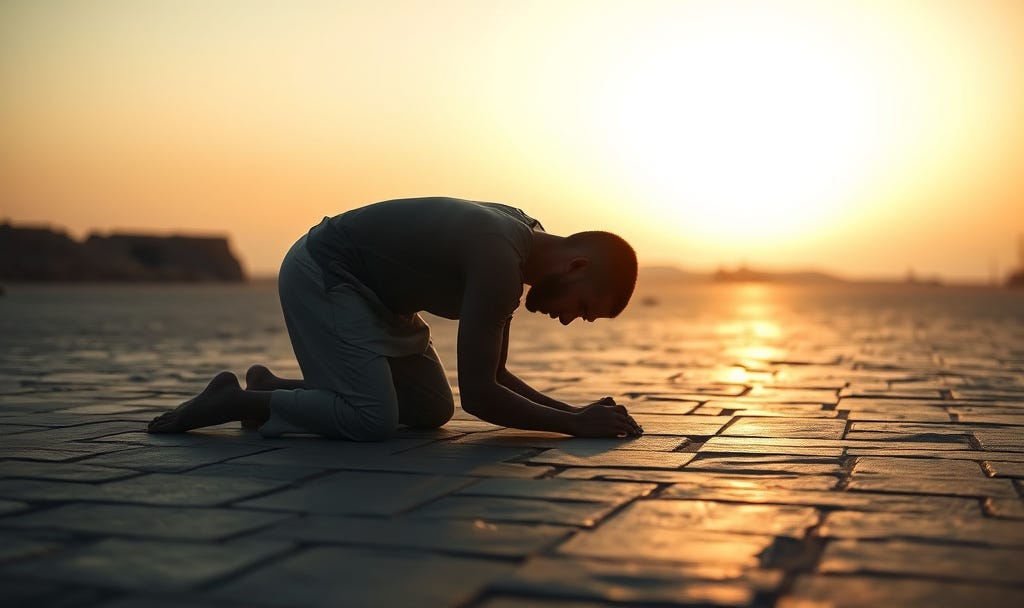
The Modern Flinch at Humility
There is something quietly revealing about the way modern people react to acts of bowing, kneeling, or prostration.
A person puts their forehead to the ground in prayer and a certain reflex kicks in. The reflex is not curiosity. It’s not even disagreement. It’s a kind of embarrassed contempt. A sneer. As if what’s being witnessed is not devotion, but humiliation. Not reverence, but weakness.
We live in a culture that has trained itself to flinch at humility.
Anything that looks like lowering oneself is immediately translated into the only language we still seem to speak fluently: power. Who is above whom. Who is submitting. Who is being dominated. Who is losing.
And because our history is full of examples where bodies were forced to kneel by other bodies, we’ve learned to assume that every bow is a form of oppression.
But that assumption misses something ancient and very human.
What the Body Knew Before Ideology
Long before there were empires, ideologies, or even formal theologies, human beings discovered something with their bodies: if you want to loosen the grip of arrogance, you lower yourself. If you want to remember that you are not the center of everything, you put your face closer to the ground than your heart.
Prostration is not a theory. It is a somatic truth.
Nearly every major spiritual tradition has discovered this independently. Islam builds it into daily prayer. Buddhism uses it to dissolve pride. Hinduism uses it to offer the ego itself. Judaism and Christianity preserved it in their older liturgies and monastic practices. Different metaphysics, same bodily wisdom.
The body teaches what the ego resists.
Not Self-Erasure, but Right-Sizing
When you prostrate, you are not saying, “I am worthless.” You are saying, “I am not everything.” There is a difference, and it is a liberating one.
But modern culture has almost no room for that distinction.
We are trained in self-assertion from infancy. Build your brand. Stand your ground. Project confidence. Optimize your image. Curate your identity. Never appear small. Never appear uncertain. Never appear to yield.
So when someone willingly kneels, the only category available is pathology. Something must be wrong. They must be brainwashed. They must hate themselves. They must be submitting to some external tyrant.
It rarely occurs to us that they might be stepping out of the tyranny of their own ego.
When “Grace” Becomes a Suspicion of the Body
I saw this up close in my own life.
I was raised in a Protestant culture where prayer rules, disciplines, and especially prostrations were framed as something done by people who “didn’t understand grace.” If you were forgiven, the logic went, why would you kneel? Why would you repeat prayers? Why would you submit your body to any kind of spiritual rule?
Those things were interpreted as fear. Or as trying to earn something. Or as not really trusting that God had already settled the account.
Later, when I became Orthodox and began keeping a prayer rule and doing prostrations, people around me didn’t just disagree. They were genuinely alarmed. In their mental map, I had gone backwards. From freedom to bondage. From grace to religion. From relationship to ritual.
But what they were really reacting to was a much deeper assumption: that grace is a legal status, not a process of healing.
In that framework, if you are forgiven, there is nothing left to train, reshape, or re-pattern. The body becomes almost irrelevant. Spiritual life becomes mostly cognitive. Anything that looks like discipline can only be interpreted as a denial of grace.
But in the older Christian vision, and in most ancient spiritual traditions, these practices are not payment. They are therapy.
They are not saying, “God, please don’t punish me.”
They are saying, “God, my soul is disordered. Reorder me.”
The reaction itself reveals how completely our culture has lost the category of embodied transformation.
The Exhaustion of Self-Importance
Here is the quiet irony: the same culture that sneers at prostration is exhausted by self-importance. Anxious. Defensive. Brittle. Constantly managing its image. Constantly negotiating status. Constantly afraid of being lowered by someone else.
When you remove all ritualized humility from a culture, you do not get freedom. You get performance. You get people trapped in a permanent standing ovation for themselves, terrified to ever sit down.
What Prostration Is Actually For
Prostration is not about groveling. In healthy traditions, it is not about self-contempt. It is about right-sizing the self.
It is the nervous system being told, “You can stop defending. You can stop performing. You can stop pretending you are the axis of the universe.”
That is not weakness. That is relief.
What the Sneer Is Really Protecting
A lot of the sneering is not confidence. It is fear of letting go. Fear of not being in control. Fear of not being the narrator, the hero, the brand, the center.
The ego always mocks the one posture that can unseat it.
And yet, every tradition that kept prostration kept it for a reason: it works. It softens the psyche. It reorders the inner hierarchy. It creates a little space where reality can get a word in.
When Things Go Sideways
There is another reason humility and prostration exist that has nothing to do with self-contempt and everything to do with what happens when life becomes too heavy. Sooner or later, everyone hits something the ego cannot carry. Something breaks. Someone dies. A plan collapses. A relationship ends. The body fails. The future you were counting on disappears. Or you just hit a wall you cannot think, work, or will your way through. In those moments, the problem is not that you are too small. The problem is that the ego is still trying to be in charge of something it was never built to hold.
This is why so many spiritual traditions teach people to lower themselves before reality crushes them. I once noticed something while watching a chronical about the life of Omar Ibn Khattab. Again and again, when things went wrong, when situations were impossible, when people were overwhelmed or trapped, a phrase kept appearing on their lips: “There is no power and no strength except through God.” It wasn’t used as a slogan. It was used as a release. It showed up exactly when effort failed, when strategy failed, when control failed. Not as resignation, but as realignment. It wasn’t a statement of weakness. It was a statement of accurate scale. It was the ego stepping out of the way so something deeper could carry what it could not.
This is what humility actually does. It does not make you smaller. It removes the part of you that is pretending to be the source of strength. The modern fantasy is that dignity means standing tall no matter what, never bending, never yielding, never admitting that you cannot handle what is happening. But that posture doesn’t produce resilience. It produces collapse. Humbling the ego is not weakness. It is getting it out of the way so something greater can move through you. When you kneel, when you bow, when you prostrate, you are not saying, “I am nothing.” You are saying, “I am not the load-bearing beam of reality.” And that is the moment real strength finally has room to appear.
When a Culture Forgets How to Bow
When a culture loses the ability to bow, it doesn’t become dignified. It becomes loud. It becomes tense. It becomes fragile.
And it forgets something the body has known for a very long time:
Sometimes the deepest act of freedom is not standing taller.
Sometimes it is finally kneeling.
Keep the Scrolls Unrolling
The Virgin Monk Boy Scrolls is a free publication.
If these words steady you, challenge you, make you laugh, or help you breathe deeper, here are three simple ways to support the work.
Share the Scrolls
Passing a link forward is how more wandering souls stumble into the monastery. Word of mouth is the whole engine.
Become a Supporting Member
Paid members unlock the Virgin Monk Boy Book Of Hours, Whispers from the Silence, and the ability to start threads and share their own Substacks in the private chat.
Tip with a coffee
A one time gift of holy caffeine that fuels both the monk and the Magdalene movement. ☕🔥

Your presence alone already helps.
Your support keeps the lantern lit for everyone else.
Follow (or troll) Virgin Monk Boy
Recommended Reading
(As an Amazon Associate, I earn from qualifying purchases. These recommendations support the scrolls at no extra cost to you.)
Ah, beautiful. Pagans sometimes put our faces close to the mother Earth to better commune, feel her presence, and slow down our vibration to a lower harmonic closer to hers. It is so peaceful. I don't kneel much because knees. I'm going to work on that.
Beautiful post. Beautiful reminder. Perhaps only in bowing, in relinquishing the will (often brought about by a breakdown) can space enter, can meaning be made, can receptivity invite guidance and resources which before, in the tight contraction of self protection or ego, were inaccessible. I find great relief in bowing. In our American culture of rugged individualism (which hopefully, collectively we are now beginning to see as the basis of much harm) bowing is the antithesis to heroism. Where in our soul, if we are able to listen, it is the ground which courageous actions may originate. As Leonard Cohen wrote, "If it be thy will."