

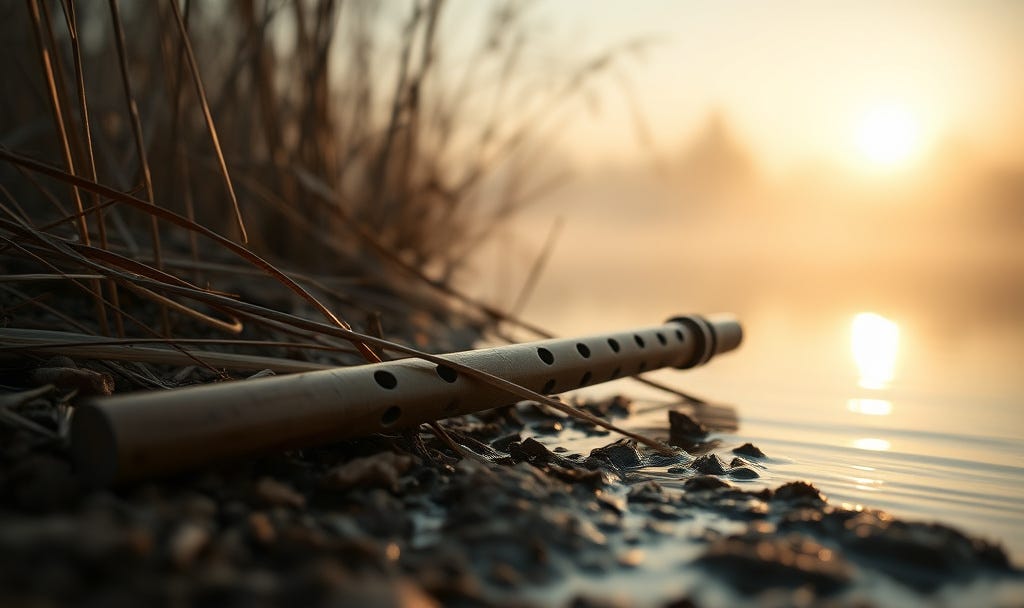
Rumi opens Book One of the Masnavi with a reed flute crying because it has been cut away from the reed-bed. “Listen to the reed,” he says, as it tells its tale and complains of separation. The reed wants a chest torn open by severance so it can unfold the pain of longing. Everyone left far from their source, Rumi says, wants back the time of union.
That is a hell of an opening.
No creed first. No theology exam. No clean little ladder of spiritual achievement. Rumi begins with the sound something makes after life has cut it from home. Before the kings, prophets, lovers, fools, hypocrites, fake teachers, bewildered animals, and men who absolutely should not have been left alone with authority, he gives us a reed flute with a wound in it.Become a Supporting Member
The reed is not trying to be profound. It is not posting a carousel about nervous system regulation. It is not announcing that separation was actually “a sacred upgrade.” It is simply crying in tune. That is the strange thing. The cry has become music. The wound has not vanished, but breath is moving through it now.
There is the first teaching, already smoking on the altar: the spiritual path does not begin when we feel impressive. It begins when we finally hear the ache we have been trying to outrun.
The reed does not say, “I am defective.” It says, “I have been separated.” That is a very different kind of pain. Defect makes us collapse into shame. Separation means some part of us still remembers belonging. The ache is not only injury. It is memory. It knows there is a reed-bed somewhere, even if the mind has forgotten the map.
Pain Is Not Always Longing
It would be easy to turn this into cheap mystical frosting. Every wound is a portal. Every heartbreak is a teacher. Every betrayal is the universe redirecting you toward your most radiant timeline. Please. Some of that is just Etsy theology with better fonts.
Rumi is not saying pain is automatically holy. Pain can make people mean. Pain can turn into obsession, contempt, paranoia, religious superiority, or the comment section version of rabies. Plenty of people get wounded and then spend the rest of their lives making sure everyone nearby pays interest on a debt they did not create.
The reed is not holy because it was cut. It becomes music because something real moves through the opening.
That distinction saves the whole teaching from becoming spiritual nonsense. The cut alone does not awaken us. The cut can just bleed. It can harden. It can become a throne, a brand, a grievance, a whole personality with merch. What changes the reed is breath. Something larger than the reed enters the hollow place and turns injury into sound.
This is where Rumi gets under the skin. He is not asking us to admire our wounds. He is asking what moves through them.
If the only thing moving through the wound is resentment, the song will be ugly. If the only thing moving through it is the need to be seen as special, the song will become theater. If the only thing moving through it is fear, then even our religion becomes a locked room with incense burning in it.
But if love moves through it, if longing moves through it, if God moves through it, then the wound is no longer just a wound. It becomes an opening.
Relief Is Not Return
Most of us do not begin there. Most of us begin by wanting the pain to stop. That is human. Nobody gets spiritually severed from the reed-bed and immediately says, “Excellent, my soul has entered a season of luminous reconfiguration.” Usually we want a sandwich, a nap, and for God to quit using grief as a can opener.
Relief matters. Sometimes the holiest thing you can do is sleep. Sometimes it is to eat actual food, call the friend who does not make everything worse, take the walk, turn off the glowing idiot rectangle, and stop letting strangers with usernames like PatriotEagle777 explain the apocalypse to your nervous system.
But relief is not the same as return.
There is a kind of comfort that restores us, and there is a kind of comfort that keeps us comfortably exiled. Rumi is not interested in making exile more pleasant. He is not handing out throw pillows for the prison cell. The reed’s cry is not asking merely to be soothed. It is trying to point back to the reed-bed.
That is what makes the ache dangerous. It refuses to stay in the little box we built for it. We think we are grieving one person, one loss, one failure, one humiliation, one vanished version of our life. Then the floor opens and we realize the ache is older than the event. It has roots deeper than the latest disappointment. Something in us has been homesick for a long time.
This does not mean every sadness is secretly divine guidance. Some sadness is exhaustion. Some is chemistry. Some is childhood ringing the doorbell with muddy boots. But sometimes, beneath all that, there is a longing that will not shut up because it remembers something the personality forgot.
The Hollow Reed
The reed has to be hollow to sing. That is the insult hidden inside the beauty.
The ego wants to be solid. It wants to be impressive, armored, defined, defended, and preferably applauded by a room full of people who finally understand how correct it has been all along. The ego does not want to be hollow. Hollow sounds like weakness. Hollow sounds like loss. Hollow sounds like the place where control used to live before life kicked in the door.
But a solid reed makes no music.
A reed packed full of itself is just a stick with opinions.
Rumi’s reed has been emptied enough for breath to pass through. That is not passivity. That is not becoming a spiritual doormat while people wipe their unresolved family systems on your face. The reed is not dead. It is alive enough to carry sound. It has stopped being sealed.
There is a hard mercy in that image. Some of what we call strength is just spiritual constipation. We are packed too tightly with fear, certainty, resentment, ambition, and the need to explain ourselves to people who are committed to misunderstanding us. No breath can move through that. No song can come from it. Only pressure.
The reed does not perform healing. It lets the breath enter the place where it was opened.
That may be one of the simplest and most brutal descriptions of the path: stop trying to turn yourself into a monument, and become available enough for something real to pass through.
Enlightenment With Better Lighting
The ego hates this, naturally. The ego wants spirituality that improves the current management structure. Same boss, nicer altar. Same fear, better vocabulary. Same control issues, but now with candles and a book by someone who smiles like they have never once had digestive trouble.
The ego wants enlightenment with better lighting.
It wants to remain in charge while appearing surrendered. It wants to say “I release” while gripping the steering wheel with both hands. It wants the mystical path to validate its preferences, decorate its wounds, and help it become more attractive at dinner parties.
Rumi gives us a reed with a hole in it.
This is why real spiritual teaching often feels rude before it feels comforting. It does not flatter the false self. It does not tell the personality, “You are the main event, and God is here to improve your user experience.” It says the personality might be the blockage. It says the ache we keep trying to manage may be trying to take us somewhere the ego cannot supervise.
That is when the spiritual path stops being cute.
It is one thing to like Rumi quotes over sunset photos. It is another thing to let the reed speak. The reed does not say, “Become more marketable.” It says, “You were cut from something living, and your cleverness has not healed the separation.”
Virgin Monk Boy hears that and mutters: finally, a flute with better theology than half the internet.
The Cut Becomes Part of the Song
The cheap version of healing wants the wound erased. It wants the old grief removed from the record, as if transformation means returning to a clean copy of the self before anything went wrong. But that is not usually how deep healing works. The wound may stop ruling us, but it does not always disappear. Sometimes it becomes the place where the song learned its depth.
The reed is not restored by pretending it was never cut. Its cut is part of what makes the music possible.
That is hard to accept because we want innocence without having to pass through honesty. We want the old self back, the one before the loss, before the betrayal, before the exile, before the faith cracked, before the room went quiet and we realized nobody was coming to rescue the version of us we had been performing.
But maybe the path is not trying to give us the old self back. Maybe the old self was too small for the breath.
Maybe some part of us had to stop being sealed.
This is not a call to worship suffering. Nobody needs to start thanking every disaster like it came with a gift receipt from the Divine. But there is a way pain can be taken up into the larger music. There is a way grief can deepen the voice without becoming the whole song. There is a way the cut can remain visible without becoming the king.
That is the difference between being wounded and being hollowed.
The first can trap us inside the injury. The second makes room.
Longing Is Homesickness for the Source
Longing gets treated like a problem because it makes us inconvenient. It interrupts the schedule. It makes achievements taste strange. It shows up after the applause, after the purchase, after the kiss, after the argument we won but somehow did not enjoy. It whispers that the thing we grabbed was not the thing we were really reaching for.
This is where human beings get into trouble. We attach infinite longing to finite objects and then act shocked when the object collapses under the weight. We ask another person to become the reed-bed. We ask success to become the reed-bed. We ask ideology, religion, money, sex, status, purity, outrage, or being right on Facebook to become the reed-bed.
Then we are furious when the thing breaks.
Of course it breaks. It was never built to carry God.
This does not make earthly love false. It makes it sacred in the right proportion. Human love can reveal the Beloved, but it cannot replace the Beloved. A person can be a window, but if you try to climb into them looking for the sky, everyone gets injured and someone ends up writing poetry they should have kept in drafts.
Rumi is merciful enough to tell us the truth: what we want is not always what we think we want. The ache under the ache is older, deeper, and less easily bribed.
You are not merely lonely for a person. You are lonely for the source.
You are not merely hungry for attention. You are hungry for the real.
You are not merely tired of your life. You may be tired of exile.
Do Not Make the World Carry God’s Weight
The world is not the enemy in Rumi. The reed is physical. Breath moves through matter. The cry comes through a body. This is not some floating escape hatch spirituality where the goal is to become vapor with opinions about nonduality.
The problem is not loving the world. The problem is asking the world to be the source.
When we ask a lover to heal the original separation, we crush them under a divine job description. When we ask success to do it, we become impressive and strangely vacant. When we ask politics to do it, we become dangerous. When we ask religion to do it without surrendering the ego, we become pious furniture blocking the doorway.
Religion can become one more way to avoid the reed’s cry. It can give us rules, costumes, enemies, vocabulary, and a lovely sense that we are not like those other fools. But if it does not lead us back to the source, it becomes another decorated exile.
The reed is not asking to be worshiped. It is asking to be heard.
That means listening beneath the noise of the personality. Beneath the outrage, beneath the performance, beneath the spiritual résumé, beneath the endless explanations, beneath the tired little courtroom where we keep trying old cases in front of imaginary judges.
Somewhere under all that, the reed is still crying.
Not because we are broken beyond repair, but because something in us still knows home.
Listening Before Fixing
The practice begins before fixing. That is the part we hate.
We want to renovate the soul like a bad kitchen. Rip this out, repaint that, update the fixtures, install better lighting, invite people over, pretend the foundation is not making sounds at night. But Rumi does not begin with renovation. He begins with listening.
Listen to the ache before you name it. Listen before you turn it into content. Listen before you recruit theology to defend it. Listen before you decide whether it proves you are a victim, a prophet, an empath, a failure, a genius, or the only sane person left in a collapsing civilization.
Just listen long enough to hear whether the wound is closing you down or calling you back.
That takes more courage than most people admit. Because once you listen, you may discover that some of your favorite coping mechanisms are just guards posted outside the door. You may find that your certainty is fear in church clothes. You may find that your ambition is grief with a gym membership. You may find that your outrage is easier to maintain than your tenderness.
The reed does not shame us for this. It just keeps singing. It keeps telling the truth in the only voice it has.
That is the mercy of the image. The reed does not need to become a trumpet. It does not need to become a cathedral organ. It does not need to become a bestselling reed with a coaching program. It only has to let the breath move through its own hollow place.
Do Not Turn the Wound Into a Throne
The wound can become a doorway, but it can also become a throne. That is where people get stuck.
A throne wound says, “Because I have suffered, I am always right.” It says, “Because I was hurt, I am exempt from tenderness.” It says, “Because I know pain, I now get to distribute it.” This is how wounded people become little emperors of their own injury, sitting there with a paper crown and a sword made of old grief.
Rumi is not interested in that throne.
The reed’s wound does not make it superior. It makes it porous. It does not use separation to dominate the room. It lets separation become song. There is no self-pity in the reed, no sales funnel, no demand that everyone gather around and admire the splinters.
The reed is honest, and honesty is different from performance.
This is where the path cuts close. Many of us do not need more dramatic language for our wounds. We need less loyalty to the identity we built around them. We need to stop confusing the scar with the self. We need to stop mistaking the place where we were hurt for the place where we are supposed to live.
The wound is not the problem.
Making a home inside it is the problem.
The doorway is there, but a doorway is not a living room. You pass through it.
From Severance, the Song Begins
Rumi begins with the reed because the spiritual life begins in the cry we finally stop running from. Not the polished cry. Not the public cry. Not the cry turned into a brand, a sermon, or a vague post aimed at three people who know what they did.
The real cry.
The one beneath the complaint.
The one that says, “I have been separated.”
The one that remembers home before it can explain home.
That cry is not the enemy. It may be the first honest prayer. It may be the soul clearing its throat after years of letting the personality do all the talking. It may be the place where the breath of God finds an opening.
The reed has been cut, yes. There is no need to pretend otherwise. Spirituality that cannot look at the cut is too fragile to be trusted.
But the cut is not the final word.
Breath enters.
The hollow place begins to sing.
And from the very wound we thought disqualified us, the path begins.
If this reflection on Rumi spoke to you, consider becoming a paid subscriber. Your support helps keep these essays coming. And if you would rather offer a small blessing in liquid form, you can always tip the monk with a cup of coffee.
Become a Supporting Member
Paid members unlock the Virgin Monk Boy Book Of Hours, Whispers from the Silence, and the ability to start threads and share their own Substacks in the private chat.
Tip with a coffee
A one time gift of holy caffeine that fuels both the monk and the Magdalene movement. ☕🔥

Your presence alone already helps.
Your support keeps the lantern lit for everyone else.
This landed friend, thank you. I am reminded of the recording of the last Kauaʻi ʻōʻō bird from the 80s. It is beautiful and haunting, and somehow made even more special because it is the last surviving bird calling to a mate that it will never find. I wept when I heard it. Initially, I thought I wept because it was deeply romantic and tragic. And then I realized How beautiful the call was and I wondered how tragic things can be so full of beauty. And I realized that in the call of longing for the partner was the partner itself. So it is with us: When I express my longing for the Beloved, it is the beloved that issues from of my mouth. When the wound sings, it is not with the voice of injury, but with the voice of wholeness and health.
Sometimes, VMB, your words are so powerful, so honest, so close to the bone … deep bow in gratitude and appreciation.