
The Ego Cannot Enlighten Itself, But It Will Absolutely Try
Spiritual Narcissism, Holy Self-Improvement, and the Mirage of the Better Me

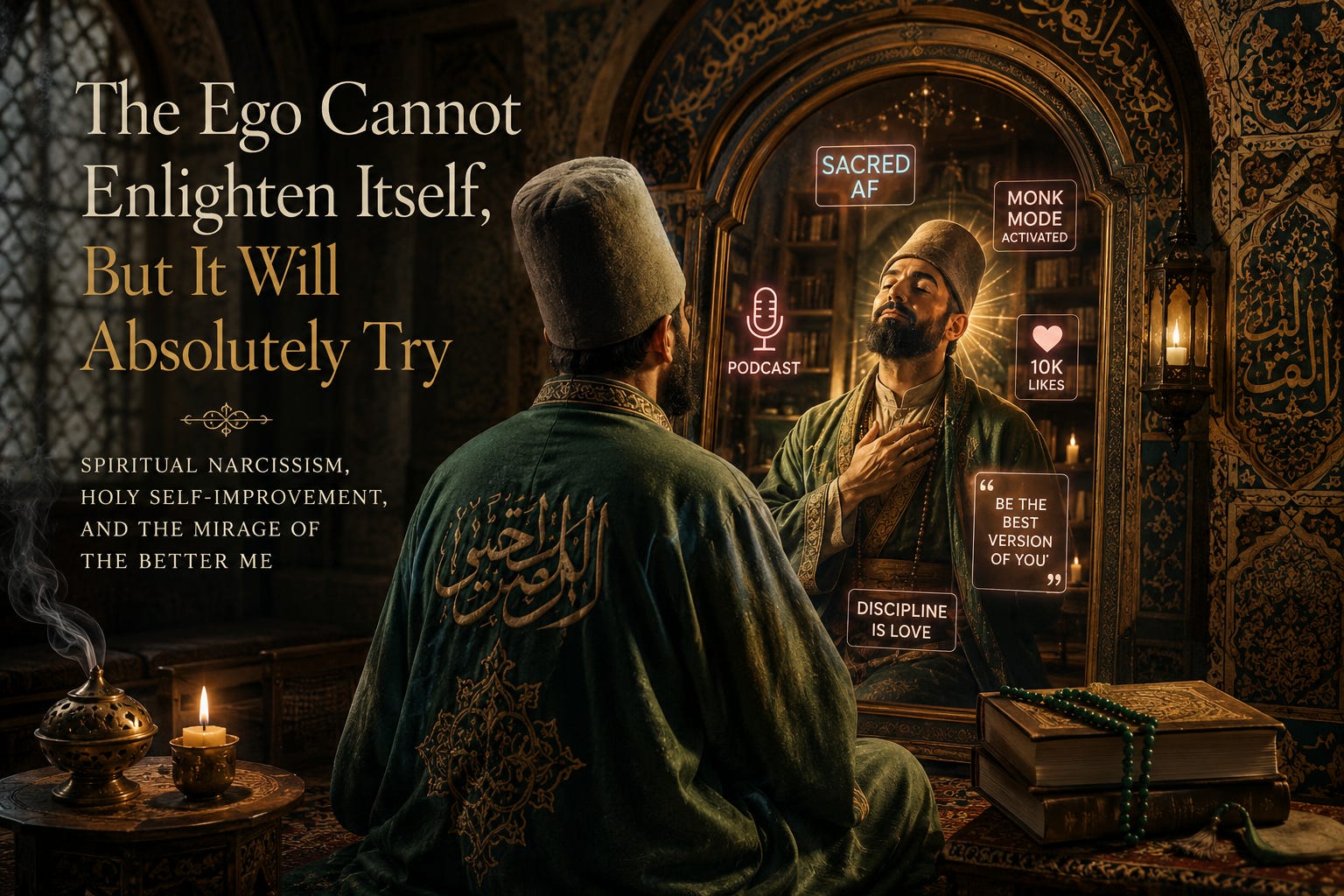
This reflection continues my series inspired by Cynthia Bourgeault’s course Discovering the Mind of Christ, Part 2, especially her commentaries on Kabir Helminski’s Living Presence. The first article explored the difference between personality and the Essential Self. This one turns toward the ego, which is where the spiritual path starts getting both funnier and more dangerous, because the ego is perfectly willing to become religious, contemplative, mystical, humble, well-read, and deeply annoying if it means it still gets to remain in charge.
The Ego Discovers Spirituality
The ego cannot enlighten itself, but Lord knows it will try. It will buy the books, join the group, learn the sacred vocabulary, quote Rumi at brunch, and begin referring to every ordinary irritation as “an invitation to deeper surrender.” It will discover shadow work and immediately become an expert on everyone else’s shadow. It will put on a monk robe, start a podcast, quote two mystics out of context, and still be running the whole damn monastery.
That is the problem. Not that the ego is evil in some cartoon-villain sense. The ego is not sitting in a velvet chair plotting your downfall while stroking a liturgical cat. The problem is more subtle. The ego believes it can manage the journey. It believes it can improve itself into holiness, discipline itself into freedom, and supervise itself into union with God. It does not mind becoming spiritual. It minds disappearing.
Holy Self-Improvement Is Still Self-Improvement
One of Bourgeault’s sharpest points in this chapter is that we cannot use the ego to fix the ego. At first, that sounds almost unfair, because most of us begin the path with egoic energy. We want to become better. We want to be less reactive, less anxious, less petty, less controlled by old wounds and automatic patterns. So we start watching ourselves. We notice when we lose presence. We try to correct ourselves. We develop little spiritual progress reports.
That is where the trap opens. The observer, which should lead us into freedom, gets hijacked by the inner judge. Instead of awakening, we start grading ourselves. Instead of becoming conscious, we turn consciousness into surveillance. “Was that my ego?” “Did I handle that spiritually?” “Am I more surrendered than last year?” “Did anyone notice how humble I was while not needing anyone to notice?”
Congratulations. The ego has opened a branch office in the monastery.
The inner judge is not the witness. The inner judge is just the ego with a clipboard. Real witnessing does not shame, tighten, posture, or supervise the personality like a nervous hall monitor. Real witnessing sees. It notices without collapsing into the drama. It watches without becoming cold. It makes space around the reaction instead of turning the reaction into another identity.
This distinction matters because a lot of spiritual practice gets stuck at the level of one part of the ego fighting another part. One part wants to forgive, while another part is still rehearsing courtroom arguments in the shower. One part wants to be holy, while another part wants revenge with footnotes. One part says, “I choose love,” while another part says, “Yes, but let me destroy them accurately first.” If the whole thing stays at that level, we are not free. We are just holding a committee meeting inside the false self.
The Ego Is the Unobserved Mind
Bourgeault highlights a line from Eckhart Tolle that cuts straight through the fog: the ego is the unobserved mind. That may be the whole sermon. The ego is what happens when we are lost in the drama of our life and do not know we are lost. It is not merely pride or selfishness. Sometimes the ego appears as concern. Sometimes as discernment. Sometimes as moral clarity. Sometimes as trauma language. Sometimes as “boundaries.” Sometimes as “speaking my truth,” which occasionally means, “I have baptized my reaction and would now like applause.”
The ego is identification. It is being merged with thought, emotion, reaction, desire, aversion, wound, role, or position. When we are in ego, we do not simply have anger. We become anger. We do not simply have anxiety. We become anxiety. We do not simply have an opinion. We become the last remaining guardian of truth on earth because someone on Facebook used the wrong meme.
This is why the ego is so slippery. It does not always show up as arrogance. It may show up as helpfulness, sacrifice, loyalty, purity, or spiritual seriousness. It can turn prayer into performance, service into identity, suffering into superiority, and humility into a costume so elaborate it needs its own dressing room.
Virgin Monk Boy has seen this liturgy. The incense is resentment. The hymn is self-justification. The sacrament is proving your point.
You Do Not Renovate a Mirage
Here is where Bourgeault gets beautifully ruthless. The ego is not your deepest identity. It simply is not you. So the task is not to lovingly renovate the mirage. You do not need to install better windows in a hallucination.
This is where some modern spiritual psychology gets mushy. It wants to take the ego, understand it, validate it, affirm it, give it a weighted blanket, and invite it into co-creatorship with Spirit. There may be some usefulness in that at certain stages. We do need to become honest about our patterns. We do need to meet our woundedness with mercy instead of contempt. But the deeper move is not to crown the ego and then persuade it to become a benevolent monarch.
The deeper move is relocation. We shift identity from unobserved mind to conscious presence, from egoic drama to the witness, from false self to Essential Self. The ego does not become enlightened. It becomes transparent. It loses its claim to being the center.
That is why self-hatred is useless. Hating the ego is still egoic. Now the ego gets to be the villain, which is still a starring role. The drama continues, the costume changes, and the false self still gets top billing. The move is not hatred. The move is seeing. When the ego is seen clearly, without panic and without worship, it begins to lose its power.
The “Better Me” Is Still Not the Real I
This may be the hardest part for spiritual people to accept: the “better me” is often still the false self. Kinder, calmer, better read, more disciplined, more compassionate in public, less visibly neurotic at dinner. Wonderful. Society thanks you. But the spiritual journey is not fulfilled by producing a more socially acceptable ego.
The “better me” may still need to be admired. The “better me” may still need to be right. The “better me” may still use spiritual maturity as a ranking system. The “better me” may still look at other people and quietly think, “They are not as evolved as I am,” which is the ego’s version of incense smoke coming out of a dumpster.
The Real I is something else. It is not an improved personality or a spiritualized ego. It is the deeper identity that becomes available when we are no longer completely fused with the contents of consciousness. It is what begins to shine when observer I is awake, when the heart is open, when attention is gathered, and when the drama of “me” no longer occupies the whole cathedral.
So the practice is not to beat ourselves into holiness. The practice is to notice. Not with the tense face of the inner judge, but with the quiet clarity of someone waking from a dream. “Oh, I am defending myself.” “Oh, I am rehearsing an argument.” “Oh, I am trying to be seen as wise.” “Oh, I am using humility as a costume.” “Oh, I am calling this discernment, but it tastes like fear.”
That moment matters because the one who can notice being lost is already not entirely lost. The ego is the unobserved mind, so the moment observation appears, the ego has already lost its absolute grip. A little space opens. A little light enters. A little freedom becomes possible.
Let the False Monk Retire
The ego will try to enlighten itself. It will make a curriculum, buy better pens, compare itself to other seekers, wonder whether its surrender is advanced enough, and imagine that union with God might pair nicely with a cleaner website. Let it try. Then see it. Smile, if possible.
Because the moment you see the ego trying to run the monastery, you are already standing somewhere deeper than the ego. That is the beginning of freedom. Not the ego defeated. Not the ego perfected. Not the ego finally getting its spiritual certification laminated. Just the ego seen.
And when the ego is seen, the whole inner government begins to change.
May the inner judge drop the clipboard. May the false monk retire from monastery management. May the witness rise quietly in the heart, not to condemn the self, but to remember the Self that was never trapped in the drama to begin with.
Source note: this draft is built primarily from Chapter 11, where Bourgeault critiques the attempt to use the ego to fix the ego, distinguishes the inner judge from real observer I, and highlights the insight that “the ego is the unobserved mind.”
Keep the Scrolls Unrolling
The Virgin Monk Boy Scrolls is a free publication.
If these words steady you, challenge you, make you laugh, or help you breathe deeper, here are three simple ways to support the work.
Share the Scrolls
Passing a link forward is how more wandering souls stumble into the monastery. Word of mouth is the whole engine.
Become a Supporting Member
Paid members unlock the Virgin Monk Boy Book Of Hours, Whispers from the Silence, and the ability to start threads and share their own Substacks in the private chat.
Tip with a coffee
A one time gift of holy caffeine that fuels both the monk and the Magdalene movement. ☕🔥

Your presence alone already helps.
Your support keeps the lantern lit for everyone else.
Follow (or troll) Virgin Monk Boy
Recommended Reading
(As an Amazon Associate, I earn from qualifying purchases. These recommendations support the scrolls at no extra cost to you.)
Living Presence: A Sufi Way to Mindfulness & the Essential Self by Kabir Helminski
