

This piece grew out of the uncomfortable realization that my understanding of other traditions was far narrower than I believed. Working through Living Presence: The Sufi Path to Mindfulness and the Essential Self forced me to confront assumptions I didn’t even know I had inherited — especially around Islam and the Sufi lineage that shaped much of the world’s contemplative heritage. As those blind spots surfaced, I began to see how easily Western deconstruction stops at the edges of its own comfort zone. What follows is an attempt to name the boundaries we pretend we’ve crossed but rarely do.
This brings us to a pattern almost no one in the deconstruction world is willing to face directly.
The Pattern No One Acknowledges
There is a curious and rarely acknowledged pattern among Western Christians who “deconstruct.” When they begin distancing themselves from the rigid forms of the faith they grew up with, they often announce their openness by embracing a kind of curated spiritual cosmopolitanism: Jesus as wisdom teacher rather than savior, Buddha as compassionate guide, Rumi as poetic companion, and perhaps a bit of mindfulness repackaged through secular psychology. This allows them to feel expansive, liberated, and intellectually adventurous. But for all the talk about openness, curiosity, and breaking free from constraints, there remains one conspicuous absence that reveals the limits of this transformation. Almost none of them will mention Muhammad.
They will publicly cite the Dalai Lama or Thich Nhat Hanh. They will discuss the Tao Te Ching, quote Richard Rohr, or praise Christian mystics. They will affirm Jesus as an archetype of awakened consciousness. But Islam — and specifically the figure of Muhammad — remains off-limits. The silence is striking not because Muslims need validation, but because the omission exposes how much of their worldview remains governed by Western cultural conditioning. They have left the church, but not the West.
I had to face this in myself the day I walked into that Muslim prayer room — the moment I described in “When My Piety Collapsed in a Muslim Prayer Room.” I thought I knew something about devotion until I saw people bowing with a sincerity that didn’t need an audience or a narrative. The atmosphere in that room shattered the cartoon version of Islam I didn’t realize I’d inherited. All my unconscious assumptions dissolved in the presence of actual prayer, actual surrender, actual humility. That encounter showed me how deeply Western conditioning shapes our spiritual instincts, and how quickly it falls apart the moment we witness a living tradition instead of an imagined one. It became a doorway into a more honest kind of self-examination — not about Islam as a label, but about my own blindness.
Inherited Western Fear, Not Spiritual Discernment
A genuinely liberated mind would interrogate why Christianity conditioned generations to view Islam as a threat, why Western culture has spent centuries defining itself against Muhammad, and why, even after shedding institutional religion, those reflexes remain in place. Instead, many deconstruction journeys simply carry old fears into new settings. They renovate the attic while ignoring the basement.
Part of the reason is that Buddhism has been made safe for Western consumption. It arrives packaged through yoga studios, meditation apps, and secular therapy. It demands little cultural or existential surrender. Westerners can borrow Buddhism without joining its community, rituals, ethics, or metaphysics. It becomes another lifestyle accessory, not a transformative path.
Muhammad, however, represents a living revelation and a structured spiritual path that demands surrender, remembrance, community, discipline, and accountability. He cannot be turned into a metaphor or a meme. Unlike the sanitized Buddhism of suburban wellness culture, Islam asks something of you — and that alone makes it unsettling for those who fled Christianity because they didn’t want a path that rearranged their life.
Deconstruction or Rebranded Western Ego?
This is why much deconstruction reveals itself not as spiritual liberation but as the Western ego reasserting itself. People leave evangelicalism but keep the empire-shaped imagination. They reject doctrines but preserve the myth of Western cultural superiority. They abandon the language of sin but retain deeply embedded Islamophobia, even if they would never name it as such. Their spirituality becomes one more consumer choice in a culture that prizes autonomy but avoids true interior transformation.
The irony is that the contemplative practices many rediscover — centering prayer, interior stillness, purification of the heart, the language of divine union — often reached Christian Europe through Sufi channels, not internal Christian development. Medieval Christians in Spain, Sicily, and the broader Mediterranean lived in constant contact with Islamic civilization. It was primarily the Sufis, not the legal or political structures of Islam, who shaped Christian mystical vocabulary. Scholars such as Louis Massignon and Miguel Asín Palacios have shown how deeply Sufi metaphysics influenced Christian writers like St. John of the Cross.
Sufism’s Influence on Western Mysticism
St. Francis of Assisi — the icon of Christian humility — famously crossed Crusader battle lines to meet Sultan Malik al-Kamil. Francis wasn’t seeking a debate or a triumph. His writings after the encounter show shifts toward simplicity, poverty, humility, and inner surrender that resonate deeply with Sufi teachings. He saw something in Muslim piety — especially in its interior warmth and devotion — that his own tradition had obscured under layers of institution and empire.
Cynthia Bourgeault goes further, suggesting that Sufism preserved the contemplative heart of Jesus more faithfully than the institutional church. Sufis maintained practices of remembrance, inner stillness, breath-attunement, purification of the heart, and surrender to the Divine Beloved — all central themes in Jesus’s original message. This continuity arose not because Christianity lacked sincerity, but because empire buried contemplation under doctrine, whereas Sufi orders cultivated the heart’s awakening for centuries.
So when Western deconstructionists quote Rumi but ignore Muhammad, they are extracting the flower while denying the soil. They claim spiritual breadth while avoiding the tradition that most directly challenges the West’s inherited worldview. And that avoidance says more about conditioning than courage.
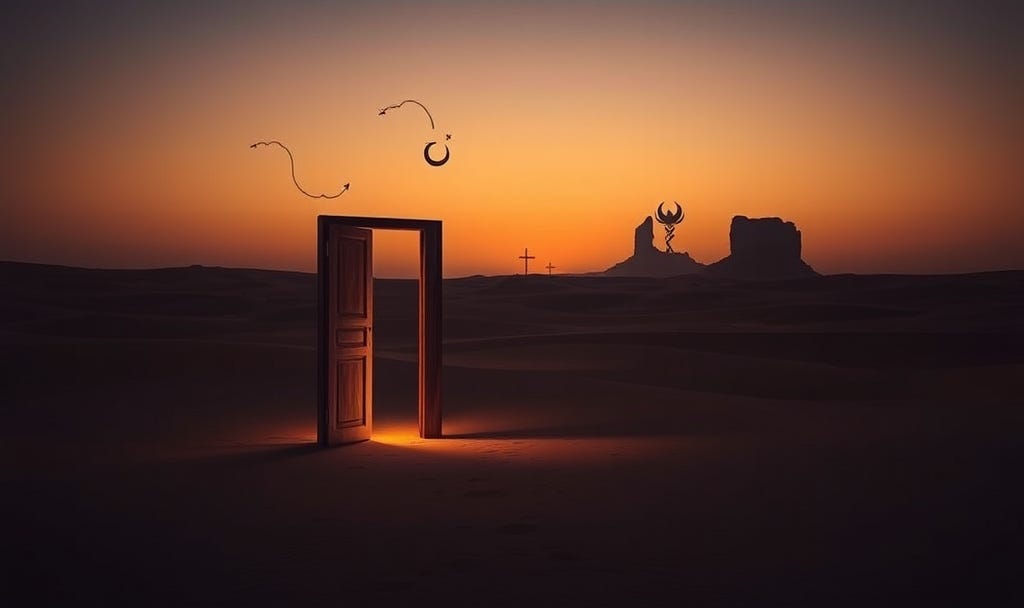
The Door Deconstructionists Refuse to Open
A truly open spiritual path would be willing to ask: What if Muhammad is not the shadow of the Western imagination but a missing conversation partner? What if Islam is not a rival but the sibling Christianity forgot? What if the Qur’an is not a threat but another transmission addressing the same human longing for union, justice, and surrender? What if Jesus and Muhammad are not incompatible but complementary teachers illuminating a shared mystery from different angles?
These questions do not demand conversion. They require honesty. They require the courage to examine the walls of the mind that Western culture taught us to treat as natural. They require humility to recognize that the West is not the axis of the spiritual world — only the narrator of its own story. Most of all, they require moving beyond curated spirituality into the deeper work of dismantling the stories empire planted within us.
Virgin Monk Boy’s Benediction for the Half-Deconstructed
May those who escaped the church but kept Caesar’s imagination finally recognize the water they swim in. May those who quote Rumi meet the Sufi path that nurtured him. May those who fear Muhammad encounter his mercy before their projections. May those who praise Jesus and Buddha recognize the lineage that kept Jesus’s inner teachings alive when the West forgot them. And may those who believe they are open-minded discover that openness is measured not by eclectic reading lists but by the walls one is willing to dismantle inside the heart.
Keep the Scrolls Unrolling
The Virgin Monk Boy Scrolls is a free publication.
If these words steady you, challenge you, make you laugh, or help you breathe deeper, here are three simple ways to support the work.
Share the Scrolls
Passing a link forward is how more wandering souls stumble into the monastery. Word of mouth is the whole engine.
Become a Supporting Member
Paid members unlock the Virgin Monk Boy Book Of Hours, Whispers from the Silence, and the ability to start threads and share their own Substacks in the private chat.
Tip with a coffee
A one time gift of holy caffeine that fuels both the monk and the Magdalene movement. ☕🔥

Your presence alone already helps.
Your support keeps the lantern lit for everyone else.
Follow (or troll) Virgin Monk Boy
Recommended Reading
(As an Amazon Associate, I earn from qualifying purchases. These recommendations support the scrolls at no extra cost to you.)
"This is why much deconstruction reveals itself not as spiritual liberation but as the Western ego reasserting itself. People leave evangelicalism but keep the empire-shaped imagination. They reject doctrines but preserve the myth of Western cultural superiority. They abandon the language of sin but retain deeply embedded Islamophobia, even if they would never name it as such. "
An important point. As people engage in the deconstruction of their previous faith, maybe that's a good time to ask oneself, "What subtle beliefs am I hiding from the deconstruction process because I don't want to let them go?"
"This is why much deconstruction reveals itself not as spiritual liberation but as the Western ego reasserting itself." And this is what I don't want for myself. You're right. There seems to be a fear of Muhammad in the West, and you have given me a lot to think about.