
The Crucifixion Story Islam Didn't Invent
Christians were questioning what really happened to Jesus on the cross centuries before Muhammad, and the idea never quite disappeared.

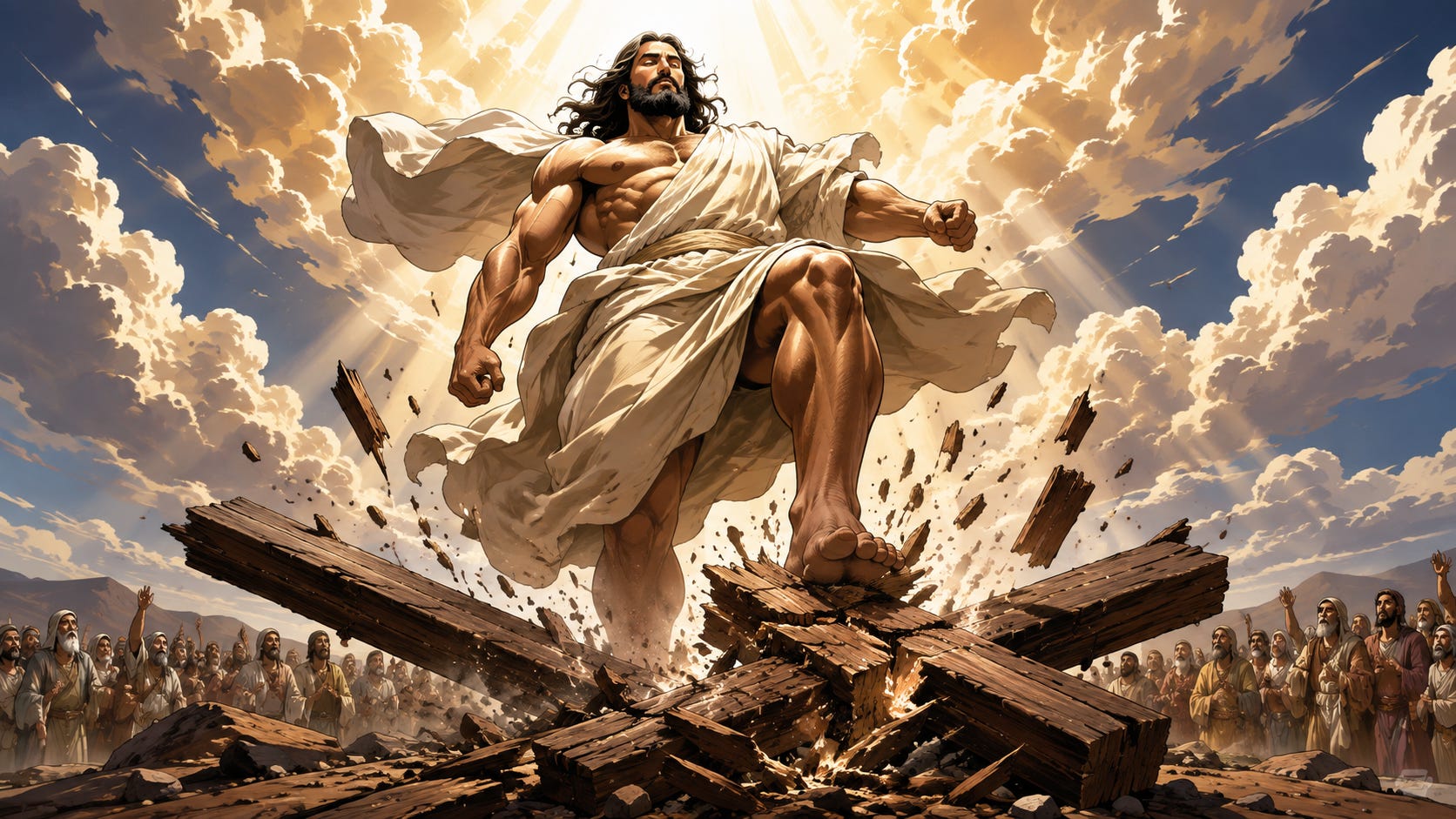
One of the easiest ways to dismiss the Qur’an’s account of Jesus is to pretend Muslims invented it six hundred years after the fact. According to this argument, Christians always knew that Jesus was crucified, died on the cross and rose bodily from the dead. Then Muhammad appeared in seventh-century Arabia and introduced an entirely new story in which Jesus was not actually crucified.
There is a problem with that argument. Christians were telling versions of that story in the second century.
Meet Basilides
Basilides was a Christian teacher active in Alexandria during approximately the second quarter of the second century. He was one of the earliest known speculative Christian theologians of Alexandria and was sufficiently serious as a Christian intellectual to produce a massive twenty-four-book work of biblical interpretation known as the Exegetica.
Think about the dates. Jesus was crucified, according to the traditional chronology, around 30 CE. Basilides was teaching roughly ninety to one hundred years later. For perspective, that is roughly the distance separating us today from World War I.
Basilides was not a medieval writer speculating about events buried beneath a thousand years of church tradition. He belonged to the turbulent formative period when Christians themselves were still arguing over what Christianity was going to become. And Alexandria was hardly some irrelevant backwater. It became one of the great intellectual centers of Christianity.
Multiple Christian schools and teachers operated there during the second century, representing very different understandings of Jesus, salvation, creation, resurrection and the meaning of his death. That matters.
There Was No New Testament Sitting on Everyone’s Altar
When Basilides was teaching, there was no universally agreed twenty-seven-book New Testament. That does not mean Christians had no scriptures. They had the Jewish scriptures, letters attributed to apostles, sayings of Jesus and numerous Christian writings and gospels circulating among different communities.
What they did not have was the leather-bound New Testament Christians recognize today, handed down from the apostles with a table of contents attached. The first surviving Christian document listing exactly the same twenty-seven New Testament books used today is Athanasius’ Festal Letter of 367 CE. That is more than two centuries after Basilides.
So we need to stop imagining second-century Christianity backward through a modern Bible. Matthew, Mark, Luke and John did not descend from heaven together as a completed collection.
Christian communities possessed different collections of texts and argued about which writings carried authority. Different theological schools interpreted Jesus in dramatically different ways. Some understood Jesus primarily as a human being specially chosen or exalted by God. Others developed extremely high views of his divinity. Some distinguished the earthly Jesus from a heavenly Christ. Some understood his physical suffering in ways radically different from the Christians who would eventually become orthodox.
The movement historians commonly call proto-orthodox Christianity championed the position that Jesus was genuinely human, genuinely divine, genuinely crucified and genuinely raised bodily from the dead. That position eventually became Christianity’s dominant standard. But in Basilides’ lifetime it had competition.
Calling those competitors “heretics” tells us who ultimately won the argument. It does not make them disappear from the second century.
And Then There Is the Crucifixion
Near the end of the second century, Bishop Irenaeus of Lyons wrote Against Heresies, attacking Christian movements whose teachings he believed were false. When discussing Basilides, Irenaeus reports an extraordinary teaching.
According to his account, Jesus was not crucified. Instead, Simon of Cyrene, the man the canonical Gospels say was compelled to carry Jesus’ cross, was transformed so that people mistook him for Jesus. Simon was crucified. Jesus was not.
Irenaeus says that according to this teaching Jesus “did not himself suffer death,” while Simon was crucified through the ignorance and error of those involved.
There is an important historical qualification here. Almost none of Basilides’ writings survive directly, and modern scholars debate how accurately hostile writers such as Irenaeus represented their theological opponents. It is therefore safer to say that Irenaeus attributes this teaching to Basilides than to pretend we possess Basilides’ own written account of it.
But notice what that qualification does not change. Irenaeus was writing in the second century. He was already arguing against Christians who knew a tradition in which someone else was crucified while Jesus escaped death.
That alone demolishes the claim that Muslims dreamed up the idea for the first time six hundred years after Jesus.
This Was Not the Only Alternative Passion Tradition
Other early Christian writings also challenged the straightforward interpretation that Jesus experienced the crucifixion exactly as later orthodox theology maintained.
The Second Treatise of the Great Seth, preserved among the Nag Hammadi writings, presents a Christ figure speaking almost mockingly about people who believe they have successfully killed him. The text distinguishes the true Christ from the suffering figure perceived by his enemies.
It is not identical to the Qur’an. Neither is Basilides. That is important.
The argument is not that we have discovered a second-century copy of Surah 4. The point is that the idea that Jesus’ enemies misunderstood what happened at the crucifixion already existed among Christians centuries before Islam.
That historical fact deserves more attention than it usually receives.
“That’s Just Gnosticism”
At this point the objection usually changes. Fine, someone will say. Muslims did not invent it. They simply revived some crazy Gnostic heresy.
But that answer doesn’t actually solve the historical problem. It gives the earlier Christians a label.
“Gnosticism” was not one alternative church with one pope, one creed and one Bible. The term gets applied to a remarkably diverse collection of movements and teachers, and modern historians continue debating just how useful the category itself is.
More importantly, calling Basilides a Gnostic does absolutely nothing to change his date. The second-century evidence is still sitting there. Christians were already entertaining versions of the idea that the people who thought they had killed Jesus had misunderstood what actually happened.
So go ahead and call it Gnostic. Then answer a more interesting question.
Why does this story keep coming back?
Why does the idea that Jesus’ enemies misunderstood the crucifixion appear among Christians so close to Christianity’s beginnings? Why does it appear in more than one form? Why does it survive long enough for Christian heresiologists to devote energy to attacking it? And why, centuries later, does the Qur’an suddenly make this startling declaration: they did not kill him, they did not crucify him, it was made to appear so to them.
That does not prove Basilides possessed the true historical account. It does not prove there was some secret underground chain carrying Basilidean Christianity from second-century Alexandria directly to Muhammad. And it does not prove revelation simply by pointing to an interesting historical recurrence.
But it does make one popular Christian argument impossible to maintain. Islam did not invent this idea six hundred years later.
The idea was already there. And there is something genuinely fascinating about its persistence.
The Christians Who Won Became “Christianity”
Over the next several centuries, one network of Christian churches became increasingly successful at defining the boundaries of acceptable belief.
This did not happen at one meeting. There was no afternoon when bishops voted and suddenly Christianity changed everywhere. It happened gradually through theology, episcopal organization, control of churches, arguments over apostolic succession, decisions about which writings were authoritative and eventually an increasingly close relationship with imperial power.
The proto-orthodox were also extremely effective institution builders. That matters. A theological movement scattered among individual teachers has a difficult time surviving against a movement capable of creating interconnected churches, recognized bishops, common creeds and an increasingly standardized body of scripture.
Then Constantine entered the picture. In 325 CE he convened the Council of Nicaea in an effort to resolve the enormous Christian controversy surrounding Arius and the relationship between the Father and the Son.
Nicaea did not create the Bible. It did not settle every Christian theological dispute. And it certainly did not make competing Christianities vanish overnight. The decades following Nicaea remained extraordinarily chaotic.
But something fundamental had changed. Christian theological disputes were now entangled with imperial politics.
Over time, the version of Christianity recognized as orthodox acquired something its second-century predecessors had never possessed: the power of the Roman state behind it.
Bishops could be deposed. Teachings could be prohibited. Church buildings could change hands. Books could be condemned. Rival movements could lose the ability to reproduce themselves openly.
What Happened to the Other Gospels?
This is another area where we should resist the Hollywood version of history. There probably wasn’t one enormous bonfire where the Church gathered every competing gospel and destroyed them at once.
The actual process was more effective. Once a religious community disappears, its books stop being copied. And before the printing press, a book that stopped being copied eventually ceased to exist.
Some writings were deliberately condemned or destroyed. Others simply disappeared because the people who valued them lost the institutional battle. Generation after generation, orthodox Christians copied Matthew, Mark, Luke and John. They did not keep making thousands of fresh copies of texts they considered heretical.
That is how literature disappears.
The discovery of the Nag Hammadi library in Egypt in 1945 showed just how much Christian literature had vanished from ordinary Christian memory. Texts that had been virtually unknown for more than a millennium suddenly resurfaced.
And the Christianity revealed in those writings was considerably messier than the tidy story many Christians had inherited.
Then the Qur’an Appears
Centuries later, the Qur’an makes its declaration concerning Jesus: they did not kill him, they did not crucify him, it was made to appear so to them.
A Christian is completely free to reject that claim. A Christian can believe Irenaeus was correct to condemn Basilides. A Christian can believe every alternative passion tradition was theological error. A Christian can believe Islam later encountered some distant descendant of these traditions and repeated it.
Those are arguments worth having.
But there is one argument that history should finally retire: “Muhammad invented the idea six hundred years after Jesus.”
No. Christians were already arguing about something remarkably similar in the second century.
Islam did not introduce the first claim that the people responsible for Jesus’ execution misunderstood what had happened. That possibility was already circulating inside the strange, diverse and highly contested world of early Christianity.
And Then Jesus Breaks the Cross
This is where the Islamic story becomes even more remarkable.
Islam does not say the controversy ends with Muhammad. According to well-known hadith preserved in both Sahih al-Bukhari and Sahih Muslim, Jesus son of Mary will return near the end of history. And among the things Jesus does when he returns is this: he breaks the cross.
Think about the symbolism of that. The Qur’an says humanity misunderstood what happened to Jesus. Christianity makes the cross the central symbol of its interpretation of Jesus. Then Islamic tradition says that at the end of history, the person who finally resolves the argument is not Muhammad. It is Jesus.
Jesus returns and breaks the symbol built around his supposed crucifixion. The controversy begins with Jesus, and according to Islam, it ends with Jesus.
From a Christian perspective, this is obviously false prophecy. Jesus will return and vindicate Christianity. From an Islamic perspective, however, the imagery is almost impossible to miss. The man whom humanity turned into the centerpiece of crucifixion theology returns and dismantles it himself.
And suddenly that strange second-century history becomes even more intriguing.
A claim appears among some of Christianity’s earliest competing movements: Jesus wasn’t actually the one they killed. That interpretation loses. The churches teaching it disappear. Their literature largely disappears with them. Centuries pass.
Then the Qur’an announces: you did not kill him, you did not crucify him.
That message does not disappear. It becomes part of one of the largest religious traditions humanity has ever known.
And Islamic tradition says the story is still not finished. Jesus is coming back, and when he does, he breaks the cross.
Maybe every appearance of this idea can be explained away separately. Maybe Basilides was simply wrong. Maybe the other early Christians were wrong. Maybe Muhammad heard some ancient Christian tradition and repeated it. That is certainly one way to interpret the evidence.
Let me know what you think in the comments and please share this.
Keep the Scrolls Unrolling
The written publication is free for everyone to read.
Paid supporting members unlock the custom Virgin Monk Boy voiceover readings, the Virgin Monk Boy Book Of Hours, Whispers from the Silence, and private chat perks like starting threads and sharing their own Substacks.
Share the Scrolls
Passing a link forward is how more wandering souls stumble into the monastery. Word of mouth is the whole engine.
Tip with a coffee
A one time gift of holy caffeine that fuels both the monk and the Magdalene movement. ☕🔥

Your presence alone already helps.
Your support keeps the lantern lit for everyone else.
Follow (or troll) Virgin Monk Boy
Recommended Reading
(As an Amazon Associate, I earn from qualifying purchases. These recommendations support the scrolls at no extra cost to you.)
Living Presence: A Sufi Way to Mindfulness & the Essential Self by Kabir Helminski
This is a deep dive, and I appreciate the care you have put into tracing the threads across traditions.
I have spent decades studying esoteric traditions, and what I have found is that the crucifixion, when read esoterically, is not just a historical event. It is a template, a structural pattern that repeats across scales and traditions.
The crucifixion is the moment when the old form must be surrendered so that the new form can emerge. It is not about suffering; it is about transition. It is the threshold where the body releases its attachment to the known pattern and opens to the unknown.
I have seen this in my own body and in my work with clients: the ‘crucifixion’ is not a one-time event. It is a recurring threshold, a moment when the organism is asked to release what it has been holding, so that something more coherent can take its place.
Thank you for this. It is a reminder that the crucifixion is not just a story, it is a physics.
Interesting. It seems that symbolically, the cross can also represent suffering, sacrifice, division, burden, and the ego’s crucifixion. On that level, “breaking the cross” could signify the end of a mode of spiritual development in which truth is reached primarily through suffering, alienation, or sacrificial conflict. In other words, the cross can also be broken through resurrection, ie enlightenment, awakening, whatever.
You’ve written quite a lot of interesting pieces about Magdalene and her importance as the first to see Christ and being the (somewhat erased) apostle to the apostles. The interpretation you present in this article, if historically accurate, would seem to invalidate all of that and sort of make her and all the apostles merely deceived patsies, for lack of a more appropriate word. What is your view of Magdalene in view of the interpretation presented here?