
The Cloud of Unknowing: Why Thinking Won’t Get You to God
The spiritual practice of surrendering control, not gaining insight

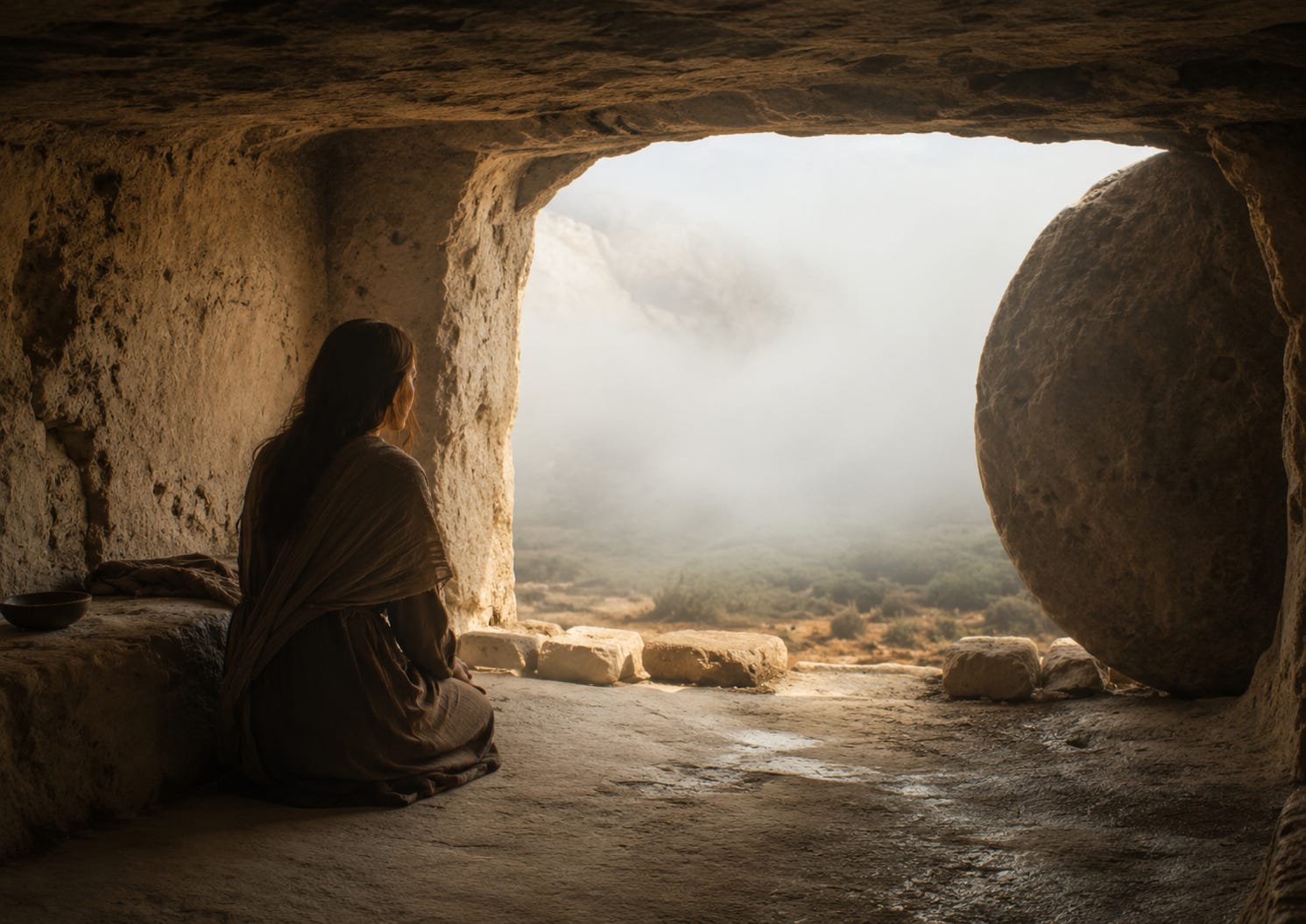
This reflection is inspired by Through Holy Week with Mary Magdalene, guided by the teachings of Cynthia Bourgeault. In this series, Holy Week is not treated as a courtroom drama about guilt and acquittal, but as an initiation into conscious love. Again and again, Bourgeault points toward something the mind cannot possess. Love may begin with insight, but it does not end there. At the deepest level, the spiritual path is not about collecting better explanations. It is about learning how to stand inside mystery without immediately trying to tame it.
The Mind Wants a Handle
Most of us do not object to mystery as long as mystery behaves itself.
A little mystery is fine. Candlelight mystery. Poetry mystery. A quote from a desert father printed over a tasteful photo of fog. We can handle that. The trouble begins when mystery stops being decorative and starts interfering with the machinery of our lives. Love does not make sense. Grief does not move on schedule. God does not answer in the language we requested. The mind reaches for a handle, and there is no handle.
Paid supporting members unlock the custom Virgin Monk Boy voiceover readings, the Virgin Monk Boy Book Of Hours, Whispers from the Silence, and private chat perks like starting threads and sharing their own Substacks.
So we do what we know how to do. We think harder. We analyze the relationship, the wound, the dream, the prayer, the silence. We read one more book, listen to one more teacher, build one more theory, and call this depth because it feels more respectable than admitting we are afraid.
The mind is not the villain here. The mind is useful. It keeps us from eating expired yogurt, believing every man with a microphone, or turning one intense feeling into a five-year life plan. Thank God for the mind. But the mind has a habit of applying for jobs it cannot perform. It wants to manage love. It wants to supervise surrender. It wants to approach God like a problem that can be solved if someone would just provide the correct password.
That is where the cloud begins.
What the Cloud Is Hiding
The cloud of unknowing is not ignorance. It is not anti-intellectualism with incense. It is not the spiritual equivalent of refusing to read the instructions and then calling the broken bookshelf “mystery.” The cloud names the place where thought has gone as far as thought can go, and the heart is invited to continue without the usual guarantees.
This is hard for people who have learned to survive by understanding things. Many of us use analysis as a shelter. If we can explain what happened, maybe it will hurt less. If we can name the pattern, maybe we will not have to feel the wound. If we can turn God into a concept, maybe we will not have to be changed by encounter.
But the old contemplative tradition keeps insisting that God cannot finally be seized by the mind. We can think about God. We can speak about God. We can create beautiful theology, and some of it may even be true. But thinking about God is not the same as union with God. A map of fire will not warm your hands. A theory of bread will not feed the body. A doctrine of love is not the same as being undone by love.
The cloud is mercy because it takes away the illusion that control is communion.
Why We Keep Analyzing
People default to analysis because surrender feels like death to the part of us that wants to remain in charge. Analysis lets us stay busy. It gives the ego a clipboard and a lanyard and allows it to walk around pretending to be useful. Even spiritual people do this. Maybe especially spiritual people. We can turn surrender into a research project and then wonder why the door still will not open.
This shows up everywhere. We analyze our longing instead of letting it teach us. We analyze our grief instead of letting it crack the heart open. We analyze prayer instead of sitting still long enough to notice how addicted we are to commentary. The mind keeps narrating the journey because silence would require trust, and trust is rarely the ego’s favorite hobby.
There is nothing wrong with reflection. The danger comes when reflection becomes a substitute for presence. At some point, we are no longer trying to see clearly. We are trying to avoid being touched. We are keeping reality at arm’s length by turning it into material for interpretation.
The cloud interrupts that habit. It says: stop managing the experience from the balcony. Come down into it.
Magdalene at the Edge of Knowing
Mary Magdalene belongs in this conversation because Holy Week brings her to the edge of everything the mind can manage.
She does not receive a clean explanation before the suffering begins. She does not get a theological diagram of crucifixion, descent, resurrection, and cosmic renewal. She gets the actual event. The arrest. The torture. The cross. The tomb. The silence. Every human strategy for securing the beloved collapses in front of her.
And still, she remains.
That is the part the mind wants to rush past because it is too simple and too devastating. Magdalene does not love by understanding. She loves by staying. She cannot grasp the meaning of what is happening, and she cannot grasp the body of the beloved either. The whole situation is ungraspable. Yet her presence becomes the place where revelation can arrive.
This is love inside the cloud of unknowing.
Not numb love. Not vague love. Not the kind of detached spirituality that acts holy because it has successfully avoided having a pulse. Magdalene’s love is aching, embodied, bewildered, and faithful. She does not control the mystery. She enters it. That is why she can become the witness.
The Small Practice of Letting Go
Centering prayer is almost insulting in its simplicity. You sit. You consent. A thought comes. You let it go. Another thought comes. You let it go. A memory, a fear, a fantasy, a grocery list, an argument you are still winning against someone from 2014 — all of it comes through the room. You let it go and return.
Nothing about this flatters the ego. There is no impressive spiritual performance. No dramatic soundtrack. No visible achievement to post about unless you want to announce, “Sat quietly and discovered my mind is a raccoon in a pantry.” Which, to be fair, is sometimes the most honest mystical testimony available.
But the practice matters because it trains the soul in release. Not rejection. Not repression. Release. We stop treating every thought as a command, every feeling as an emergency, every mystery as a problem requiring immediate management. Slowly, almost invisibly, the grip loosens.
That loosening is the path.
Entering What Cannot Be Managed
The shift is from managing reality to entering it.
That sounds simple until life asks it of us. We want to understand love before we risk it. We want to understand grief before we feel it. We want to understand God before we surrender. We want the resurrection explained before we are willing to stand near the tomb.
But Holy Week does not hand out explanations in advance. It draws us into the mystery and asks whether love can remain present without control. Magdalene shows that it can. The cloud of unknowing shows that it must.
Thinking can bring us to the edge. It can clear away nonsense, sharpen attention, and save us from all kinds of spiritual foolishness. But it cannot make the final crossing for us. The final movement is consent. Release. Presence.
God is not another object for the mind to manage.
God is the living mystery we enter when the hands finally open.
Keep the Scrolls Unrolling
The written publication is free for everyone to read.
Paid supporting members unlock the custom Virgin Monk Boy voiceover readings, the Virgin Monk Boy Book Of Hours, Whispers from the Silence, and private chat perks like starting threads and sharing their own Substacks.
Share the Scrolls
Passing a link forward is how more wandering souls stumble into the monastery. Word of mouth is the whole engine.
Tip with a coffee
A one time gift of holy caffeine that fuels both the monk and the Magdalene movement. ☕🔥

Your presence alone already helps.
Your support keeps the lantern lit for everyone else.
Follow (or troll) Virgin Monk Boy
Recommended Reading
(As an Amazon Associate, I earn from qualifying purchases. These recommendations support the scrolls at no extra cost to you.)
Living Presence: A Sufi Way to Mindfulness & the Essential Self by Kabir Helminski
Keep reading with a 7-day free trial
Subscribe to The Virgin Monk Boy Scrolls to keep reading this post and get 7 days of free access to the full post archives.