
Support the Troops, Then Lock Them Up: Trump’s New Veteran Homelessness Theater
How Trump’s “support the troops” routine turns into forced treatment, legal control, and the same old cruelty with a flag pin.

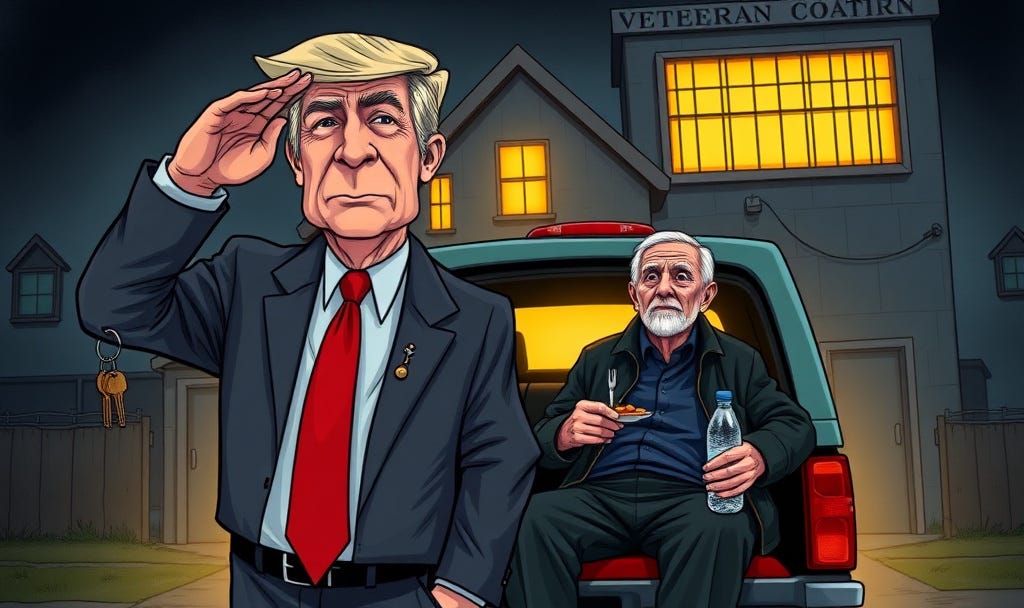
There is a special kind of American political magic trick where politicians say “support the troops” with one hand while using the other hand to quietly take away the actual support.
Donald Trump has apparently found the prestige version.
According to NPR, the Trump administration’s push to institutionalize homeless people may also sweep in veterans. Yes, veterans. The people Republicans invoke every time they need a flag backdrop, a country song, or a reason to defund someone else’s food stamps.
The public line is familiar: compassion, safety, care, treatment, order. The actual machinery looks a lot darker. Trump’s executive order on homelessness leans hard into civil commitment, long-term institutional settings, and cracking down on public homelessness like the problem is not poverty, housing costs, trauma, untreated illness, or lack of support — but visibility. The sin is not that people are suffering. The sin is that people with brunch reservations have to see it.
And now veterans may be caught in the same dragnet.
This is where the patriotic bumper sticker starts peeling off the truck.
The VA and Justice Department signed a memorandum that allows VA attorneys to participate in state guardianship or conservatorship proceedings for vulnerable veterans, including some veterans who are homeless or at risk of homelessness. The administration says this is about helping veterans who cannot make medical decisions and have no family or representative.
Fine. In rare cases, guardianship may be necessary.
But guardianship is not a wellness check. It is not a friendly ride to the clinic. It can strip a person of the right to make decisions about medical care, housing, finances, benefits, and daily life. That is not a “support our veterans” policy. That is a legal cage with softer lighting.
And the people who actually work with homeless veterans are waving red flags.
The National Coalition for Homeless Veterans warned that involuntary interventions remove major personal autonomy and must be used sparingly, with strong safeguards. Iraq and Afghanistan Veterans of America said the agreement risks taking rights away from veterans who need housing, care, and support — not fewer rights. Disability advocates are saying the quiet part out loud: homelessness is a housing crisis, not a justification for court-ordered control.
But Trumpism has never met a human crisis it could not turn into a police problem.
Homelessness? Criminalize it.
Mental illness? Institutionalize it.
Addiction? Punish it.
Veterans sleeping in trucks? Put them in a legal process and call it compassion.
This is the same old authoritarian sales pitch in a new patriotic hat: “We are doing this for your own good.” History is full of governments saying that right before they start taking away someone’s freedom.
The sickest part is that we already know what has worked for veteran homelessness. It was not chest-thumping. It was not press conferences. It was not one more executive order with a name that sounds like it was focus-grouped by a cable news producer.
It was housing.
Actual housing.
Housing First. Rental support. VA case management. Outreach workers. Trust. Repeated contact. Food. Coffee. Someone showing up again and again until the person who has been failed by every institution finally believes this one might not be another trap.
NPR’s story tells us about Curtis Ervin, an 87-year-old Navy veteran sleeping in his truck. Outreach workers did not tackle him, threaten him, or drag him into “care” like a sack of laundry. They built trust. They brought food. They came back. They treated him like a man, not a public-order inconvenience. And he came in. He got housed.
That is the whole lesson.
But Trump looks at that and says, “What if instead of relationships, we used force?”
Of course he does. The man has the emotional intelligence of a casino carpet and the policy instincts of a mall cop with executive privilege.
This is the contradiction at the heart of the whole performance. Trump promised to house thousands of homeless veterans in Los Angeles. Big, shiny, camera-ready promise. Then the reporting says his budget put zero dollars toward that housing. Zero. Not “insufficient.” Not “delayed.” Zero.
That is the Trump veteran policy in miniature: promise a roof, budget a ghost, then call the cops when the person is still outside.
He does not want to solve homelessness. He wants to remove homeless people from the frame.
Because solving homelessness requires money, housing, staff, services, patience, and humility. Removing homeless people from public view requires force, paperwork, and a press release about restoring order.
One is governance.
The other is cosmetics for cruelty.
And let’s drop the fake confusion. Veterans are not props. They are not flag accessories. They are not campaign scenery. They are human beings who served, came home, and in far too many cases were handed a maze of trauma, bureaucracy, addiction, disability, poverty, and rent they could not afford.
If you want to honor veterans, house them.
If you want to help veterans, fund the programs that work.
If you want to treat veterans, build trust and give them voluntary care they can actually access.
But do not salute them on Monday, underfund them on Tuesday, and put them under guardianship on Wednesday because their suffering became inconvenient to the optics of your America.
That is not patriotism.
That is empire with a lapel pin.
Trump’s whole brand is pretending cruelty is strength. But there is nothing strong about threatening broken people with institutions because you failed to give them homes. There is nothing brave about forcing veterans into legal dependency while calling it freedom. There is nothing pro-military about treating an 87-year-old Navy veteran in a truck like a nuisance to be managed instead of a neighbor to be housed.
The real scandal is not that homeless veterans exist in public.
The scandal is that the richest country on earth keeps producing homeless veterans, then elects leaders who would rather disappear them than house them.
So no, Mr. “Support the Troops,” you do not get a parade for this.
You do not get to wrap forced institutionalization in red, white, and blue bunting and call it compassion.
You do not get to campaign on veterans, budget zero for housing promises, and then act shocked when advocates notice the handcuffs hiding under the flag.
The troops do not need another salute.
They need keys.
They need care.
They need housing.
And above all, they need a country that stops using them as political props the moment they become inconveniently human.
Receipts
This piece is based on NPR’s reporting on the Trump administration’s homelessness policy and its possible impact on veterans, the White House executive order on “Ending Crime and Disorder on America’s Streets,” the VA/DOJ memorandum on guardianship and conservatorship proceedings for vulnerable veterans, and public responses from veteran, housing, and disability advocacy groups.
The key point: veteran homelessness has gone down because of housing, outreach, VA support, and voluntary services — not because the government got better at disappearing people into institutions.
Keep the Scrolls Unrolling
The Virgin Monk Boy Scrolls is a free publication.
If these words steady you, challenge you, make you laugh, or help you breathe deeper, here are three simple ways to support the work.
Share the Scrolls
Passing a link forward is how more wandering souls stumble into the monastery. Word of mouth is the whole engine.
Become a Supporting Member
Paid members unlock the Virgin Monk Boy Book Of Hours, Whispers from the Silence, and the ability to start threads and share their own Substacks in the private chat.
Tip with a coffee
A one time gift of holy caffeine that fuels both the monk and the Magdalene movement. ☕🔥

Your presence alone already helps.
Your support keeps the lantern lit for everyone else.
There are times I'm truly shocked that the current administration hasn't banned, or at leary try to ban Daredevil: Born Again, or the recent seasons of The Punisher. Clearly DJT has been inspired by Vincent D'Onofrio's performance as Wilson Fisk...But without the charisma...
💜🌶🧠🌶💜
“This is where the patriotic bumper sticker starts peeling off the truck.”
This quote was the perfect lead-off to almost every piece-of-shyte executive order this creep has ever signed with his big magic marker signature he holds up like a three year old showing Mommy his drawing.
The man (only yesterday) refused to sign one of the only bipartisan pieces of legislation that our impotent Congress has managed to cobble together: AFFORDABLE HOUSING.
The bill was held hostage by our Jackal in Chief until Congress passes his desperate Save America Act: requiring proof of citizenship to vote.
And now his frightening executive order to institutionalize “vulnerable” American veterans is a smooth and easy move. Why sign a bill that would help all Americans to afford a place to live when you can sign an order to round up the ones who are visibly homeless, in this case veterans, and ship them off, ostensibly for their own good, which the government feels it understands better than the many effective organizations already helping homeless Vets.
So with this order, we’re on the path to concentration camps, the definition of such being a camp-or institution-in which a certain population is concentrated, or intensely grouped.
As pointed out in your article, it’s the visibility, the inconvenience, of homeless veterans that really sticks in his craw. It doesn’t jibe with his flag-hugging routine.