
Stay in the Fire: The Spiritual Power of Not Reacting
Why your growth depends on what you don’t do

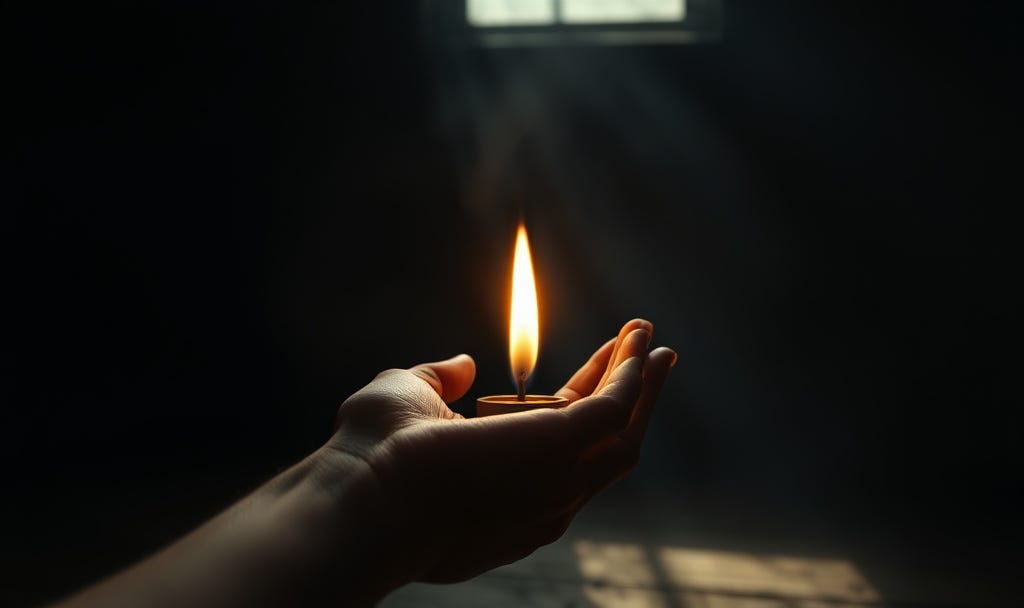
This reflection is inspired by Through Holy Week with Mary Magdalene, guided by the teachings of Cynthia Bourgeault. In this series, Holy Week is not treated as a courtroom drama about guilt and acquittal, but as an initiation into conscious love. That initiation does not happen only in grand mystical moments. It happens in the small places where something in us gets triggered, frightened, offended, exposed, or hurt, and we have to decide whether to react from the old wound or remain present long enough for something deeper to open.
Paid supporting members unlock the custom Virgin Monk Boy voiceover readings, the Virgin Monk Boy Book Of Hours, Whispers from the Silence, and private chat perks like starting threads and sharing their own Substacks.
The Moment Before You Blow It
Most transformation is lost in the first three seconds.
Something happens. Someone says the thing. The tone is wrong. The email arrives. The face changes. The silence goes on too long. Suddenly the body is flooded, the mind starts building a prosecution case, and the old machinery comes roaring to life like a gas station chainsaw that has been waiting all winter for one bad afternoon.
That is usually where we lose the thread.
Not because we are terrible people. Not because we lack insight. Many of us have enough insight to fill a storage unit. We know our patterns. We have named our wounds. We have read the books, listened to the podcasts, highlighted the passages, and probably explained our attachment style to someone who deeply regretted asking how our day was going.
The problem is not that we know nothing.
The problem is that when the fire rises, we react.
Reaction feels powerful because it gives the nervous system something to do. Defend. Explain. Attack. Withdraw. Fix. Perform innocence. Send the text. Delete the text. Rewrite the text in Notes app like a spiritually literate hostage letter. Anything is better than simply feeling the heat.
But transformation usually begins right there, in the tiny space where reaction has not yet become action.
Reaction Is Not Presence
Reaction is the old self trying to survive contact with discomfort. It is fast, automatic, and usually convinced of its own righteousness. It rarely says, “Hello, I am your ancient wound wearing today’s outfit.” It says, “Obviously this person is wrong, and we must respond immediately.”
Presence is different. Presence does not mean passivity. It does not mean letting people mistreat you, pretending nothing matters, or becoming one of those serene people who somehow make everyone nearby want to commit a minor felony. Presence means you remain inwardly available before you move outwardly. You do not hand the steering wheel to the first frightened part of yourself that grabs for it.
That is a hard practice because reaction often looks like clarity. The triggered self is very persuasive. It comes with evidence, tone analysis, historical references, and a full PowerPoint presentation titled “Why I Am Absolutely Correct and Also a Victim.” Presence has much less flair. Presence says, wait. Feel this. Stay here. Do not run so quickly into the familiar performance.
That pause may not look impressive from the outside. No angels descend. No one writes a hymn about the time you did not send the message. But spiritually, that small refusal to react can be enormous. It is the first sign that the old pattern no longer owns the whole room.
Staying Power
Bourgeault often points toward a quality that is easy to underestimate: staying power. Not dramatic endurance. Not clenched-jaw suffering. Not the religious talent for looking holy while secretly turning into beef jerky inside. Staying power is the capacity to remain present when the inner weather turns ugly.
This is why centering prayer matters. At first, it looks almost too simple to be useful. You sit. A thought comes. You release it. Another thought comes. You release it. A memory shows up. A fantasy. A resentment. A grocery list. A completely unnecessary replay of a conversation from eight years ago in which you finally say the perfect thing. Each time, you return.
That little gesture trains something deeper than concentration. It trains non-reaction. You learn that not every thought has to become a storyline. Not every feeling has to become a command. Not every discomfort has to become a project. Something arises, and instead of chasing it, fighting it, explaining it, or building a shrine to it, you let it pass through.
Then real life begins doing the same thing, except with better special effects. Someone disappoints you. Shame flares. Fear rises. Anger burns. The practice is no longer happening in a quiet room with a sacred word. It is happening in traffic, in marriage, online, at the kitchen counter, in the middle of some deeply unnecessary human nonsense.
And the invitation is the same.
Stay.
What the Fire Reveals
The first layer of the fire is usually irritation. Someone is annoying. Something is unfair. A plan is interrupted. The world has failed to consult us again, which is rude, but consistent. If we can stay there without immediately reacting, we may discover that irritation is only the smoke near the surface.
Under irritation there is often shame. Not always obvious shame, not theatrical shame, but the old fear of being dismissed, unseen, foolish, unwanted, exposed, powerless, or not enough. This is why small things can hit with such strange force. The comment was minor, but the body reacts as if the tribe has gathered to vote us out of existence. The present moment has touched something ancient.
If we keep staying, even shame may open into something deeper: the raw pain of being a separate creature in a world where everything we love can change, leave, disappoint, or die. That pain is not a mistake in the system. It is part of the human condition. Most of our reactions are attempts to avoid touching it.
We lash out so we do not have to feel powerless. We fix so we do not have to feel grief. We explain so we do not have to feel uncertainty. We perform so we do not have to feel exposed. The fire reveals all of this, not to punish us, but to show us what has been running the show from the basement.
Why This Prepares You for Death
This is where the practice becomes much more serious than “being less reactive.” Staying in the fire is preparation for death.
That may sound intense, but Holy Week is not exactly a scented candle retreat. The path leads through loss, surrender, and the stripping away of every false form of control. Death is the final place where reaction cannot save us. The body lets go. The story lets go. The familiar identities loosen. Whatever cannot remain present without control will panic.
This is why the small moments matter. Every time we sit through discomfort without becoming possessed by it, something in us learns how to die before we die. The false self loses a little of its grip. The soul discovers that it can remain present without immediately fixing, fleeing, or fighting. We learn, in tiny rehearsals, that surrender is not annihilation.
Mary Magdalene stands at the heart of this mystery. She does not fix Holy Week. She does not prevent the cross. She does not manage the tomb into meaning. She stays. Her love remains present where control has vanished. That is not weakness. That is the strength most of us spend our lives avoiding because it cannot be faked.
The Work Is Staying
The real work is not always fixing the feeling. Sometimes fixing is just another form of running away with a toolbox. The real work is staying long enough for the feeling to reveal what it is protecting, what it is hiding, and what it is asking us to surrender.
This does not mean we never act. Sometimes action is necessary. Boundaries are necessary. Words are necessary. Change is necessary. But action that arises from presence is very different from reaction that erupts from an old wound. One is responsive. The other is possessed.
Spiritual growth depends on that difference.
Not because God is impressed by emotional restraint, but because love needs a vessel large enough to hold fire without immediately throwing it at someone else. The heart has to become spacious enough to feel anger without becoming anger, to feel shame without becoming shame, to feel fear without letting fear write the next chapter.
Stay in the fire.
Not forever. Not stupidly. Not in places that destroy you.
Stay long enough to find the part of you that does not burn.
Keep the Scrolls Unrolling
The written publication is free for everyone to read.
Paid supporting members unlock the custom Virgin Monk Boy voiceover readings, the Virgin Monk Boy Book Of Hours, Whispers from the Silence, and private chat perks like starting threads and sharing their own Substacks.
Share the Scrolls
Passing a link forward is how more wandering souls stumble into the monastery. Word of mouth is the whole engine.
Tip with a coffee
A one time gift of holy caffeine that fuels both the monk and the Magdalene movement. ☕🔥

Your presence alone already helps.
Your support keeps the lantern lit for everyone else.
Follow (or troll) Virgin Monk Boy
Recommended Reading
(As an Amazon Associate, I earn from qualifying purchases. These recommendations support the scrolls at no extra cost to you.)
Living Presence: A Sufi Way to Mindfulness & the Essential Self by Kabir Helminski
