
Relaxed but Alert: Why the Body Is the Key to Meditation
How posture and sensation keep us present when the mind begins to wander

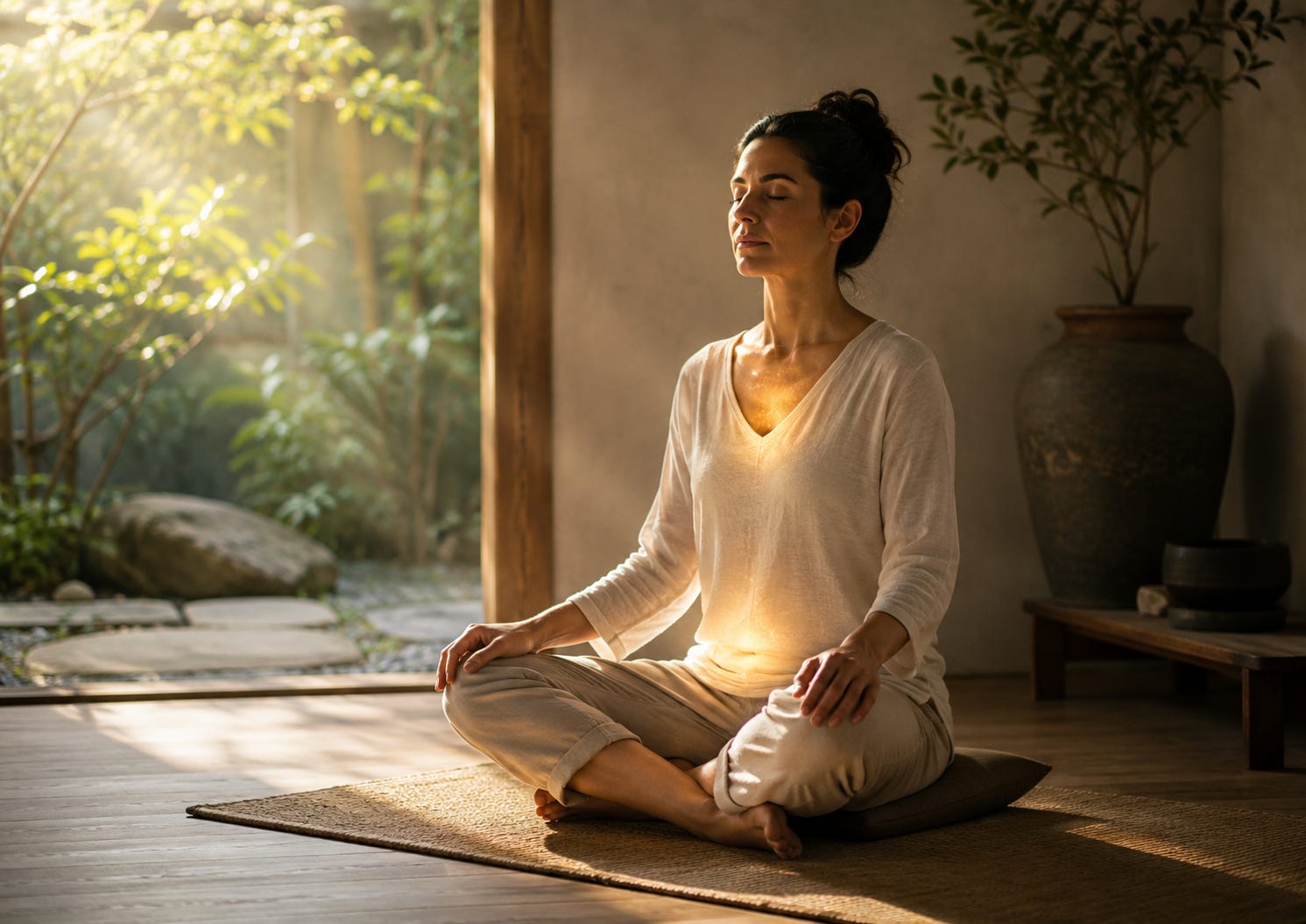
This reflection continues my series inspired by Cynthia Bourgeault’s course Discovering the Mind of Christ, Part 2, especially her commentary on Kabir Helminski’s Living Presence. In the last essay, I followed the watcher to the point where even the watcher begins to disappear. This time Cynthia brought the discussion back down to earth. Feet on the floor. Breath in the body. Shoulders released. Spine awake.
Helminski writes that the simplest form of meditation requires a body that is “still and relaxed.” Cynthia immediately objects. A body can be still and relaxed in a Barcalounger in front of the television, she says, snoring loudly, while whatever meditation takes place is purely coincidental.
What meditation requires is a body that is relaxed but alert.
I laughed because the correction seems obvious. Of course we should not fall asleep. But she was not merely adjusting Helminski’s posture instructions. She was describing the quality of attention contemplation is trying to awaken in us.
Relaxed without alertness becomes drifting. Alert without relaxation becomes control. Most of us know both.
Stillness Can Be Full of Noise
I used to assume that if I sat quietly for twenty or thirty minutes, I had meditated. Maybe not well, but at least technically. I had remained in the chair. I had not checked my phone. Surely some spiritual credit had been earned.
The problem is that the body can be perfectly still while the mind performs an entire stage production. I have replayed arguments, planned articles, rehearsed conversations that were never going to happen, and solved problems no one had asked me to solve. All without moving anything but my eyelids.
Stillness is useful because it removes some distractions, but it does not create presence. Sometimes it merely gives the imagination a quieter theater.
Cynthia’s Barcalounger is funny because it exposes the mistake. Relaxation is not the same thing as awareness. We can float through a meditation period in a pleasant fog and mistake the absence of tension for the presence of God.
Relaxation matters. A tense body keeps announcing that something must be defended, controlled, or accomplished. But relaxation has to remain awake. Otherwise meditation becomes a respectable form of daydreaming.
Alertness Has Its Own Ego Problem
The opposite mistake is familiar to anyone who can turn almost anything into a performance review.
Sit upright. Follow the breath. Do not wander. Catch every thought. Return immediately. Try harder.
I know this posture too. The body may appear composed, but internally there is a supervisor with a clipboard. Every distraction is noted. Every return is evaluated. The ego serves as both employee and management.
Cynthia warns against holding attention entirely through the mind and will. Attention can become another faculty we try to dominate. We may become good at concentrating while also becoming more controlling and more impressed with ourselves as people who know how to concentrate.
The body tells on us. The jaw tightens. The breathing becomes shallow. The spine is no longer upright but braced. We are not present. We are trying to force presence to happen.
Relaxed but alert means neither drifting nor gripping. We are here, but we are not clutching the moment.
The Body Knows Where Now Is
The most practical part of Cynthia’s teaching was also the part I most needed to hear. When identification takes over, begin with sensation.
Feel the feet on the ground. Sense the volume of the head. Notice the breath moving in the lower abdomen. Become aware of the hands, the base of the spine, or whatever place in the body most quickly returns you to yourself.
This sounds almost insultingly simple. The ego would prefer a more impressive assignment. It wants hidden knowledge, a rare technique, perhaps a diagram with several levels and a password.
Cynthia says: feel your feet.
There is a reason for that simplicity. Sensation can only happen now.
We can remember a sensation from yesterday, but the remembering is happening now. We can anticipate pain tomorrow, but the anticipation is happening now. The pressure of the floor beneath the feet, the weight of the hands, the breath entering the body, the tightness in the throat—those are present-tense realities.
Thought can live almost anywhere. Sensation refuses to leave the room.
That is why the body interrupts identification. It does not argue with the story in the mind. It simply introduces something more immediate than the story. The feet are here. The breath is here. For one moment, so am I.
Finding the Posture That Wakes You Up
There is no single posture that works for every body. Some people sit on cushions. Some sit in chairs. Some need back support. Some of us have knees, necks, or hips that have already submitted formal complaints about the standard meditation photographs.
The goal is not to imitate a statue. It is to find a position in which the body can be at ease without becoming dull.
Let the spine rise naturally. Release the shoulders. Unclench the hands. Soften the face. Allow the feet or knees to make clear contact with the ground. The posture should have dignity, but not strain. It should feel awake without feeling guarded.
Then find the sensation that serves as your deepest reminder. For one person it may be the soles of the feet. For another, the movement of breath low in the abdomen. Someone else may respond to the hands or the interior space of the head.
The right place is not the most dramatic one. It is the place that brings you back. Once you find it, touch it lightly with attention. Remember the body. The body remembers the present.
The Posture Leaves the Chair
What Cynthia is teaching does not remain inside formal meditation.
Relaxed but alert is also a way of listening. It is a way of entering a difficult conversation without collapsing into passivity or tightening into combat. It is a way of driving through traffic, answering an email, or noticing that an old reaction has already started winding itself around the nervous system.
The body often knows before the mind admits anything is happening. The jaw has tightened. The shoulders have risen. The breath has shortened. We are already halfway into the boat before we realize it has left the shore.
Then comes the simplest intervention: feel the feet, notice the breath, sense the body from within.
Nothing dramatic may happen. The difficult person may still be difficult. We may still need to speak, decide, refuse, apologize, or leave. But there is now a little more space around the reaction. We are no longer entirely inside it.
I had thought posture was mostly about keeping the body from becoming a distraction during meditation. Cynthia turns that around. The body is not merely something to arrange so the real spiritual work can happen elsewhere. The body is one of the instruments through which we wake up.
Relaxed enough to stop controlling, alert enough not to disappear, still enough to notice, present enough to respond.
Perhaps that is the posture of transformation: not a perfect position held for thirty minutes, but a human being learning how to remain here.
Keep the Scrolls Unrolling
The written publication is free for everyone to read.
Paid supporting members unlock the custom Virgin Monk Boy voiceover readings, the Virgin Monk Boy Book Of Hours, Whispers from the Silence, and private chat perks like starting threads and sharing their own Substacks.
Share the Scrolls
Passing a link forward is how more wandering souls stumble into the monastery. Word of mouth is the whole engine.
Tip with a coffee
A one time gift of holy caffeine that fuels both the monk and the Magdalene movement. ☕🔥

Your presence alone already helps.
Your support keeps the lantern lit for everyone else.
Follow (or troll) Virgin Monk Boy
Recommended Reading
(As an Amazon Associate, I earn from qualifying purchases. These recommendations support the scrolls at no extra cost to you.)
Living Presence: A Sufi Way to Mindfulness & the Essential Self by Kabir Helminski
The distinction between what a system says it values and what it actually rewards is the pivot that changes everything. We have been trained to read mission statements as if they were the truth, but the truth is written in the promotions, the metrics, the things that survive. The Labrador is not confused. It knows exactly where the treats are.
What I find myself sitting with is the idea that we are systems too. We reward ourselves all the time—with avoidance, with convenience, with the appearance of productivity. And we do not even notice we are training ourselves, because the training is so quiet. We are the Labrador. We are also the trainer.
The line that stayed with me is: "Behavior leaves fingerprints. Speeches do not." That is the whole of it. The speeches are the introduction. The reward system is the biography. If you want to understand anything, watch what it sits for.
The distinction between relaxation and alertness is the pivot that changes everything. We are so conditioned to think of meditation as either effort (trying to control the mind) or collapse (drifting into a pleasant fog). But the space between—relaxed but alert—is where presence actually lives.
What I find myself sitting with is the idea that sensation can only happen now. The feet on the floor, the breath in the body, the weight of the hands—these are present-tense realities that thought cannot replicate. Thought can live almost anywhere. Sensation refuses to leave the room.
The line that stayed with me is: "The body knows where now is." That is the whole of it. The body is not a distraction from the present. It is the anchor that keeps us from floating away.