

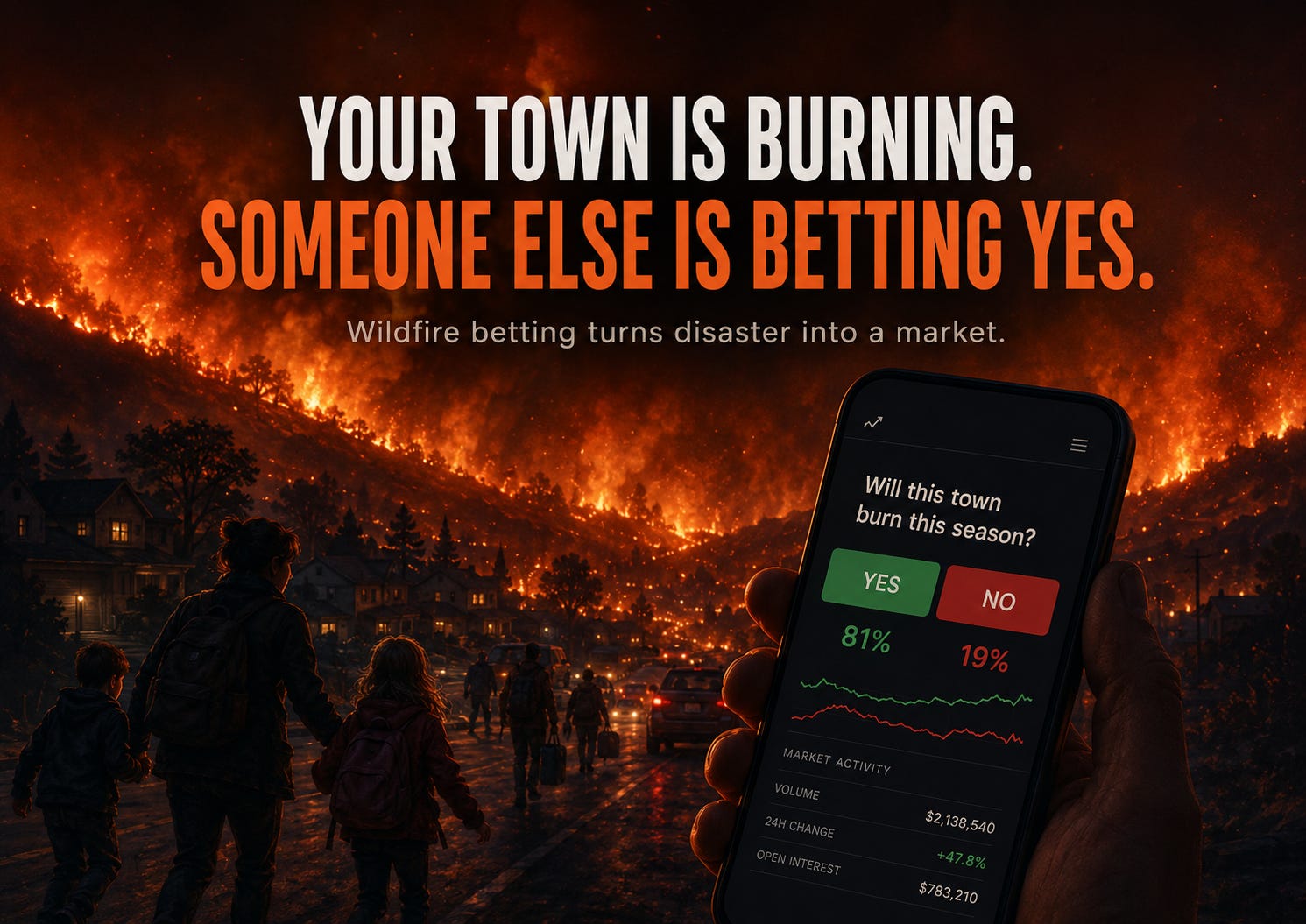
There are moments when modern capitalism looks at human suffering and says, “Could this be an app?” And because apparently no one in the boardroom owns a functioning conscience, the answer keeps coming back yes.
The latest holy innovation from the temple of number-go-up is wildfire prediction betting. Not wildfire forecasting in the serious, public-safety sense. Not climate modeling. Not resource planning. Not the painstaking work of firefighters, meteorologists, emergency managers, and people with actual boots on actual burning ground. I mean prediction markets where users can wager on wildfire outcomes: how far a fire spreads, when it gets contained, whether it reaches a city, how much destruction it causes.
Yes, beloveds. We have entered the “bet on your neighbor’s ashes” phase of civilization. Very advanced. Very disruptive. Very “the serpent has a Series B funding round.”
For anyone new to this, prediction markets are basically betting platforms where people buy and sell contracts tied to future events. A market might ask, “Will X happen by Friday?” Users buy “yes” or “no” positions, and the price moves as people bet. A 50-cent “yes” contract roughly means the betting crowd thinks the event has a 50 percent chance of happening. These markets already exist around elections, sports, oil prices, disease outbreaks, international incidents, and weather events. The argument from supporters is that when people put money behind their predictions, markets can reveal useful information faster than pundits or institutions. Sometimes that argument has merit. Sometimes the crowd sees something early. Sometimes the crowd is just a bunch of caffeine goblins trying to turn human misery into lunch money. Discernment, as the monks say, is useful. Also, maybe try having a soul.
Kylie Mohr’s reporting for High Country News, republished by Wired, looked at this exact problem after the devastating January 2025 Eaton and Palisades fires in Southern California. Those fires destroyed more than 16,000 structures and killed 31 people. While families were evacuating, grieving, and watching entire neighborhoods disappear, users on Polymarket were betting on how the fires would grow, how long they would last, and how much they would destroy. Polymarket reportedly listed almost 20 wildfire-related questions, and people spent about $1.2 million betting on those queries.
This is where the argument stops being abstract. We are not talking about a clean little thought experiment in an economics seminar where everyone has a blazer, a graph, and no emotional relationship to reality. We are talking about people losing homes, family histories, pets, medication, photos, heirlooms, neighborhoods, and sometimes lives. Then, while the smoke is still in the air, strangers are refreshing odds like they are checking fantasy football.
Capitalism has always had a talent for arriving at the scene of suffering with a folding table and a payment processor. Disaster capitalism is not new. People have made money off war, famine, debt, housing collapse, medical desperation, climate crisis, and every other wound humans can inflict or endure. But this is a special little goblin because it does not merely profit after the disaster. It creates a financial interest in the disaster’s outcome while it is still unfolding.
That matters.
Betting on rain is one thing. Betting on whether a hurricane forms is one thing. Still weird, perhaps, but you cannot walk outside with a lighter and personally encourage a hurricane. Wildfire is different. A fire can be started or worsened by one person in minutes. That is why wildfire survivors and ethicists are worried about arson incentives. A U.S. Forest Service spokesperson told High Country News that systems tying financial gain to wildfire outcomes risk misuse, including arson, and are not compatible with the agency’s mission.
And let’s sit with that for a moment, because the whole tech-bro defense of these markets is usually wrapped in incense labeled “public good.” The claim is that the crowd can help generate better forecasts. Very noble. Very Prometheus bringing fire to humanity, except this time Prometheus also has a crypto wallet and a Discord server called BurnAlpha.
A new wildfire-focused platform called Wyldfyre reportedly framed itself as a tool for collective intelligence and wildfire forecasting. Its tagline, according to the reporting, was: “You can’t predict wildfire. But you can trade on it.” At the time of the reporting, users could only simulate trades, but the site said real-money betting was “coming soon.”
That tagline deserves to be preserved in a museum of cursed human sentences. “You can’t predict wildfire. But you can trade on it.” Translation: “We may not be able to save your town, but have we considered monetizing the odds of its destruction?” Truly, the Buddha left the palace for less.
And here is the funniest part, by which I mean funniest in the “laugh so you don’t scream into a damp towel” sense: the actual agencies responsible for wildfire forecasting are not asking Chad from Polymarket to reveal the hidden wisdom of the flame. The Forest Service said it does not use prediction-market information for wildfire forecasting and does not rely on any system that treats wildfire as speculation. CAL FIRE said it does not use prediction-market-derived data either. CAL FIRE’s intelligence program described its modeling as science-based, using weather observations, forecast data, fuel and vegetation conditions, topography, location data, and available resources. In other words: physics, not vibes with a betting slip.
This is the moral distinction that matters. Forecasting is not the problem. Forecasting wildfires is sacred work. It saves lives. It helps communities prepare. It helps firefighters deploy resources. It helps people know when to leave before the road turns into a death trap. The problem is not prediction. The problem is turning another person’s peril into an asset class.
There is a difference between studying suffering to reduce it and studying suffering to profit from it. One is compassion with tools. The other is the ego wearing a data-science hoodie.
Some defenders will say, “But markets reveal information.” Fine. Sometimes they do. But markets also reveal desire. They reveal what a society is willing to normalize. They reveal what we are willing to reduce to price. And when the market says a family’s home, a neighborhood’s survival, or a person’s evacuation nightmare is just another contract, the market is not revealing wisdom. It is revealing spiritual rot with a user interface.
A society has to decide that some things should not be markets. A home is not liquidity. A burned neighborhood is not alpha. A fleeing family is not a contract. A firefighter’s tactical decision is not insider edge. Grief is not a derivative.
This is where the old spiritual traditions are inconvenient to the modern casino. They keep insisting that the human person is not an instrument. The neighbor is not a price signal. The world is not merely raw material for appetite. The soul is shaped by what it consents to enjoy. And if someone can watch a fire consume a town and think, “I wonder if I can make money if this gets worse,” then the problem is not only legal or regulatory. The problem is formation. The heart has been trained badly.
The Gospel of Mary says the soul is harassed by powers like desire, ignorance, and wrath. Modern people hear that and imagine ancient superstition. But honestly, look around. Desire says, “You belong to me.” Ignorance says, “This is just data.” Wrath says, “Who cares? Someone always profits.” Then the soul, if it remembers itself, says: No. I am not required to become smaller just because the market found a clever way to monetize cruelty.
That is the real spiritual practice here. Not escaping the world. Seeing it clearly. Seeing the moment when “innovation” becomes desecration. Seeing when “forecasting” becomes gambling on harm. Seeing when “collective intelligence” becomes a mob of hungry ghosts tapping yes or no while someone else is praying the wind changes.
And yes, there should be regulation. Some lawmakers have started proposing limits on prediction-market contracts tied to things like terrorism, assassination, war, illegal activity, gaming, and individual death, though wildfire was not explicitly included in those proposed restrictions as of the High Country News reporting. But regulation alone will not save a culture that has forgotten shame. Law can draw a boundary. It cannot, by itself, resurrect reverence.
So maybe the first boundary is this: we refuse to call everything “innovation” just because someone found a way to charge fees on it. We refuse to confuse gambling with wisdom. We refuse to let the suffering of the vulnerable become entertainment for the financially bored.
If someone wants to help predict wildfires, great. Fund science. Support public agencies. Build tools firefighters can actually use. Donate to survivors. Help your town prepare. Clear brush. Check on elderly neighbors. Learn evacuation routes. Do literally any useful thing.
But betting on whether someone’s town burns down?
No, beloved. That is not prophecy. That is not intelligence. That is not the future.
That is just the old demon of greed discovering push notifications.
Keep the Scrolls Unrolling
The Virgin Monk Boy Scrolls is a free publication.
If these words steady you, challenge you, make you laugh, or help you breathe deeper, here are three simple ways to support the work.
Share the Scrolls
Passing a link forward is how more wandering souls stumble into the monastery. Word of mouth is the whole engine.
Become a Supporting Member
Paid members unlock the Virgin Monk Boy Book Of Hours, Whispers from the Silence, and the ability to start threads and share their own Substacks in the private chat.
Tip with a coffee
A one time gift of holy caffeine that fuels both the monk and the Magdalene movement. ☕🔥

Your presence alone already helps.
Your support keeps the lantern lit for everyone else.
It's amazing how prediction markets can lower the bar on just about anything. Isn't it fun to bet on people's loss of property and perhaps even their lives? Isn't it? It certainly is if you're dead inside! Well, let's just look at the Zombies in the current administration! There's your model for a sinking hole of depravity. Hey, let's bet on how long they will last???
There are 2 things I don't get about humanity. Well, probably way more than 2, but these 2 really perplex me because when I look inside, I just don't see the attraction. I don't get why people enjoy watching sports. To me it just seems utterly boring. Doing sports, doing intense physical activities, that I get. But add in competition and an audience, and I just don't see it (from the audience point of view). And part of it is, why would anyone case if "my" team beat's someone else's team? Why identify with a team based on something like locality or what school you attended or what country you happen to live in or things like that? And I'm not saying I somehow better than others because I don't get the attraction. I think it's more like I'm somewhere on the autism spectrum, though undiagnosed, so what I like and don't like is to some extent abnormal.
To connect this with what the article is about, the other thing I just don't get is what the attraction is to betting on things. First, I just don't feel the attraction, the excitement. But there's also the reasoning aspect. I mean, everyone knows that any betting system that makes money has got to work in such a way that, on average, bettors lose more money than they make. So it just doesn't make rational sense to imagine that somehow you are one of the lucky ones who comes out ahead. And then to feel excitement about it. I just don't see where that comes from.
Another area where I'm confused about human behavior, but which I do understand the impulses from looking within, is status seeking. I wish I could avoid the feelings, but I do want to be admired and I don't want to be looked down on. Life would be so much easier, I imagine, if one just felt okay with oneself and didn't care about the opinions of others concerning oneself. But I can't seem to help caring, and it does cause a lot of discomfort (and occasionally a sense of fitting in and being appreciated). So maybe you could help me work on this issue by liking my comment!