

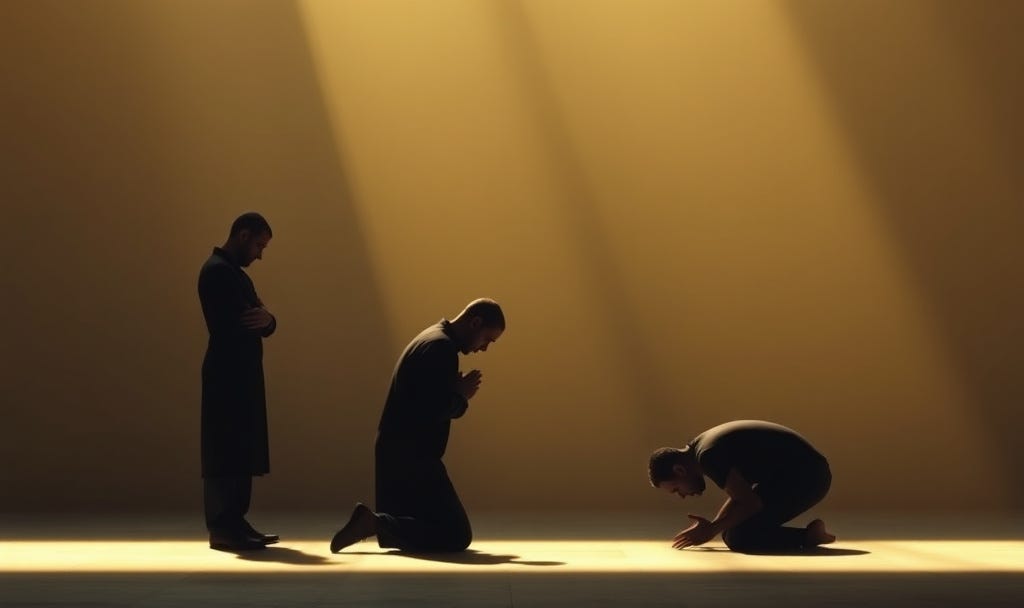
This piece is a practice-level reflection comparing three daily prayer traditions—Tibetan Buddhist Field of Merit practice, Islamic Ṣalāt (the five daily prayers), and Eastern Orthodox prayer—through the lens of how they orient the human body, heart, attention, and presence over time.
Rather than comparing doctrines or beliefs, it focuses on structure: the ratio of praise to petition, orientation to pleading, embodiment to interior narration. A fourth stream—post-Reformation Protestant prayer—appears later as a contrast point, highlighting how different prayer architectures train very different inner lives.
I’m approaching this at the level of practice deliberately. I’ve never been particularly impressed with most forms of religious deconstruction, because they almost always operate at the level of argument and analysis. They try to dismantle belief by attacking the intellect, while leaving the deeper patterns of the heart untouched.
Prayer works in the opposite direction. It shapes orientation before it shapes ideas. Once we understand how prayer actually works on the body, the nervous system, and attention, adjustments made there tend to reorganize belief on their own. When the heart is reoriented, the intellect usually follows. Inner intelligence does the reforming, without needing to be coerced.
This perspective is strongly informed by Buddhist training logic and Sufi heart-centered epistemology, both of which assume that practice reshapes belief more reliably than argument ever could.
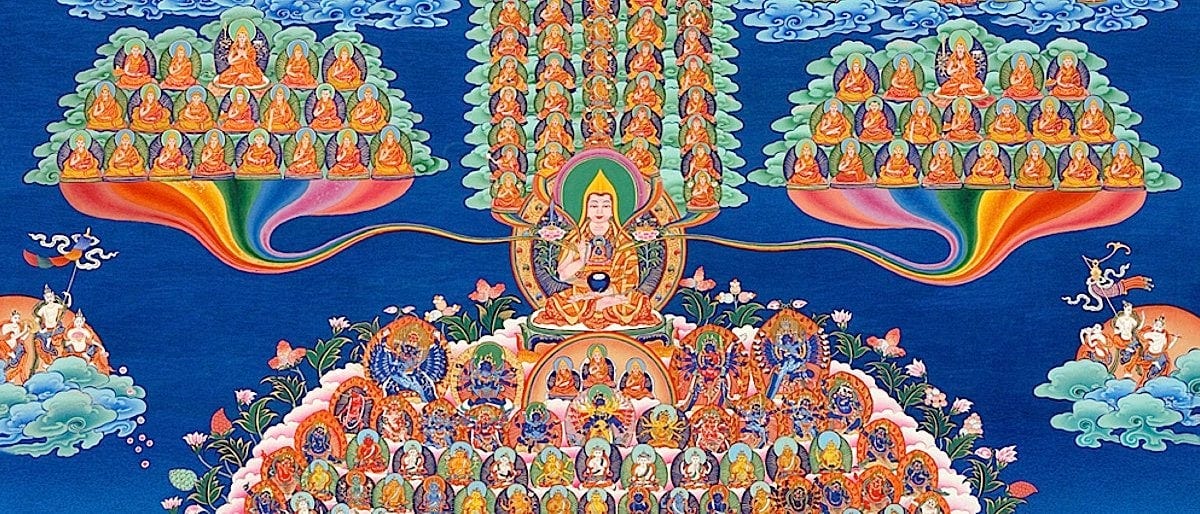
Tibetan Buddha Field of Merit
When I look at Tibetan Buddhist practice, especially the Field of Merit, I see almost the same interior mechanics at work. Different cosmology. Same function.
1. Orientation before petition
In the Field of Merit, you don’t start by asking for anything.
You place yourself in a field saturated with awakened presence. Buddhas, bodhisattvas, lineage holders, teachers. You’re not pleading upward. You’re situating yourself inside a reality that is already awake.
That’s the same move Ṣalāt makes by beginning with praise.
Before “guide us,” there is recognition.
2. Praise expands the field, it doesn’t flatter the divine
In Tibetan practice, offerings and praise aren’t for the Buddhas’ benefit. They don’t need butter lamps.
The praise opens perception. It thins self-referentiality.
Likewise in Ṣalāt, glorifying God isn’t about inflating God.
It’s about deflating the ego’s claim to centrality.
Different language. Same function.
3. Confession is secondary, alignment is primary
The Seven-Limb Prayer includes confession, but notice where it sits:
after refuge
after offering
after praise
Confession arises within a larger field of goodness.
It’s not self-loathing. It’s realism inside grace.
That mirrors Islam’s approach closely. Forgiveness isn’t dramatized. It’s assumed to flow from correct orientation.
4. Embodied humility over psychological drama
In Tibetan practice, full prostrations do the heavy lifting.
The body learns surrender before the mind explains it.
Same with sujūd.
Both traditions understand something Western religion largely forgot:
humility is trained somatically, not argued into existence.
5. Merit is not transactional, it’s gravitational
Merit doesn’t mean points earned.
It means conditions aligned.
You step into the Field of Merit and the field does the work.
You enter Ṣalāt and remembrance reshapes attention.
Nothing is being begged.
You’re allowing yourself to be re-patterned by proximity to the sacred.
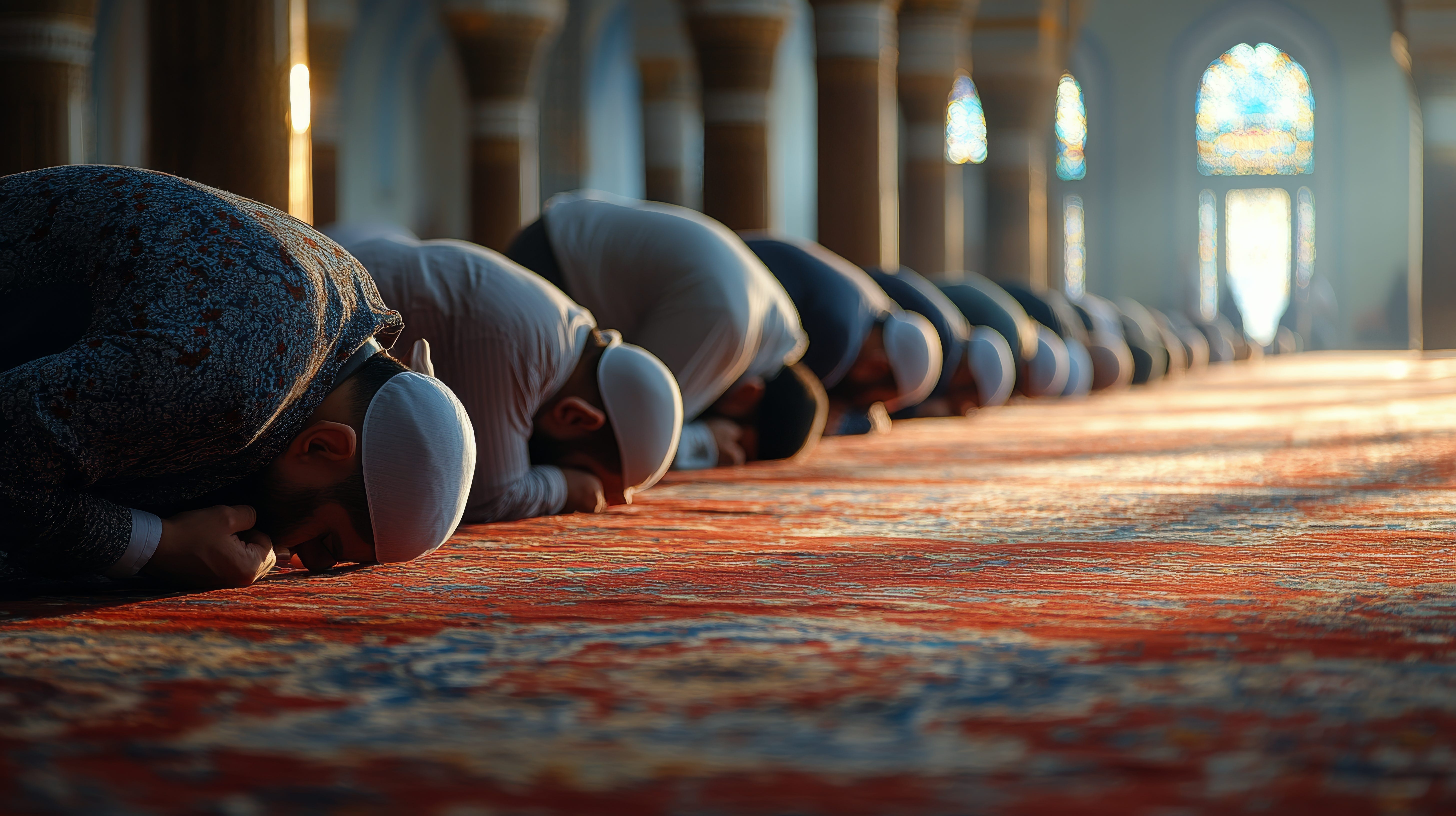
Salat (Five Daily Prayers of Islam)
When you actually look closely at the structure of the Ṣalāt, the overwhelming weight is on praise, glorification, and orientation, not on petition or begging.
A few things jump out once you see it clearly.
1. Praise comes first and sets the tone
Ṣalāt opens with Al-ḥamdu lillāh—all praise belongs to God—and the repeated glorifications Subḥāna rabbiyal-ʿaẓīm and Subḥāna rabbiyal-aʿlā, declaring God’s magnificence and transcendence.
The prayer begins by:
affirming God as the sole source of reality
re-centering the self before anything is asked
dissolving ego through remembrance, not confession
You’re not starting with “here’s what’s wrong with me.”
You’re starting with “here’s what is.”
2. Petition is minimal and highly restrained
There are requests, but they’re sparse and universal:
guidance to the straight path
protection from deviation
mercy rather than transactional favors
There are no long lists. No personal shopping cart of desires.
It’s alignment, not negotiation.
3. Forgiveness is implicit, not dramatized
Islam assumes that forgetfulness (ghaflah) is the human problem, not moral depravity.
So the solution is remembrance, not self-flagellation.
Prostration says more than words ever could:
“I am not the center.”
That posture is repentance, without theatrics.
4. The ratio reveals the theology
Christian prayer, especially post-Reformation, often centers:
guilt
personal sin narratives
emotional pleading
Ṣalāt centers:
divine unity
right orientation
humility through embodiment
One system trains conscience through emotion.
The other trains consciousness through rhythm, posture, and repetition.
5. It functions like spiritual physiology
Standing. Bowing. Prostrating. Sitting.
Breath slows. Attention narrows.
The body learns submission before the mind argues.
That’s why it doesn’t need much begging.
The practice itself is doing the work.
So yes, that instinct is correct.
Ṣalāt isn’t primarily about asking God to fix you.
It’s about remembering who God is until the self falls back into proportion.
Once that happens, very little needs to be said.
What becomes clear is this:
Both systems so far assume the core human problem is misorientation, not moral bankruptcy.
The solution isn’t endless asking.
It’s remembering reality until the self relaxes into its proper scale.
Once you’re standing in the right field, very little needs to be said.
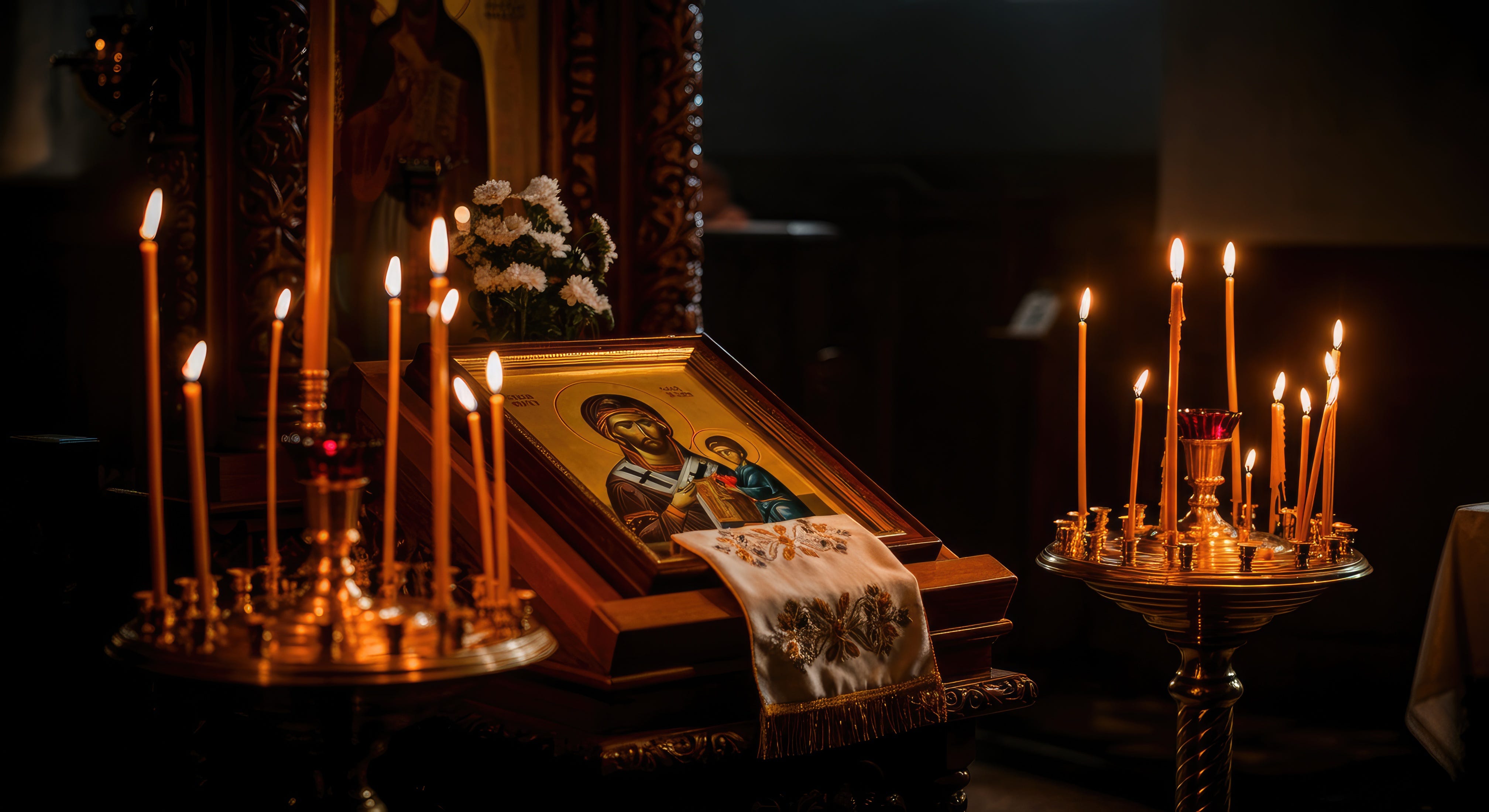
Eastern Orthodox Prayers
Eastern Orthodox daily prayer shares this same initial orienting move. It begins with doxology. It places the practitioner before divine reality before anything is requested. In that sense, it belongs clearly within the same family of practices.
But after that shared beginning, the center of gravity shifts.
Where the Field of Merit and Ṣalāt assume misorientation as the core human problem, Orthodoxy increasingly frames the human condition in terms of insufficiency, weakness, and dependence. That difference in anthropology reshapes the emotional architecture of prayer in noticeable ways.
This is especially true in prayers attributed to St. Macarius, where supplication intensifies into something that genuinely feels like begging. That shift is not accidental, nor is it a distortion. It is a deliberate therapeutic strategy rooted in a particular understanding of the human soul.
That isn’t a misreading. It’s built into how Orthodoxy frames the human condition.
1. The shared orientation is real
Orthodox prayer begins with:
doxology
remembrance of God’s greatness
placing oneself before divine reality
“Blessed is our God.”
“Glory to You.”
“Holy God, Holy Mighty.”
That re-centering move is unmistakable. Orthodoxy never starts cold with requests.
So far, the ground is shared.
2. Where it diverges: anthropology
Orthodoxy assumes a wounded will and a darkened nous that cannot self-correct without grace.
Islam assumes forgetfulness.
Tibetan Buddhism assumes ignorance.
Orthodoxy assumes ontological weakness.
That assumption changes the emotional tone of prayer.
3. St. Macarius intensifies this dramatically
The prayers attributed to St. Macarius are extreme, even by Orthodox standards.
They come from a world where:
temptation is constant
the heart is porous
demonic pressure is assumed, not metaphorical
So the prayers sound like:
“I cannot stand without You”
“I am utterly powerless”
“Do not abandon me”
That is much closer to begging than what you hear in Ṣalāt or Tibetan liturgy.
And it’s intentional.
4. The logic behind the begging
In Macarius, the pleading isn’t transactional. It’s therapeutic self-emptying.
The prayer is trying to:
crush spiritual self-sufficiency
prevent subtle pride
keep the practitioner radically dependent on grace
The prayer isn’t telling God something.
It’s telling the monk’s ego that it is not in charge.
5. Why it feels heavier than the others
Orthodoxy developed inside:
monastic enclosure
ascetic warfare imagery
a worldview saturated with spiritual struggle
It trains vigilance through contrition rather than alignment.
That doesn’t make it wrong.
But it does mean the emotional cost is higher and not practical for people living in the world
And as many know from lived experience, that cost can tip into:
scrupulosity
chronic self-accusation
prayer becoming a mirror for despair rather than clarity
Orthodox daily prayer does share the same orienting move as Ṣalāt and the Field of Merit.
But it places far more weight on human insufficiency, especially in Macarian texts.
Where the others say:
“Remember reality and you’ll realign.”
Macarius effectively says:
“Unless God intervenes constantly, I will fall apart.”
All aim at humility.
They just train it through very different emotional architectures.
Conclusion
What these three traditions make clear, when viewed at the level of practice rather than belief, is that prayer is not primarily a method for getting things from God. It is a method for getting the self back into proportion.
Ṣalāt, the Field of Merit, and Eastern Orthodox prayer all begin by re-establishing orientation. They refuse to let the practitioner start from ego, panic, or narrative. They insist that praise, remembrance, and bodily placement come first. Only after reality is named does anything else happen.
Where they differ is not in whether orientation matters, but in what they believe goes wrong once orientation is lost.
Tibetan Buddhism assumes ignorance and counters it by placing the practitioner inside a field already awake. Islam assumes forgetfulness and counters it with rhythmic remembrance that steadily returns the self to scale. Orthodoxy assumes weakness and counters it with radical dependence, training humility through sustained contrition and vigilance. Each produces a different emotional texture, a different inner climate, and a different relationship to effort and grace.
What modern deconstruction often misses is that belief usually follows practice, not the other way around. You do not think your way into a new heart. You stand, bow, remember, and repeat your way into one. The nervous system learns first. The intellect catches up later.
This is why arguments about prayer so often go nowhere. They aim at ideas while leaving orientation untouched. But orientation is the root system. Change that, and belief reorganizes on its own, without coercion, panic, or moral pressure.
Seen this way, prayer is closer to spiritual physiology than theology. It works by repetition, posture, and proximity. It trains humility before it explains it. It teaches surrender without demanding that the mind agree in advance.
And that may be the quiet invitation these traditions still offer a restless, over-analyzed religious landscape: stop asking what you think about prayer for a moment, and notice what your body is being trained to do when you pray.
Stand in the right field long enough, and very little needs to be said.
Keep the Scrolls Unrolling
The Virgin Monk Boy Scrolls is a free publication.
If these words steady you, challenge you, make you laugh, or help you breathe deeper, here are three simple ways to support the work.
Share the Scrolls
Passing a link forward is how more wandering souls stumble into the monastery. Word of mouth is the whole engine.
Become a Supporting Member
Paid members unlock the Virgin Monk Boy Book Of Hours, Whispers from the Silence, and the ability to start threads and share their own Substacks in the private chat.
Tip with a coffee
A one time gift of holy caffeine that fuels both the monk and the Magdalene movement. ☕🔥

Your presence alone already helps.
Your support keeps the lantern lit for everyone else.
“Stand in the right field long enough, and very little needs to be said.” And this is how we pray without ceasing.
This is so good. I have always had a hard time understanding, explaining what prayer actually is. And this is so helpful.
My dad always said “God is not Santa Clause.” and I have the understanding that prayer was about changing me not about getting the results I wished for.
Thank you so much for this article. The orientation, the posture, it’s like an ahah moment. I never really was Southern Baptist after all. Thank God. Heeeheee
Also, I’ve never liked the deconstruction idea for the same reason. I appreciate you and Joe Boyd’s approach. Love, kindness and humility go a long way. Blessings VMB.
This makes so much sense, intuitively. You have given me much to think about. I changed the way I prayed five years ago, and that led to many more changes....all of which I'm grateful for.