

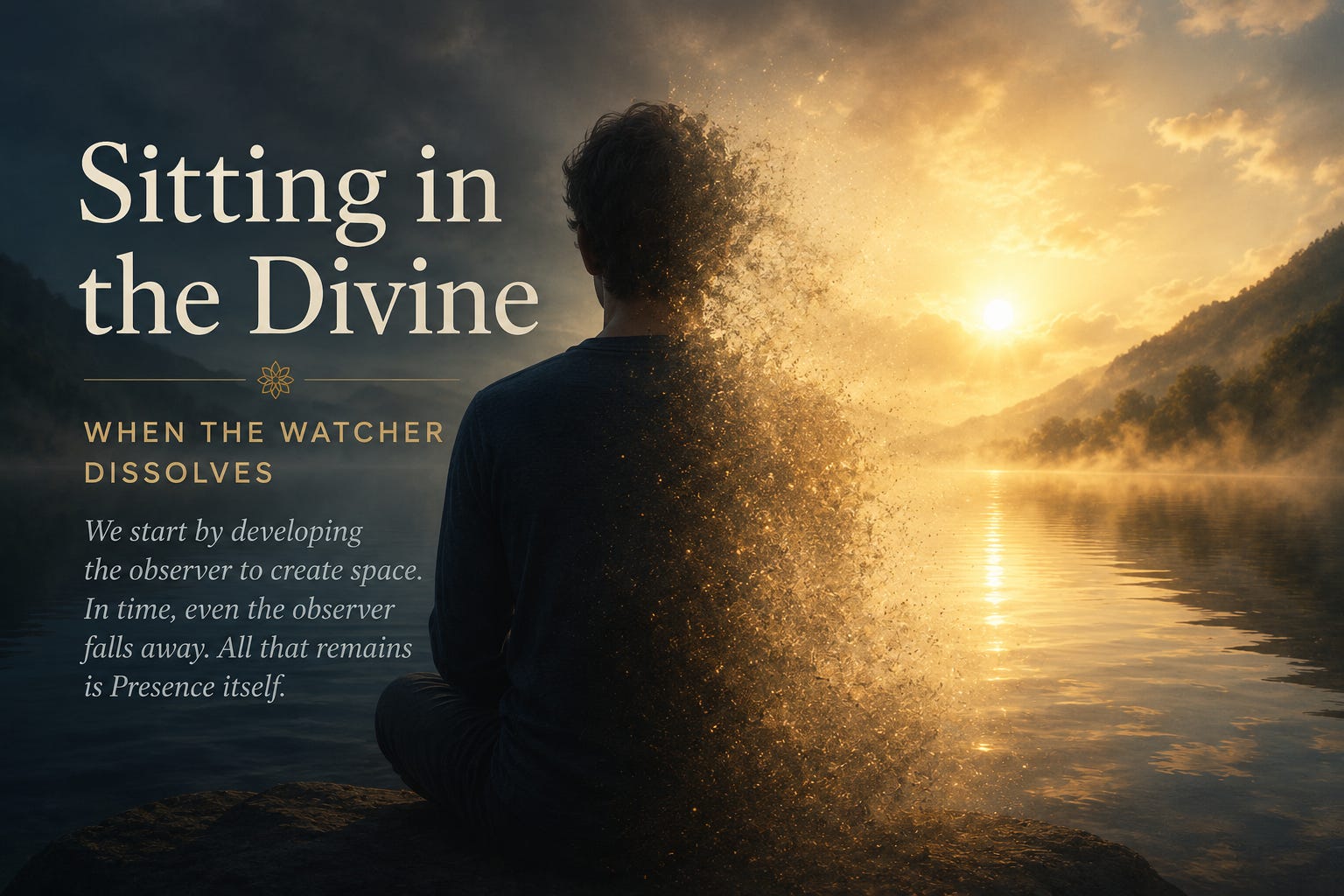
This reflection continues my series inspired by Cynthia Bourgeault’s course Discovering the Mind of Christ, Part 2, especially her commentaries on Kabir Helminski’s Living Presence. The first articles explored the Essential Self beneath personality, the ego’s attempt to manage its own enlightenment, and meditation as freedom from identification. Most recently, we looked at compassion without attachment and the possibility that right action can arise from presence rather than emotional compulsion. This reflection follows meditation to its strangest conclusion: we begin by learning to observe ourselves, only to discover that even the observer cannot be the final destination.
At first, the watcher feels like a breakthrough. A thought appears, but instead of immediately becoming the thought, something in us notices it. Anger rises, and we recognize anger before it becomes the whole room. An old fantasy begins gathering momentum, and for once we can see the machinery starting up before it carries us away. That tiny separation between awareness and experience is where contemplative freedom begins.
Then one of Cynthia’s students asks the question that inevitably arrives: do we eventually have to give up the watcher?
The answer is yes, although almost everything about that answer can be misunderstood.
The Watcher Is a Useful Beginning
In ordinary life, we are usually fused with whatever happens to be moving through consciousness. We do not experience a thought as something passing through us. We experience it as reality. If resentment appears, the mind immediately begins collecting evidence for the prosecution. If anxiety appears, it starts writing tomorrow’s weather report. If someone praises us, the ego quietly updates its résumé.
Meditation creates a little distance from this automatic process. In awareness practice, we observe thoughts arising and dissolving. In Centering Prayer, we notice that attention has wandered and gently return to the sacred word. In concentrative meditation, we return again and again to the breath or another simple anchor. The methods differ, but each one teaches the same elementary lesson: a thought can be present without becoming our identity.
This is the watcher in its most useful form. It is not a new personality supervising the old one. It is awareness recognizing that it has been asleep inside its own contents. For a person who has spent decades being dragged around by every passing emotion, this discovery can feel almost miraculous.
The trouble begins when the ego notices the miracle.
The Spiritual Hall Monitor
The ego has a remarkable ability to survive every stage of the journey by changing jobs. When worldly success becomes embarrassing, it becomes interested in spiritual success. When control is exposed as a problem, it tries controlling attention instead. When we discover the watcher, the ego applies for the position.
Before long, there is a new character sitting inside us, monitoring the meditation and taking notes. It watches the thoughts, evaluates the silence, measures the depth of the experience, and occasionally congratulates itself for being the one who is watching. The ordinary ego may have wanted praise, money, influence, or control. The spiritual ego wants pure awareness and preferably wants to know how well it is doing compared with everyone else.
Cynthia calls this “watching the watcher,” and it becomes another form of self-reflection. Instead of being lost in the original thought, we become fascinated by ourselves as the person who is observing the thought. The boat is still carrying us downstream. It has simply been renamed Advanced Meditation Practice.
This does not mean the watcher was a mistake. It means the watcher was never meant to become another permanent identity.
Who Notices?
Cynthia points to a quiet mystery hidden inside the basic instructions for Centering Prayer. When you notice that you are engaged with a thought, return gently to the sacred word.
The instruction sounds simple enough, but it contains an unanswered question.
Who notices?
You may have been completely lost in a fantasy, a memory, or tomorrow’s grocery list. Then something inside you remembers the original intention and quietly interrupts. You were not consciously supervising the process. In fact, you had forgotten the meditation entirely. Yet something recognized the identification and brought you back.
Cynthia treats this as more than a mental technique. Something deeper has registered the intention of the heart. Something in us is already aligned with awakening before the surface mind manages to catch up. She describes these moments as hidden streams of mercy rising from within our own depths.
The watcher, then, is not something we manufacture from scratch. We do not build a superior self and position it above the personality. What we call developing the watcher may really be the gradual removal of everything that obstructs our natural capacity for awareness.
Helminski uses the image of polishing a mirror. The mirror does not create the light. It becomes transparent to what was already there.
When the Observer Becomes the Obstruction
Eventually the watcher itself becomes too much.
As long as there is a distinct observer proudly standing apart from experience, a subtle duality remains. There is someone here who is watching something over there. The observer may be quieter than the ordinary ego, but there is still a structure of separation: I am observing my thoughts. I am surrendering my distractions. I am entering the divine presence.
Cynthia suggests that at a certain point, this entire arrangement begins to soften. The technique is not rejected; it simply becomes unnecessary for a moment. The observer, the observed, and the act of observing no longer feel like three separate things. There is only awareness, or presence, without anyone standing outside it to claim possession.
This is where spiritual language becomes slippery. The moment we hear about awareness without an observer, the mind wants to visualize it, analyze it, and achieve it. The ego immediately adds “dissolve the watcher” to its project-management software.
But the watcher cannot dissolve the watcher.
The self cannot empty itself while remaining in charge of the emptying.
What disappears is precisely the sense that there is a spiritual manager accomplishing the surrender.
Leaning Back into Presence
Cynthia offers a beautiful image from Beatrice Bruteau’s reflection on the Gospel of John. At the Last Supper, the beloved disciple does not turn around and stare directly at the one holding him. He simply leans back into the beloved.
That becomes an image for contemplative life.
When we try to look directly at pure awareness, we immediately divide reality into subject and object. There is the person looking, and there is being itself, now turned into the most elusive object imaginable. We may catch a glimpse of something spacious and luminous, but the mind quickly begins asking who is seeing what, and who is watching the one who sees. Before long, we are trapped in a hall of mirrors.
Leaning back is different. We stop trying to grasp presence and allow ourselves to be held within it. Instead of turning divine reality into something we inspect, we consent to rest inside what has always been carrying us.
Cynthia admits that she finds this easier than trying to watch being itself. She speaks of coinciding with presence rather than examining it. That distinction feels important. Meditation is not an expedition in which the heroic little self finally captures God. It is the gradual relaxation of everything in us that insists on remaining separate.
Self-Emptying, Not Self-Improvement
This is why meditation cannot finally be reduced to self-improvement. Self-improvement leaves the basic structure untouched. There is still a person in charge, evaluating weaknesses, adding strengths, monitoring progress, and hoping to become a more impressive version of the same familiar character.
Contemplative practice begins by giving that character useful work. Sit still. Return to the breath. Notice the thought. Release the identification. These disciplines matter because they interrupt the automatic patterns that usually govern us.
But the practices slowly reveal something the ego never expected. The one performing the work is not the deepest center of the work.
The watcher was helpful because it created space around the personality. Eventually, however, even that space loses its owner. Awareness remains, but the person claiming to be aware becomes less solid. Presence remains, but no one needs to stand beside it holding a certificate of achievement.
Thomas Merton once wrote that we have to experience duality for a long time before discovering it is not there. Cynthia’s advice is not to force that discovery. Work with the duality you actually have. Develop the watcher. Notice identification. Return to sensation. Use the sacred word. Let the practice teach you what comes next.
Then, when the observer begins to soften, do not rebuild it out of fear.
Sitting in the Divine
Perhaps this is what Helminski means by going beyond the identification of consciousness with experience. At first, we discover that awareness is larger than any particular thought. Later, we discover that awareness does not belong to the separate self we imagined was observing everything.
Meditation begins with a person trying to become present.
It deepens as the effort relaxes.
Eventually, there may be only presence itself.
Not permanently. Not on demand. Probably not without the mind returning five seconds later to ask how well it went. But even a brief taste changes our understanding of the path.
We are not manufacturing the Divine Presence.
We are not earning access to it.
We are not standing outside it, trying to find the correct entrance.
We are learning to stop leaving.
Keep the Scrolls Unrolling
The written publication is free for everyone to read.
Paid supporting members unlock the custom Virgin Monk Boy voiceover readings, the Virgin Monk Boy Book Of Hours, Whispers from the Silence, and private chat perks like starting threads and sharing their own Substacks.
Share the Scrolls
Passing a link forward is how more wandering souls stumble into the monastery. Word of mouth is the whole engine.
Tip with a coffee
A one time gift of holy caffeine that fuels both the monk and the Magdalene movement. ☕🔥

Your presence alone already helps.
Your support keeps the lantern lit for everyone else.
Follow (or troll) Virgin Monk Boy
Recommended Reading
(As an Amazon Associate, I earn from qualifying purchases. These recommendations support the scrolls at no extra cost to you.)
Living Presence: A Sufi Way to Mindfulness & the Essential Self by Kabir Helminski