
Mary Magdalene’s Holy Saturday Vigil: The Love That Called Jesus Home
How the woman beside the tomb becomes the fixed point of the Easter story

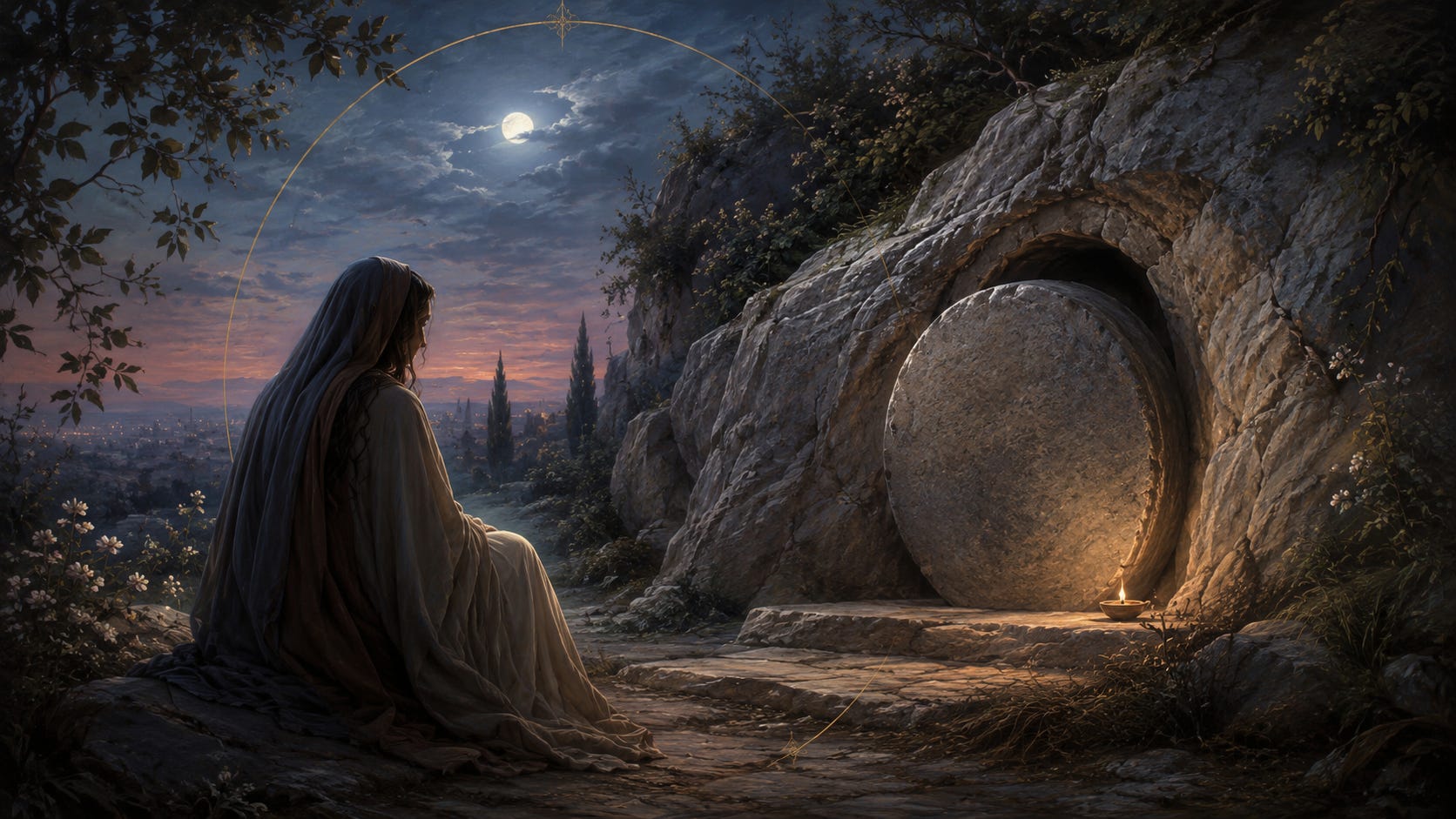
This reflection is inspired by Through Holy Week with Mary Magdalene, guided by the teachings of Cynthia Bourgeault. In this series, Holy Week is not treated as a courtroom drama about guilt and acquittal, but as an initiation into conscious love. Mary Magdalene is not a background character waiting for the men to understand what happened. She stands at the center of the mystery.
Holy Saturday is the quietest day in Christianity.
Good Friday gives us the cross, the cries from the crowd, the darkness, the torn curtain, and the body taken down from the wood. Easter morning gives us angels, an empty tomb, astonished disciples, and the impossible announcement that death has not won.
But Saturday gives us almost nothing.
The stone has been rolled into place. Jesus has disappeared into the silence of the earth. His followers have scattered. The movement appears to be over. There is no teaching, no miracle, and no public drama.
Only absence.
And sitting opposite the tomb is Mary Magdalene.
The Gospel does not tell us exactly how long she remained there. It leaves us only with the image of Mary Magdalene and the other Mary sitting across from the place where Jesus had been buried. But sitting carries a different feeling than passing through. It suggests waiting. It suggests that although everyone else has gone home, love has not yet found a reason to leave.
Jesus is descending into what the Christian tradition calls the heart of the earth, while Mary remains above, holding vigil beside the tomb.
What if these are not two unrelated actions?
What if Holy Saturday is held between them?
The Last Possible Place
When someone we love dies, we follow them as far as the body will allow.
We sit beside the hospital bed after the machines have been turned off. We remain in the funeral home when there is nothing left to say. We stand beside the grave after the prayers have ended and everyone else has begun walking back toward the cars.
The mind knows the person is gone, but the heart moves toward the last place where the beloved can still be located. It goes to the point of departure and waits there.
Mary has reached that point.
The body that carried the voice she knew, the eyes that recognized her, and the hands that blessed and healed has been placed behind a stone. Everything that gave their relationship its familiar shape has disappeared. She cannot speak to him. She cannot touch him. She cannot help him. She cannot even see the body.
Yet she remains.
This is not necessarily the dramatic grief so often projected onto Mary Magdalene. Something quieter and more powerful may be happening. She is not collapsing into helplessness. She is holding her place.
Jesus has left behind an extraordinary amount of unfinished human pain. His disciples abandoned him. The people who welcomed him into Jerusalem turned against him. His teaching was misunderstood, his movement was shattered, and his life ended beneath the accusation that everything he had attempted had failed.
Whatever was happening in the hidden depths, there was still an earthly burden to be carried.
Mary holds what has been left unresolved. She holds the betrayal, the humiliation, the abandoned mission, and the broken hearts of those who could not remain. She carries the pain of watching someone she loved give everything and appear to lose everything.
She cannot undo any of it.
She does not have to.
Her task is to witness that love is still present inside it.
The Fixed Foot of the Compass
John Donne offers one of the most beautiful images for this kind of love in his poem “A Valediction: Forbidding Mourning.” He compares two lovers to the two legs of a drawing compass.
One foot is planted at the center. The other travels outward, tracing the circumference of a circle. They appear to move separately, but they remain joined. The fixed foot is not rigid or indifferent. It leans toward the traveling foot as it moves and rises again as the traveler comes home.
“Thy firmness draws my circle just,” Donne writes.
The shape of the journey depends upon the steadiness of the center.
This is not codependency. The foot at the center does not prevent the other from moving. It does not shorten the journey, demand constant reassurance, or treat distance as abandonment. Its love allows movement while preserving unity.
This may be the image we need for Holy Saturday.
Jesus is the traveling foot, moving into the hidden depths, into the boundary region between death and life, presence and absence, history and eternity. Mary is the fixed foot, planted upon the earth, remaining beside the tomb.
She cannot travel his path for him. She does not attempt to drag him back into the form he has left behind. She remains rooted in the love they share, holding the earthly end of the connection while he enters the heart of the mystery.
The two realms remain joined through love.
The cosmic and the personal are not separated. The descent into the heart of the earth is connected to a woman sitting in grief beside a stone. The transformation of creation is tethered to the intimate faithfulness of one human heart.
This does not mean Mary somehow causes the resurrection, as though Jesus requires her emotional energy to escape the grave. It means resurrection is not portrayed as an isolated demonstration of spiritual power.
It emerges within relationship.
The Christ who returns on Easter morning does not first appear before a throne, a temple, or a council of religious authorities.
He comes to Mary.
The Tether That Does Not Break
We usually imagine love as something that happens through proximity. We know another person through their voice, face, touch, habits, and physical presence. When those things disappear, it seems obvious that the relationship must also be disappearing.
Holy Saturday asks whether love may be capable of another movement.
Perhaps the bond between two people can stretch beyond visible contact without breaking. Perhaps separation is not always a rupture. It may become what Donne called an expansion, love drawn “to airy thinness” but still joined at its source.
Anyone who has loved someone through illness, distance, estrangement, dementia, or death knows something about this stretching. The familiar forms of relationship fall away one after another. Conversation changes. Touch becomes impossible. Memory begins to fail. The person we love seems to be traveling into a country we cannot enter.
The temptation is either to cling desperately to the old form or to protect ourselves by declaring the relationship finished.
Conscious love does neither.
It remains present without grasping. It allows the beloved to travel while keeping the heart open. It becomes a tether rather than a leash.
A leash says, “You may go only as far as I permit.”
A tether of love says, “Go where you must. The connection between us is deeper than distance.”
Mary’s vigil becomes an icon of that faithfulness. She stays near the last place where Jesus can be found, not because she understands resurrection, but because love has not released her from presence.
She keeps the center.
The Hidden Work of Remaining
Our culture does not have much respect for waiting when waiting produces nothing visible.
We want action, closure, answers, and forward movement. We want the stone rolled away before the sun has even gone down on Friday. We want grief to complete its work on a schedule. We want loss to offer us a lesson that can be turned into something useful.
Holy Saturday refuses all of that.
Mary does not know she is waiting for a resurrection. From where she sits, there is no reason to expect one. She is not performing optimism. She is not using positive thinking to deny what happened.
Jesus is dead.
The tomb is sealed.
The future they imagined has ended.
Her faithfulness consists in remaining inside that reality without allowing it to destroy her capacity to love.
This is the hidden work of the vigil.
To stay without demanding an answer.
To grieve without turning grief into bitterness.
To face the apparent ending without pretending it is something else.
To allow love to remain alive when there is no longer anything it can possess.
This is not passivity. It is an intense form of spiritual labor. Most of us escape the tension of loss by reacting. We explain it, spiritualize it, numb it, bargain with it, or rush toward whatever comes next.
Mary sits.
She neither changes the conditions nor abandons them. She holds the contradiction that the one she loves is gone and that her love for him is still fully alive.
She keeps vigil at the place where those two truths meet.
Love Calls Us Home
What if this is one of the hidden movements inside the Easter story?
Jesus descends into the heart of the earth, into the depth where human sorrow, contradiction, violence, and death have their roots. Mary remains at the surface, holding the human story they shared. One moves into the depths. The other remains at the center.
Between them stretches a current of love.
The image cannot be proved, and it should not be hardened into another doctrine. It is a contemplative possibility, a way of seeing the story that restores relationship to the center of redemption.
Perhaps Mary is the fixed foot whose faithfulness holds the earthly realm while Christ traces the great circle through the boundary regions and returns on Easter morning.
Perhaps love calls us to the things of this world. Perhaps the one who travels into eternity is still drawn toward the unfinished work of mercy, healing, and reconciliation. Perhaps the risen Christ returns not because he has been dragged backward into physical existence, but because love completes its circle through service.
He returns to send Mary forward.
The fixed foot will soon move. The woman who sat beside the tomb will become the apostle who runs from it. Her faithfulness during the silence prepares her for the announcement that follows.
“I have seen the Lord.”
Holy Saturday teaches us that love is not inactive merely because nothing appears to be happening. Remaining can be a form of spiritual labor. Keeping vigil can hold together realities we do not yet understand. Sitting beside what seems irretrievably lost may be the place where a new beginning is already taking shape.
Mary does not know that Easter is coming.
She only knows where love has asked her to remain.
Perhaps that is enough.
Perhaps the circle is drawn by the one who travels, but it is made true by the one who keeps the center. Perhaps beneath every resurrection is a hidden vigil, and beneath every return is a love that remained present long after hope had fallen silent.
Keep the Scrolls Unrolling
The written publication is free for everyone to read.
Paid supporting members unlock the custom Virgin Monk Boy voiceover readings, the Virgin Monk Boy Book Of Hours, Whispers from the Silence, and private chat perks like starting threads and sharing their own Substacks.
Share the Scrolls
Passing a link forward is how more wandering souls stumble into the monastery. Word of mouth is the whole engine.
Tip with a coffee
A one time gift of holy caffeine that fuels both the monk and the Magdalene movement. ☕🔥

Your presence alone already helps.
Your support keeps the lantern lit for everyone else.
Holy Saturday is the most silent day, and perhaps the most important. The absence is not empty. It is a vigil. A holding of the space between what has ended and what has not yet begun. The love that remains when there is nothing left to hold is the love that makes resurrection possible.
What lingers with me is the image of the compass. The fixed foot at the center, the traveling foot moving through the mystery. Mary is the fixed foot. She does not travel his path, but she keeps the center. Her faithfulness is not passive. It is the tether that holds the earthly realm while Christ moves through the depths. She does not cause the resurrection. But she holds the space where it can occur.
The vigil is the hidden work. To stay without demanding an answer. To grieve without becoming bitter. To allow love to remain alive when there is nothing left to possess. That is the discipline. That is the practice.
Profound midrash (commentary)…thank you…