
Mary Magdalene and Aisha: The Women Who Knew the Messenger
Lived Witness, Memory, and the Shape of Faith

Every religious tradition has to answer two different questions. First: what was revealed? Second: what did the life of the messenger actually look like while carrying that revelation?
In Islam, that distinction is explicit. The Qur’an is the revelation. The Prophet Muhammad is its messenger. Alongside the text grows the Sunna, the remembered and transmitted pattern of how that revelation was lived. Christianity makes different theological claims, but it also rests not only on teachings, but on witnesses to events and to a life.
In both traditions, there are figures whose authority does not come from later office, rank, or theory. It comes from something more basic and harder to replace: proximity. They were not in the crowd. They were inside the circle.
Christianity has Mary Magdalene.
Islam has Aisha.
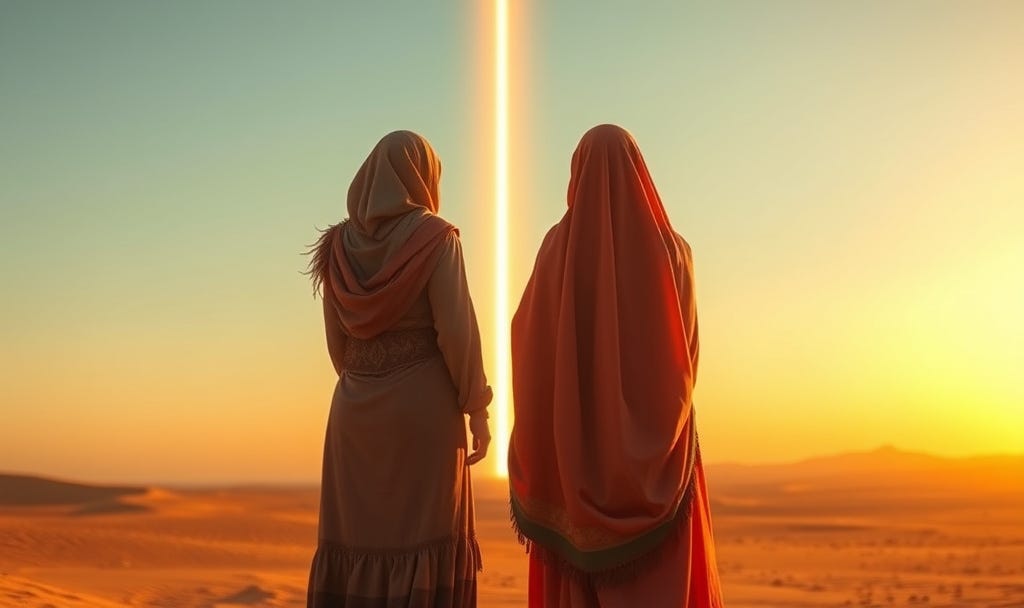
They are not the same kind of figure theologically. They do not play the same role in doctrine. But they occupy the same human position in the architecture of their traditions: they are women who knew the messenger not only in public, but in life.
They knew from the inside.
Mary Magdalene and the Authority of Seeing
Mary Magdalene stands in the Christian story as the first witness to the resurrection. Whatever one believes about what that event means, the texts are clear about this much: the first person to encounter it and to report it is her. Christianity begins, in narrative terms, with a woman who says, “I have seen.”
Aisha and the Authority of Living with the Prophet
Aisha’s role is different in shape but just as intimate in scope. She does not witness a single decisive moment. She witnesses a life.
She lives in the Prophet Muhammad’s household. She sees how he prays when no one is watching. How he behaves when he is ill. How he treats people when he is tired. How he argues, how he listens, how he changes his mind, how he handles ordinary domestic situations. She sees how the revelation is lived when it is not being proclaimed from a pulpit.
After the Prophet’s death, the Muslim community does not only ask, “What does the Qur’an say?” They also ask, “What did the Prophet do?”
And again and again, the answer is: Aisha knows.
Aisha as a Legal and Practical Authority
She is one of the most prolific narrators of hadith, transmitting over two thousand reports. But more important than the number is the type of knowledge she preserves.
She tells people how the Prophet prayed at night.
How he fasted.
How he bathed.
How he treated his wives.
How he behaved when he was sick.
What he did in situations that never appear in the Qur’an at all.
And she does not just transmit. She corrects.
There is a famous incident where some companions claim that a woman, a dog, or a donkey passing in front of a praying man breaks the prayer. Aisha responds sharply: she points out that she herself would be lying in front of the Prophet while he prayed, and he would continue without interruption. In other words: “Do not turn us into bad omens. I saw what actually happened.”
In another case, a legal ruling circulates about ritual purity and water. Aisha recounts an incident where she lost a necklace while traveling with the Prophet. The caravan stopped. There was no water. People were distressed. Then the verse permitting tayammum (dry ablution with clean earth) is revealed. This single domestic inconvenience becomes the source of a lasting legal mercy for the entire community. Aisha is not just remembering a story. She is preserving the circumstances under which law itself emerged.
And in countless reports, she transmits details that only someone inside the household could know. She describes how he slept. How he divided his time. How he prayed in the night until his feet were swollen. This is not public preaching material. This is domestic observation.
There is also the moment when someone claims the Prophet never stood to urinate. Aisha replies, in effect, “Don’t say things like that. I saw him do it.” Again and again, she prevents the tradition from becoming idealized at the cost of being truthful.
There is a recurring pattern in early Islamic literature: a legal or practical opinion is offered, and then someone says, “But Aisha said the Prophet did otherwise.” And the matter shifts.
This is not mysticism. This is not theology. This is eyewitness authority.
She is not a source of revelation. She is a source of how revelation was embodied.
“His Character Was the Qur’an”
One famous report illustrates this perfectly. When someone asks Aisha what the Prophet’s character was like, she replies, “His character was the Qur’an.” Which is another way of saying: “If you want to know what this book looks like when it walks around, I watched it.”
That is the kind of knowledge only proximity can produce.
The Same Human Role in Two Traditions
This is the same human kind of authority Mary Magdalene represents in Christianity.
Not the authority of doctrine.
Not the authority of office.
But the authority of having seen.
In both cases, these women do not give later generations a theory. They give them access.
Access to tone.
Access to gesture.
Access to the way a sacred life actually looks when it is being lived and not just preached.
They are not interchangeable figures. They belong to different theologies and different histories. But they perform the same indispensable function:
They anchor the tradition in first-order witness.
They prevent the faith from becoming something that exists only in texts and arguments.
They remind later generations that the message was not only spoken. It was inhabited.
Why Proximity Matters
This kind of authority is quiet, but it is structural. You cannot reconstruct it later. You either have it, or you don’t.
Aisha’s presence inside the Islamic tradition ensures that the Prophet’s life is not remembered only in public gestures and formal moments. It is remembered in human ones.
Mary Magdalene’s presence in the Christian story ensures that the resurrection is not first encountered as a doctrine, but as a recognition by someone who says, simply, “I have seen.”
Different traditions. Different claims. Same human role.
They are the ones who knew from the inside.
And every tradition depends on someone like that, whether it admits it or not.
Keep the Scrolls Unrolling
The Virgin Monk Boy Scrolls is a free publication.
If these words steady you, challenge you, make you laugh, or help you breathe deeper, here are three simple ways to support the work.
Share the Scrolls
Passing a link forward is how more wandering souls stumble into the monastery. Word of mouth is the whole engine.
Become a Supporting Member
Paid members unlock the Virgin Monk Boy Book Of Hours, Whispers from the Silence, and the ability to start threads and share their own Substacks in the private chat.
Tip with a coffee
A one time gift of holy caffeine that fuels both the monk and the Magdalene movement. ☕🔥

Your presence alone already helps.
Your support keeps the lantern lit for everyone else.
I believe that this crucial point you make is what people so frequently miss: "They remind later generations that the message was not only spoken. It was inhabited." We are meant to INHABIT the teachings of these sacred messengers. If we don't try to habituate their teachings, then we have missed the whole point.
Thank you for teaching us more about Islam.☪️ I haven’t learned enough about it before.