
Magdalene and Fana: The Woman Who Stayed Until There Was No Self Left
What happens when love burns through identity and leaves only recognition

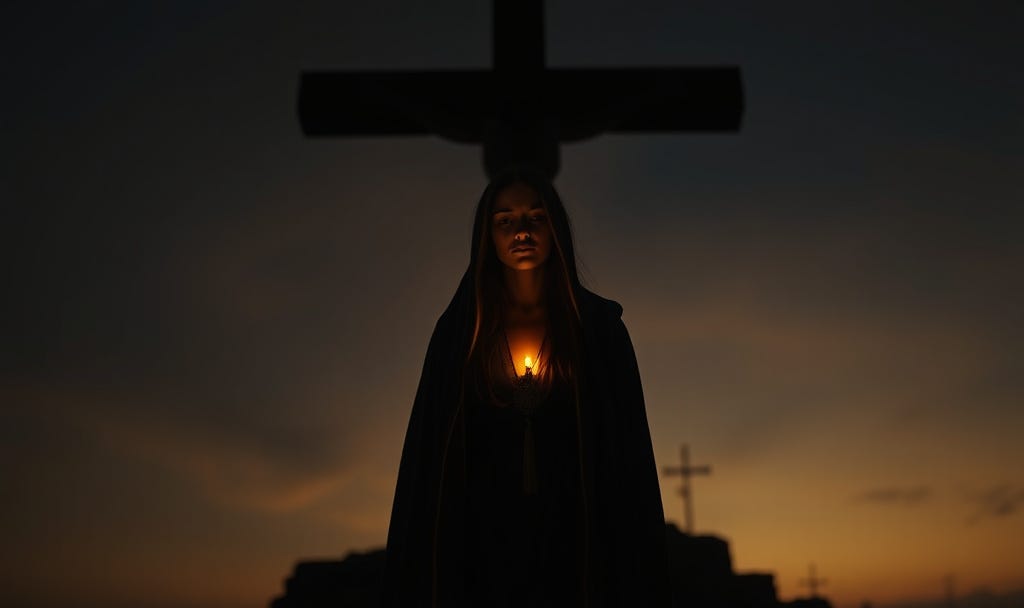
This reflection is inspired by the metaphysical stream flowing through René Guénon, deepened by Frithjof Schuon, and embodied in the writings of Martin Lings. Within that lineage, religion is not primarily about belief or moral structure, but about realization — the stripping away of illusion until only the Real remains. Through that lens, Mary Magdalene is not merely a devoted follower at the edge of the story, but a figure who stands at the threshold where the self dissolves and recognition begins.
The One Who Didn’t Leave
Everyone else had a reason.
Fear. Confusion. Survival.
Peter had theology to protect.
The others had futures to consider.
Mary Magdalene had none of that left.
She stayed.
Not because she was brave.
Not because she understood.
She stayed because something in her had already died.
Fana: The Disappearance of the Self
In Sufi language, there is a word for this:
fana
The annihilation of the self in the presence of the Divine.
Not moral improvement.
Not becoming a better version of yourself.
The end of the one who needs to survive.
The Sufis say:
“Die before you die.”
Mary Magdalene did not wait for the tomb to learn this.
She entered it at the cross.
Love That Refuses to Collapse
Most people think love fails when it loses its object.
The beloved dies.
The relationship ends.
The presence disappears.
So the mind says:
“Withdraw. Protect. Survive.”
But Magdalene doesn’t do that.
She doesn’t numb the love.
She doesn’t redirect it.
She doesn’t turn it into memory.
She lets it burn.
This is the same movement described in the mystical tradition of The Cloud of Unknowing, where the seeker is told to “hang up” their longing in the unknown rather than resolve it through thought or emotion.
She hangs her love in the dark.
No answers.
No closure.
No guarantee it means anything.
Just fire.
And that fire does something terrifying.
It begins to consume the one who is loving.
The Alchemy of Love
What you shared from the transcript hits this directly:
Love has a trajectory.
It begins as desire… and transforms itself.
Not by suppressing desire.
But by passing through it completely.
The tradition says:
Eros becomes agape
Not by removal
But by transfiguration
The Sufis would say:
The lover disappears
Only the Beloved remains
Same movement. Different language.
Magdalene at the Cross: Fana in Real Time
Look at the scene again.
She is not:
trying to understand
trying to fix
trying to preserve identity
She is standing in the collapse of everything that made her “herself.”
No teacher
No future
No role
No certainty
And she does not step back.
This is fana.
Not in a cave.
Not in meditation.
In public.
In grief.
In full exposure.
Why She Recognizes Him
Now the resurrection scene makes sense.
Everyone else is confused.
They debate.
They analyze.
They question.
Mary sees.
Why?
Because there is no longer a “self” in her filtering reality.
The one who needed proof is gone.
The one who needed certainty is gone.
What remains is pure recognition.
In Sufi terms:
When the self is annihilated
Only the Real can be seen
Or more bluntly:
You don’t recognize the Divine
until there’s no one left to misinterpret it
The Church Missed This
The institutional version of Christianity leaned hard into:
sin
debt
repayment
fear
But the mystics kept whispering something else:
This is about love completing itself
Even in the text you shared, Magdalene becomes the signal:
When she is present
everything softens toward love
When she is absent
everything hardens toward judgment
That’s not an accident.
That’s a diagnostic.
The Dangerous Truth
Here’s where this stops being theology and starts becoming practice:
Most people don’t want resurrection.
They want relief.
They want the pain to stop
without the self dissolving
But the path Magdalene walked doesn’t offer that deal.
Love will take everything.
Identity
Certainty
Control
Narrative
And it will not apologize.
The Woman Who Stayed
Magdalene is not just the one who loved.
She is the one who did not interrupt the trajectory of love.
She did not:
retreat into memory
collapse into despair
rebuild a safer version of herself
She let love finish what it started.
And what it started was the end of her.
And What Remains?
Not emptiness.
Not loss.
Something far more unsettling:
A presence that no longer belongs to a separate self.
The Sufis call it baqa
Abiding in God after annihilation
The Gospel of Mary hints at it
The resurrection reveals it
Magdalene doesn’t “recover.”
She continues.
But now…
There is no longer a “her” in the way we think.
Final Word
Peter built a church.
Mary recognized God while everyone else was still explaining what happened.
One preserved the structure.
The other passed through the fire.
Blessed are those who do not rush to understand.
Blessed are those who let love take them past themselves.
Blessed are those who stay.
Keep the Scrolls Unrolling
The Virgin Monk Boy Scrolls is a free publication.
If these words steady you, challenge you, make you laugh, or help you breathe deeper, here are three simple ways to support the work.
Share the Scrolls
Passing a link forward is how more wandering souls stumble into the monastery. Word of mouth is the whole engine.
Become a Supporting Member
Paid members unlock the Virgin Monk Boy Book Of Hours, Whispers from the Silence, and the ability to start threads and share their own Substacks in the private chat.
Tip with a coffee
A one time gift of holy caffeine that fuels both the monk and the Magdalene movement. ☕🔥

Your presence alone already helps.
Your support keeps the lantern lit for everyone else.
This is a potent read. I appreciate it as inviting, instructive, and also poetic... Thank you for testifying to the simple and profound power of Mary's response...
Your Substack is transformational. Thank you. Thank you.