

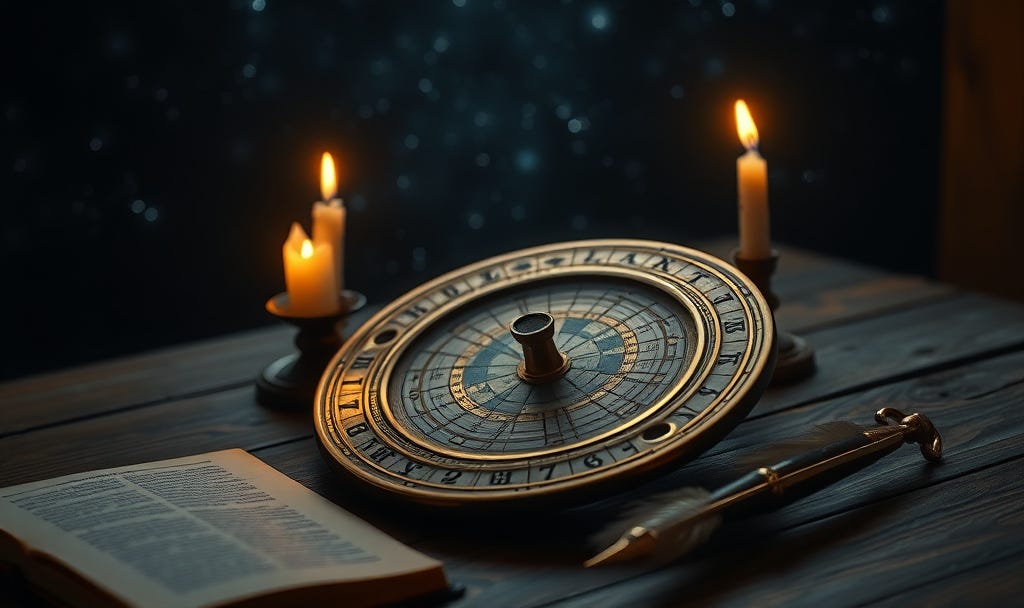
The Instrument That Reads the Hidden Sky
In the story of the king and the handmaiden, Rumi gives us one of those lines that should not be rushed past just because it sounds beautiful.
Love is the astrolabe of the mysteries of God.
That is not greeting-card love. That is not “love and light” typed by someone who will block you the moment you become inconvenient. That is not sentimental foam poured over the spiritual life so nobody has to taste anything bitter. Rumi is saying love is an instrument of perception. It shows us what the ordinary mind cannot measure.
An astrolabe was used to read the heavens. It was not the heavens. It did not control the stars. It did not manufacture the sky. It helped the one holding it orient himself under a vastness he did not create.
That is what love does.
It does not make us masters of the mystery. It teaches us how lost we were before the mystery touched us.
This is why Rumi refuses to reduce love to an emotion. Emotion rises and falls. It changes with sleep, hunger, weather, hormones, memory, disappointment, and whether someone replied to the text with enough punctuation to calm the nervous system. Emotion is real, but it is not stable enough to carry the whole weight of love.
Love, for Rumi, is stranger than that.
Love is not merely what we feel. Love is what reveals.
The Intellect Gets Its Sandals Stuck
Right after calling love the astrolabe of the mysteries of God, Rumi starts backing away from his own explanation. He says that whatever he says in exposition of love, when he comes to love itself, he is ashamed. The tongue may explain, but silent love is clearer. When the pen tries to write about love, it splits. The intellect, trying to explain love, lies down like a donkey stuck in mud.
That is Rumi being both mystical and funny, which is usually when he is most dangerous.
He does not say the intellect is evil. He says it has limits. The intellect can point, arrange, compare, clarify, and keep us from confusing every emotional thunderstorm with revelation. God bless the intellect. Somebody has to read the contract before the guru asks everyone to sign over their inheritance in the name of surrender.
But when intellect tries to become the sovereign over love, it gets stuck.
Because love is not an object sitting on the table waiting to be defined. Love is the fire that changes the one trying to define it. You do not stand outside love with a clipboard and say, “I have completed my assessment of the Beloved.” The moment love is real, the observer is implicated. The one doing the explaining begins to burn.
This is why the pen splits.
This is why the donkey sits down in the mud and refuses to continue the PowerPoint.
Love cannot be fully explained by the part of us that wants to remain untouched.
Emotion Is Weather. Love Is Climate.
Part of the confusion comes from the way we use the word love for almost everything. We say we love God, our spouse, our children, pizza, a show, a song, a dog, a dead saint, a jacket on sale, and the exact coffee that makes life briefly tolerable. The word is exhausted by overwork. It needs a retreat and possibly foot care.
But Rumi is not talking about preference. He is not talking about attraction. He is not even talking only about affection.
He is talking about a force that dislocates the false self.
Emotion is weather. Love is climate.
Emotion can be bright one day and storming the next. Emotion is not fake, but it is changeable. Anyone who has tried to pray while tired, hungry, or spiritually annoyed knows this. One day the heart opens like a rose. The next day the same prayer feels like chewing cardboard in a waiting room.
If love were only emotion, the path would be hopeless. We would spend our whole life chasing moods, confusing intensity with truth, and assuming the Beloved has vanished every time the inner weather gets cloudy.
Love is deeper than mood. It can be tender, but it is not always soft. It can bring joy, but it is not entertainment. It can feel like sweetness, but sometimes it feels like being stripped of every false thing we thought would save us.
This is why love is an astrolabe, not a scented candle.
It helps orient the soul when the sky is too large for the mind.
The Fake Love Problem
Once you understand love as a revealing force, a lot of fake love starts looking ridiculous.
Possession calls itself love. Need calls itself love. Control calls itself love. Spiritual bypassing calls itself love. A person who cannot tolerate your actual humanity says, “I love your soul,” which usually means they love the version of you that does not inconvenience their fantasy.
The king in Rumi’s story says the handmaiden is the life of his life. He thinks she is his cure. But the physician of the heart sees something deeper. The sickness is not what everyone thinks it is. The obvious love story is not the real diagnosis.
This is painfully current.
People say “love” when they mean attachment. They say “love” when they mean hunger. They say “love” when they mean control. They say “love” when they mean, “Please become the missing parent, the missing God, the missing mirror, the missing medicine, and do it without complaining.”
That is not love. That is making another person serve a divine sentence for a crime they did not commit.
Virgin Monk Boy lights one candle and says: beloved, if your love requires another human being to become God, someone is going to end up crucified and it will not be as poetic as you think.
Rumi does not let us confuse obsession with love just because the obsession has tears in its eyes.
Love reveals God. False love reveals the wound we are trying to avoid.
Both revelations can be useful, but only one should be trusted with the steering wheel.
Love Shows Us What We Worship
If love is an astrolabe, then it does not only show us God. It also shows us our idols.
This is the part nobody wants embroidered on the pillow.
Love reveals what we are actually oriented toward. Not what we claim to believe. Not what we post. Not what we say during the spiritual discussion when everyone is using their soft voice and pretending not to judge the snacks. Love shows what has gravitational pull over the soul.
Follow the ache and you will often find the altar.
Some people worship being wanted. Some worship certainty. Some worship being morally spotless. Some worship the group. Some worship the teacher. Some worship their wound. Some worship success, or intelligence, or being seen as deep, or being the only one in the room who “gets it.”
The language may be religious, therapeutic, activist, mystical, or academic, but the altar gives itself away by what we cannot bear to lose.
Love exposes this. Real love does not simply comfort us. It reorders us. It says, “You are turned toward the wrong star.” It says, “This thing may be beautiful, but it is not the source.” It says, “You have made a god out of something too small to hold you.”
This is why love hurts before it heals.
Not because love is cruel, but because we are so often attached to what is killing us gently.
The Heart Knows Before the System Does
The intellect likes systems because systems give it something to hold. This is not bad. A good system can protect us from chaos. A tradition can carry wisdom across generations. Theology can guard the sacred from being reduced to whatever mood wandered through the room.
But love often arrives before the system knows what to do with it.
Love unsettles the categories. It reveals that the person we dismissed may be carrying light. It reveals that the doctrine we used as a weapon may have been hiding our fear. It reveals that the enemy we needed may have been a mirror we could not stand.
This is why religious people often fear love while praising it.
Love is too alive. It does not always ask permission from the committee. It does not fit neatly inside the management structure. It refuses to remain sentimental. It keeps walking into the room and pointing to the person everyone agreed not to see.
When love becomes real, the heart may know something before the system can explain it.
That does not mean every feeling is revelation. The heart can be confused. The ego owns many costumes and several of them are embroidered with “discernment.” But there is a knowing that comes through love which is not the same as emotional impulse. It is quieter, deeper, less frantic, and less interested in applause.
It does not need to win the argument.
It simply will not lie.
Why Explanation Fails
Rumi’s embarrassment before love is not anti-intellectual laziness. It is humility in front of a reality larger than language.
There are things that explanation can approach but not possess. Grief is like this. Prayer is like this. Beauty is like this. Death is like this. The face of someone you love after years of struggle is like this. You can say true things about them, but something escapes the net.
Love escapes the net.
That does not mean we should stop speaking. Rumi clearly did not stop speaking. The man produced a mountain range of words, then kept telling us words were not enough. That is not contradiction. That is honesty.
Language can become a doorway. It cannot become the Beloved.
This is where bad spirituality goes wrong in two opposite directions. One side tries to explain everything until nothing breathes. It pins the butterfly to the board and calls it understanding. The other side refuses all explanation and calls confusion “mystery,” which is very convenient when someone asks where the money went.
Rumi chooses a third way. Speak, but know speech is not the thing. Explain, but do not worship the explanation. Use the astrolabe, but do not mistake the instrument for the sky.
The point is not to humiliate the intellect. The point is to keep the intellect from becoming Pharaoh in a scholar’s robe.
Love Is Not Nice
There is also a terrible mistake in thinking that divine love is merely niceness.
Niceness wants everything smooth. Love wants everything true.
Niceness avoids the wound because it does not want awkwardness. Love enters the wound because truth is hiding there. Niceness smiles while the room rots. Love opens the window, points to the smell, and risks being called negative by people who have built their whole identity around air freshener.
Rumi’s love is not sentimental. It is medicinal, but not always gentle. It burns pride. It exposes vanity. It empties the hand. It ruins the little empire of self-importance. It can make a person look foolish, tender, alive, undone, and finally less available for the usual nonsense.
That is why people prefer emotional excitement to love.
Excitement gives us a high without requiring surrender. It makes the personality feel vivid. Love makes the personality less central. Excitement says, “Look what I am feeling.” Love says, “Look what is being revealed.”
That difference is everything.
A person can be intoxicated with spiritual emotion and still remain selfish. A person can weep in worship and still be cruel at lunch. A person can talk about divine love while treating actual humans like poorly designed furniture in the temple of their own importance.
Love is not proven by intensity.
Love is proven by what it makes possible in the soul.
The Astrolabe Does Not Control the Stars
An astrolabe helps the traveler read the heavens, but it does not command the heavens. This matters because spiritual people love to turn sacred things into techniques of control.
We want love to guarantee outcomes. If I love purely enough, this person will change. If I love God deeply enough, my life will become legible. If I love the path sincerely enough, I will not have to pass through confusion, grief, boredom, or the humiliating discovery that I am still petty before breakfast.
But love is not control.
Love does not make us managers of the mystery. It makes us available to it.
This is why love can feel like losing before it feels like finding. It takes away the illusion that we can stand outside life and negotiate with God like a consultant. It teaches us to orient, not dominate. To receive, not possess. To be moved, not merely informed.
The astrolabe gives direction under the stars. It does not reduce the night sky to a spreadsheet.
Love helps the soul turn toward God, but it does not make God into an object we can own. The Beloved remains free. This is unbearable to the ego, which prefers a god it can schedule.
The Mystery Changes the Knower
Here is the real reason Rumi cannot reduce love to emotion: love changes the one who knows.
An emotion can pass through and leave the basic self-structure intact. Love does not always do that. Love gets into the architecture. It rearranges the room. It changes what we can tolerate, what we hunger for, what we regret, what we notice, what we can no longer pretend not to know.
This is why real love often feels like both wound and cure.
It wounds the false self. It cures the deeper self.
It wounds pride. It cures isolation.
It wounds control. It cures numbness.
It wounds the fantasy of separateness. It cures the lie that we belong only to ourselves.
No wonder the intellect struggles. The intellect likes to know things without being altered by them. Love does not allow that luxury. Love is not a concept the mind holds. It is a fire that holds the mind until the mind stops pretending to be the whole house.
When Rumi says the intellect gets stuck, he is not insulting thought. He is describing the moment thought reaches the edge of its jurisdiction.
Beyond that edge, the heart has to learn another kind of knowing.
The Silence That Explains More
Rumi says silent love is clearer than the commentary of the tongue.
That line is easy to misunderstand. It does not mean silence is always wisdom. Some silence is cowardice. Some silence is manipulation. Some silence is what happens when power does not want witnesses. We do not need to spiritualize every closed mouth.
But there is a silence that carries more truth than speech because it is not trying to control the meaning.
Anyone who has sat with grief knows this. Anyone who has prayed past words knows this. Anyone who has loved someone at the edge of death knows this. There are moments when explanation becomes rude. Not false, just too small. The mouth keeps reaching for sentences and the heart says, “Not now. Take off your shoes.”
That is the silence Rumi means.
Not emptiness as absence, but silence as reverence. Silence as the room where the mystery is allowed to be more than our interpretation of it.
The tongue can explain love from the outside.
Silent love knows from within.
Let Love Read the Sky
So maybe the question is not, “What is love?” as if we are trying to define it correctly enough to pass the exam.
Maybe the question is, “What does love reveal when it is allowed to read the sky of the soul?”
Does it reveal God, or only our hunger to be admired?
Does it reveal the Beloved, or the old wound looking for a new costume?
Does it make us more truthful, more tender, more awake, more willing to be stripped of illusion?
Or does it simply make us dramatic?
Rumi is not interested in love as decoration. He is not giving us a nicer word for emotional weather. He is pointing to love as an instrument of unveiling, a sacred astrolabe held up beneath the night of existence. Through love, the soul begins to read what the intellect alone cannot decipher.
The mind can help. The mind can serve. The mind can keep us from walking into every ditch with a halo painted over it.
But the mind cannot replace the fire.
Love is the astrolabe of the mysteries of God because love reveals the direction of home. It shows us what we worship, what we fear, what we have mistaken for God, and where the light keeps calling from beyond the visible.
The intellect may get stuck in the mud.
The pen may split.
The tongue may fall silent.
But somewhere beyond the explanation, the heart begins to understand.
Keep the Scrolls Unrolling
The Virgin Monk Boy Scrolls is a free publication.
If these words steady you, challenge you, make you laugh, or help you breathe deeper, here are three simple ways to support the work.
Share the Scrolls
Passing a link forward is how more wandering souls stumble into the monastery. Word of mouth is the whole engine.
Become a Supporting Member
Paid members unlock the Virgin Monk Boy Book Of Hours, Whispers from the Silence, and the ability to start threads and share their own Substacks in the private chat.
Tip with a coffee
A one time gift of holy caffeine that fuels both the monk and the Magdalene movement. ☕🔥

Your presence alone already helps.
Your support keeps the lantern lit for everyone else.
Follow (or troll) Virgin Monk Boy
Recommended Reading
(As an Amazon Associate, I earn from qualifying purchases. These recommendations support the scrolls at no extra cost to you.)
The Rumi Collection: An Anthology of Translations of Mevlana Jalaluddin Rumi
I was never identified with Christianity, much. That's really an understatement, but folks like William Blake and Thomas Merton and ... a very few others soften my position. Oh, yes, Gandhi and Kalil Gibran.
I became a Buddhist for a while, but I woke up from that. I didn't leave it. I swallowed it enough to metabolize it a bit. One never fully metabolizes it. Haha.
I'm a nature mystic, with or without the capital N. If being itself is not "the divine" then nothing is.
Anyway, I like this little essay. It speaks to the true heart of the matter well.
Peace.
Oh, VMB! You keep doing this. THIS THIS is so perfectly timed, synchronistic, for me in this moment! I have so much I want to say, but for now, I want to tell you again how much you function as a spirit guide for me, an Anam Cara. I KNEW when I first “tripped over you” in service of Mary Magdalene, that the Divine Universe connected us. As much as I want to stay here with you for awhile, my Soulmate and constant companion , Jessie Mae, canine spirit dressed up as an English Springer Spaniel needs my attention and presence: she has been assigned to keep me grounded! And, I’m proving a challenge for her! She loves unconditionally and so has honed her ability to be patient as a gift from God to me!!! Am I well-blessed or what? Namaste ❤️🙏