

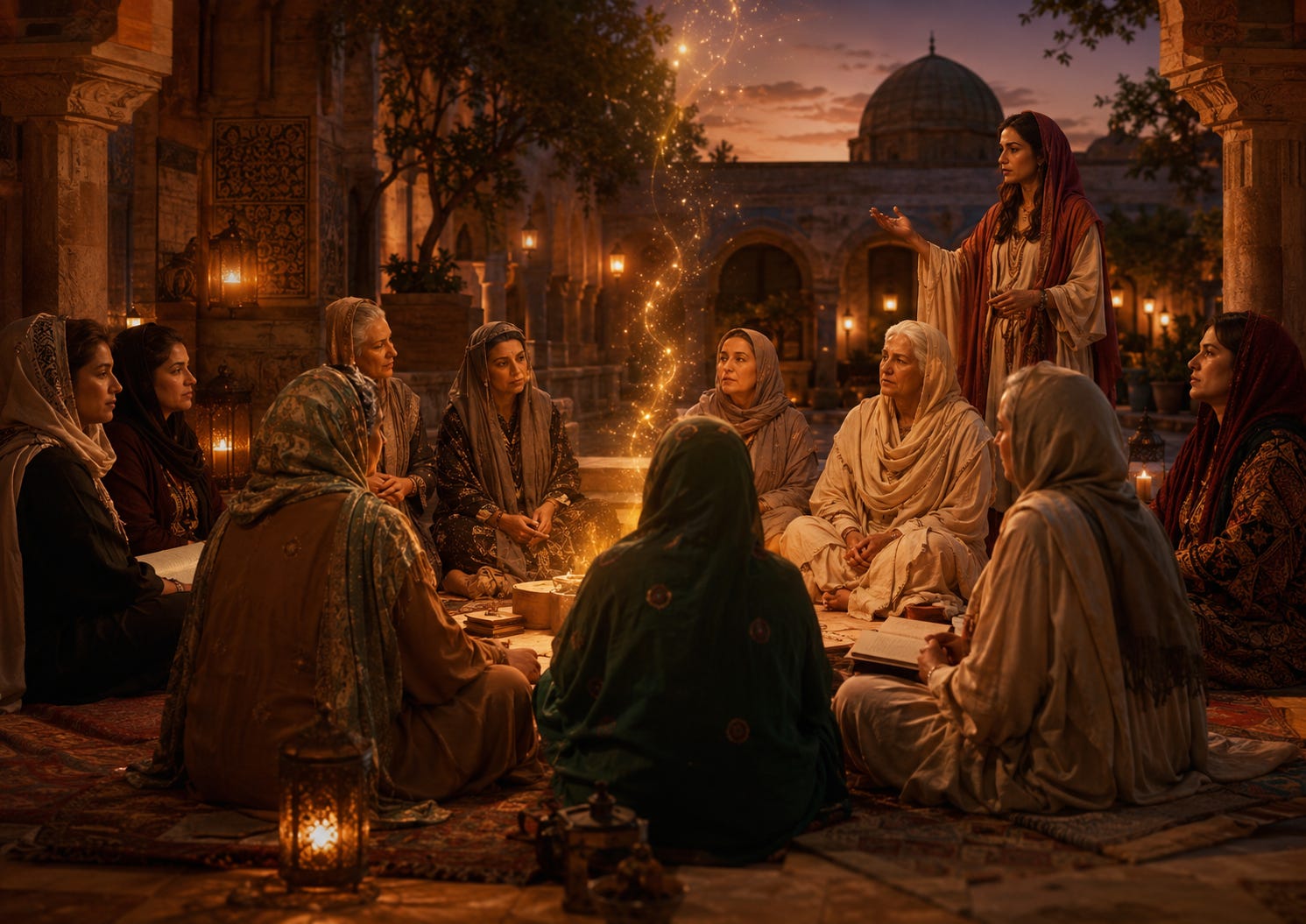
The Cartoon Version of Islam
One of the laziest modern takes about Islam is that it is simply a “bro religion,” as if the entire tradition is just men with beards, rules, and unresolved control issues.
And look, have Muslim societies had patriarchy? Obviously. Welcome to human history. Christianity, Judaism, Hinduism, Buddhism, and secular modernity are not exactly innocent little doves floating above the gender problem. Patriarchy has been the background music of civilization for most of recorded history.
But the idea that Islam has no room for women as spiritual authorities is not just wrong.
It is historically embarrassing.
Visibility Is Not the Same as Absence
If we compare public books, classes, retreats, and teaching pages, female Christian contemplatives are easier to find in the English-speaking world. You can probably identify 60 to 100 contemporary female Christian contemplative teachers without much effort.
Female Sufi teachers are also clearly present, with at least 45 to 60 publicly identifiable contemporary examples, and over 220 named historical Sufi women from just two published sources.
That alone should end the cartoon.
The difference is not that Christianity has women mystics and Islam does not. The difference is visibility. Christian contemplative publishing is more visible in English. It has retreat centers, university platforms, mainstream publishers, podcasts, monastery bookstores, and a whole “spiritual but not too churchy” marketplace.
Women’s Sufi authority, by contrast, often lives in local circles, oral transmission, women’s gatherings, family lineages, non-Western communities, and tariqas that do not feel obligated to market themselves to Western seekers with a landing page and a downloadable PDF called Five Ways to Awaken Your Inner Rose Priestess.
And that is where the comparison gets interesting.
A Living River, Not a Spiritual Smoothie
Many contemporary female Sufi teachers are not cobbling together a personal brand from Jung, yoga, Celtic mist, trauma language, divine feminine branding, and a few Rumi quotes with Islam surgically removed.
They are rooted in living traditions.
They are connected to actual lineages. Tariqas. Teachers. Transmission. Dhikr. Prayer. Fasting. Adab. Qur’an. The Prophet Muhammad. Centuries of saints, poets, scholars, realized mystics, and spiritual discipline.
That does not mean every Sufi community is perfect. Please. Humans can turn even a path of divine love into a committee meeting with worse snacks.
But the tradition itself is not some floating aesthetic. It is embodied. It is practiced. It has daily rhythm. It has memory. It has lineage.
A Sufi path is not just “follow your bliss” with better incense. It is remembrance. It is surrender. It is purification of the heart. It is learning how to see through the false self before the false self turns your spiritual life into another personality disorder with candles.
Women Were in the Stream From the Beginning
Women have been part of that stream from the beginning.
Early Sufi literature preserves the names and teachings of women saints, ascetics, scholars, poets, and guides. South Asian Sufi history gives us a long record of women recognized for spiritual authority. In the contemporary world, women serve as teachers, murshidas, retreat leaders, scholars, translators, community guides, and lineage holders.
So when someone says Islam is just a “bro religion,” what they usually mean is: “I have consumed a lot of anti-Muslim content and almost no Islamic spirituality.”
Because if your picture of Islam has room for every angry male preacher on YouTube but no room for Rabia al-Basri, no room for women Sufi guides, no room for women’s dhikr circles, no room for the mothers, saints, poets, and teachers who carried the tradition in kitchens, homes, shrines, schools, and intimate circles of practice, then you are not describing Islam.
You are describing your algorithm.
Mary Magdalene and the Path of the Real
This is also where Mary Magdalene enters the conversation. She is not being dragged in as a historical Sufi, because obviously Islam comes later and we do not need to insult everyone’s timeline to make a mystical point. The point is that Mary embodies the same wisdom function we later recognize in the great Sufi masters: the one who has seen, the one who knows, and the one who points the frightened back toward the Real.
In the Gospel of Mary tradition, the male disciples are afraid, confused, and spiritually wobbling after the loss of Jesus. Mary becomes the one who steadies them. She points them back toward the Good. And the Good is not Hallmark morality. It is not polite church behavior with better posture. The Good is Ultimate Reality. God. The Real.
Mary Magdalene does not show up with institutional permission. She does not wait for Peter to validate her experience, stamp her mystical passport, or ask whether her revelation has been approved by the Committee for Nervous Men Protecting the Brand. She has seen. She knows. She speaks from direct recognition.
That is exactly what the great Sufi masters do. They do not merely explain doctrines. They point past fear, past ego, past religious performance, and back toward What Is Real. They remind the seeker that God is not an idea to defend but a Reality to remember.
In that sense, Mary Magdalene is not just “included” in the story. She is a guide. She is a witness. She is the one pointing bewildered disciples back toward the Good while the men in the room are busy mistaking panic for discernment.
Very on brand for men in religious history, by the way.
The Christian Contemplative Problem
The Christian contemplative world has wonderful women teachers. No question. There are Benedictines, Franciscans, Episcopal priests, spiritual directors, theologians, mystics, and writers who have given real gifts to the world.
But let’s be honest about that landscape too.
A lot of Christian female contemplative authority comes either through celibate monasticism or through modern interspiritual synthesis. The nun may be holy, disciplined, and profound, but her path is renunciation. That does not always translate cleanly into a full-bodied practice for women living inside marriage, sexuality, motherhood, work, aging, grief, money, activism, and family life.
And the modern retreat marketplace often fills the gap with a spiritual smoothie: a little Teresa of Ávila, a little Mary Magdalene, a little Jung, a little yoga, a little Celtic moonlight, a little trauma-informed language, stir gently, charge $497.
Again, not all of it is useless.
But it is different.
Sufism Gives Women a Path Inside Life
The Sufi women I am talking about are often standing in a living river.
The river has banks. It has a source. It has practices that reshape the body, speech, heart, and attention. It remembers the Prophet. It remembers the Qur’an. It remembers the saints. It remembers that love is not just a mood.
Love is discipline.
Love is surrender.
Love is remembrance until the false self gets tired of pretending it runs the place.
That is not bro spirituality.
That is a complete path.
And it is a path women have carried, embodied, taught, and transmitted.
The Real Question
So no, Islam is not merely a religion of men talking over women.
It has certainly been used that way, because men can turn almost anything into a podium. Give a man a sacred text and half the time he will use it to explain why God conveniently agrees with his management style.
But beneath the noise is a deep, ancient, embodied mystical tradition where women have prayed, taught, guided, transmitted, written, sung, healed, remembered, and realized.
The real question is not whether Islam has women mystics.
The real question is why so many Westerners were never told to look for them.
Sufi / mystical Islam books by women
Disclosure: As an Amazon Associate, I earn from qualifying purchases. Some links below may be affiliate links, which means I may earn a small commission at no extra cost to you.
Women of Sufism: A Hidden Treasure by Camille Adams Helminski
Probably the first one I’d recommend for your exact argument. It collects poetry, teachings, and stories from Sufi women throughout history, making it useful for dismantling the idea that Islam has no women mystics.
The Principles of Sufism by ʿĀʾishah al-Bāʿūniyyah
This is huge because it is not just a modern book about women in Sufism. It is a classical Sufi text written by a major woman scholar from Damascus. Amazon’s listing describes it around repentance, sincerity, remembrance, and love.
Daughter of Fire: A Diary of a Spiritual Training with a Sufi Master by Irina Tweedie
A raw diary of spiritual training, ego dissolution, surrender, and transformation under a Sufi master. Useful if you want to show Sufism as an embodied path, not just “nice Rumi quotes.”
A Journey Through Ten Thousand Veils by Sheikha Maryam Kabeer Faye
A memoir of spiritual transformation from a Jewish upbringing into Islam and Sufi realization. This one is especially good for showing Islam as a living path of return, not a rigid ideology.
Divine Names: The 99 Healing Names of the One Love by Rosina-Fawzia al-Rawi
This is a beautiful one for embodied mystical practice around the Divine Names. Al-Rawi has a PhD in Islamic studies and has taught Sufism for over 20 years.
Secrets of Divine Love: A Spiritual Journey into the Heart of Islam by A. Helwa
Very accessible, modern, devotional, and love-centered. Good for readers who are new to Islam and need an entry point that does not feel academic.
The Light of Dawn: Daily Readings from the Holy Qur’an by Camille Adams Helminski
A Qur’an-centered devotional companion. Amazon’s listing says Helminski presents a journey through the Qur’an and its spiritual meaning.
Rumi: Daylight: A Daybook of Spiritual Guidance by Camille Adams Helminski
Good for people who like Rumi but need a version connected to spiritual guidance rather than stripped-down Hallmark mysticism.
Jewels of Remembrance by Camille Helminski
Another Rumi-centered daybook. Amazon’s listing notes Helminski’s work with Qur’an and Sufi literature, including The Light of Dawn.
Mystical Dimensions of Islam by Annemarie Schimmel
More scholarly than devotional, but still essential. It is one of the classic introductions to Sufism as Islamic mysticism.
Keep the Scrolls Unrolling
The Virgin Monk Boy Scrolls is a free publication.
If these words steady you, challenge you, make you laugh, or help you breathe deeper, here are three simple ways to support the work.
Share the Scrolls
Passing a link forward is how more wandering souls stumble into the monastery. Word of mouth is the whole engine.
Become a Supporting Member
Paid members unlock the Virgin Monk Boy Book Of Hours, Whispers from the Silence, and the ability to start threads and share their own Substacks in the private chat.
Tip with a coffee
A one time gift of holy caffeine that fuels both the monk and the Magdalene movement. ☕🔥

Your presence alone already helps.
Your support keeps the lantern lit for everyone else.
This is great! I've recently come to appreciate the many spiritual contributions of Mary Magdelene (The Great One) during her presence 2000 years ago. It was Pope Gregory the Great in 591 AD who decided to "recast" her as a "prostitute." Imagine that, more than 500 years after her presence. In 1969 the Vatican quietly RETRACTED that false claim. Most Christians today still see her in that formerly made up lowly regard. Oh the Christian Patriarchy??? Whatever lies may have suited them are Back to Bite them in the Asspirations!
Heartfelt thanks, wise Brother, for giving some light to the women seekers, of all faiths. And it’s true that Westerners know hardly anything about the women teachers of Islam (but we also know hardly anything about the men teachers of Islam).☪️ Thank you for the very interesting book list.📚
You’re right that all faiths have been horribly abused by power-hungry men — to know a faith we have to go deeper. Islam has a rich history full of wonderful teachers, of both genders. As a true path to God it has reached so very many.❤️