


Satire Alert
This piece is written against Christian Nationalism and its escalating campaign of fear, misinformation, and public hostility toward Muslims.
After Texas Governor Greg Abbott labeled Muslim organizations as terrorist threats and anti-Muslim protests intensified across the state, it became impossible to ignore how openly Christian Nationalist rhetoric now targets Islam, the largest religious community currently being marginalized, demonized, and scapegoated in American political life.
Exhibit A: Prayer Without Applause
Jesus did not treat prayer as optional, symbolic, or seasonal.
“When you pray,” he says. Not if.
And then he teaches an actual prayer.
Muslims pray five times a day.
On schedule.
Facing God.
With their bodies.
This is not metaphorical prayer. This is not “thoughts and prayers.” This is discipline.
Christian Nationalism, by contrast, treats prayer like a photo opportunity. Prayer rallies. Prayer breakfasts. Prayer before voting for policies Jesus explicitly warned against.
If Islam is dangerous, perhaps it is because it still assumes prayer is something you do, not something you reference while doing something else.
Exhibit B: Fasting That Isn’t a Brand Strategy
Jesus fasted.
He assumed his followers would fast.
“When you fast,” he says again. Not if.
Islam mandates fasting for an entire month every year. No food. No water. No performance. God sees it or it does not count.
Christian Nationalism fasts from social media occasionally and calls it spiritual maturity.
The threat here is obvious: a religion that still treats the body as something trained for God, not indulged for clicks.
Exhibit C: Charity as Obligation, Not Vibes
Jesus was relentlessly clear about wealth.
Uncomfortably clear.
Sell what you have.
Give to the poor.
Care for the widow, the orphan, and the stranger.
Islam did not sentimentalize this. It structured it.
Zakat is not a tax on survival. It is not taken from people living paycheck to paycheck. It applies only to surplus wealth. If you do not have enough to meet your basic needs, you owe nothing. If you are barely getting by, you are a recipient, not a payer.
In other words, Islam assumes no one should be punished for being poor.
Zakat is a duty imposed on excess, not labor. On hoarding, not breathing. Wealth is treated as a trust, not an absolute private possession, and only after personal needs are met.
Christian Nationalism calls this Marxism.
Which is strange, because Marx never asked anyone to pray, fast, or submit to God.
Jesus said essentially the same thing without spreadsheets or thresholds. He simply told the rich to give, warned that wealth hardens the heart, and made it clear that God has opinions about surplus.
Islam just did what Christian Nationalism refuses to do.
It took Jesus seriously enough to define terms.
Exhibit D: Submission, the Word Christian Nationalism Won’t Say
Jesus’ defining posture is submission.
“Not my will, but yours.”
Islam builds an entire religious civilization around this posture. The word Muslim in Arabic simply means one who submits to God. That is not a theological claim. It is a linguistic definition.
The Aramaic world Jesus spoke from uses the same semantic field.
In Aramaic, Mšalmanā refers to one who yields, entrusts oneself, aligns into wholeness. Submission here is not humiliation. It is alignment. Yielding into what is real so that life becomes integrated rather than fractured.
This matters because Jesus spoke entirely inside this semantic world.
When Jesus speaks of surrendering to God’s will, trusting the Father, losing one’s life to find it, or becoming whole, he is not inventing a new idea. He is speaking from within this same submission–peace–wholeness framework shared across Semitic language and spirituality.
And while we are clearing up basic misunderstandings, Jesus did not speak English. He spoke Aramaic. When he prayed, the word he used for God was Alaha or Allaha, the same Semitic name for God still used today by Arabic-speaking Christians and Muslims.
So when Christian Nationalists insist Muslims worship a “different god,” they are not defending Christianity. They are contradicting Jesus in his own linguistic world.
Christian Nationalism replaced submission with control. God became a mascot. Obedience became optional. Dominance became holy.
This is where the panic lives.
Islam refuses to turn God into a prop.
Exhibit E: Women Who Speak
Now let us address the part Christian Nationalists pretend they care about.
Women.
The Qur’an records women speaking directly. Questioning. Arguing. Owning property. Inheriting. Testifying. The Prophet Muhammad is corrected by women in public. This is not fringe material. It is text.
Jesus spoke openly with women in public, something scandalous in his time. Women funded his ministry. Women stayed when the men ran. And in the canonical Gospels, women are the first witnesses to the resurrection.
In a culture where women’s testimony did not count, Jesus entrusts the central proclamation of Christianity to women.
Christian Nationalism noticed none of this.
Instead, it weaponizes “biblical womanhood” to silence women, control their bodies, and exclude their voices, all while claiming to defend Christianity from Islam.
Islam did not invent women who speak.
Jesus already endorsed them.
Christian Nationalism buried them.
So What Exactly Is the Threat?
Islam still teaches:
Prayer as discipline
Fasting as obedience
Charity as obligation
Submission as virtue
Women as moral agents
Jesus taught all of this.
Christian Nationalism teaches something else:
Power as proof
Dominance as faith
Control as righteousness
So when Christian Nationalists warn that Islam is incompatible with Christianity, they are accidentally telling the truth.
Islam is incompatible with Christian Nationalism.
Because Islam still recognizes the Jesus they abandoned.
Blessed are the unsettled, for mirrors do not lie.
Keep the Scrolls Unrolling
The Virgin Monk Boy Scrolls is a free publication.
If these words steady you, challenge you, make you laugh, or help you breathe deeper, here are three simple ways to support the work.
Share the Scrolls
Passing a link forward is how more wandering souls stumble into the monastery. Word of mouth is the whole engine.
Become a Supporting Member
Paid members unlock the Virgin Monk Boy Book Of Hours, Whispers from the Silence, and the ability to start threads and share their own Substacks in the private chat.
Tip with a coffee
A one time gift of holy caffeine that fuels both the monk and the Magdalene movement. ☕🔥

Your presence alone already helps.
Your support keeps the lantern lit for everyone else.
Follow (or troll) Virgin Monk Boy
Recommended Reading
(As an Amazon Associate, I earn from qualifying purchases. These recommendations support the scrolls at no extra cost to you.)
Living Presence: A Sufi Way to Mindfulness & the Essential Self A clear articulation of presence as lived remembrance, not abstraction. Essential for understanding how practice forms consciousness before belief catches up.
The Knowing Heart Explores how the heart, not the ego, is trained through disciplined spiritual practice. Resonates deeply with embodied traditions.
Purification of the Heart A classical Islamic manual on disciplining the ego, translated into accessible language without modern spectacle.
The Vision of Islam A non-polemical presentation of Islam’s intellectual, ethical, and spiritual architecture. Especially useful for understanding why Islam resists fragmentation.
The Gospel of Mary Magdalene by Jean-Yves Leloup - A Magdalene-centered vision of spiritual authority rooted in presence, fidelity, and interior transformation rather than hierarchy.
The Meaning of Mary Magdalene by Cynthia Bourgeault - Frames Mary Magdalene as a witness of embodied wisdom rather than doctrinal control, aligning naturally with the WWMS lens.
Share the image below with your favorite Christian Nationalist and watch their head explode
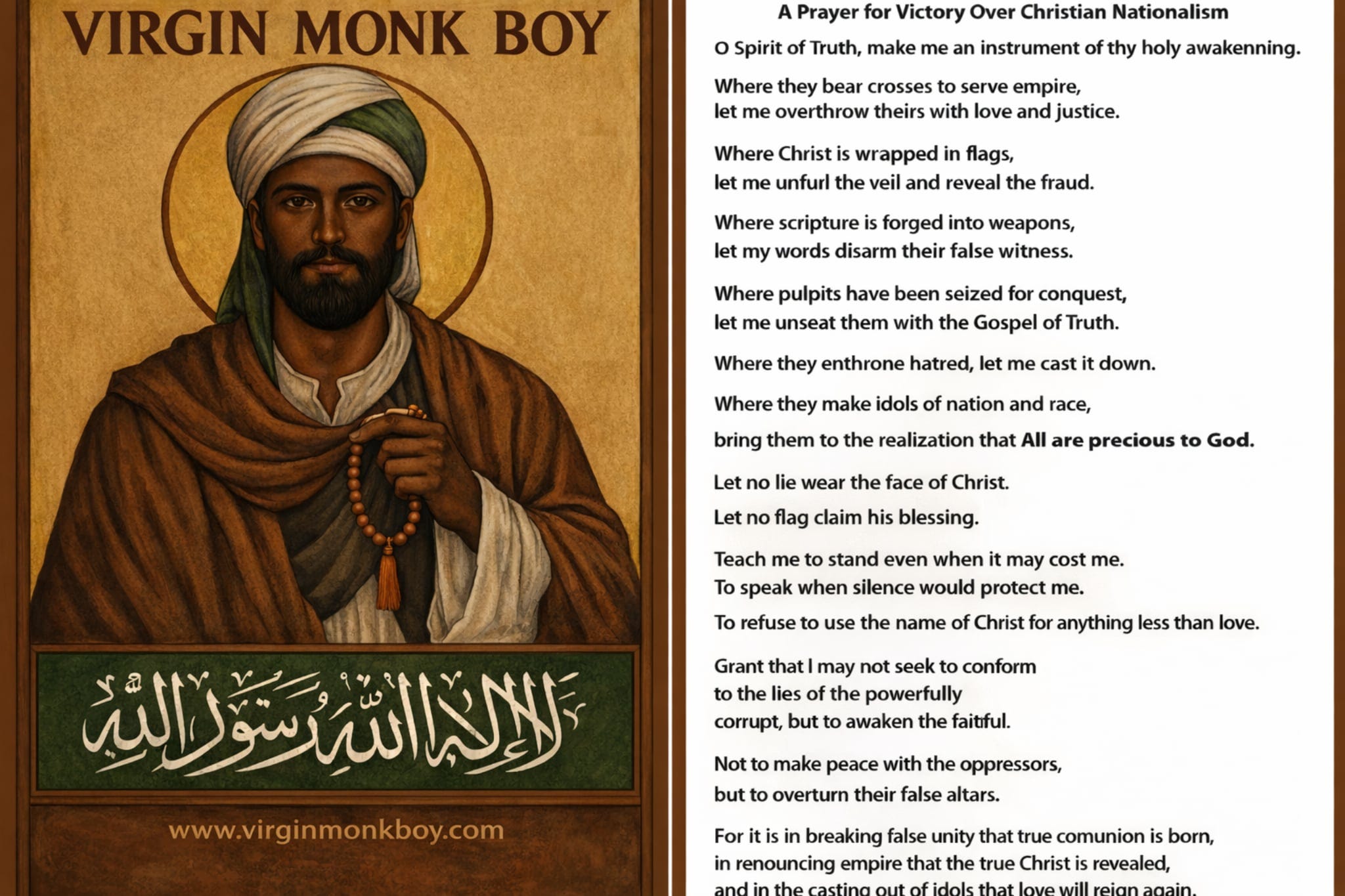
Well that has told them (the Christian Nationalists that is). Those of us who know will always appreciate that most if not all Muslims are better 'Christians' than many, if not most, of those who profess to be Christians.
Crazy good insight! Well done.