
How to Watch Yourself Slip Out the Back Door
Developing the Inner Witness Through Daily Practice

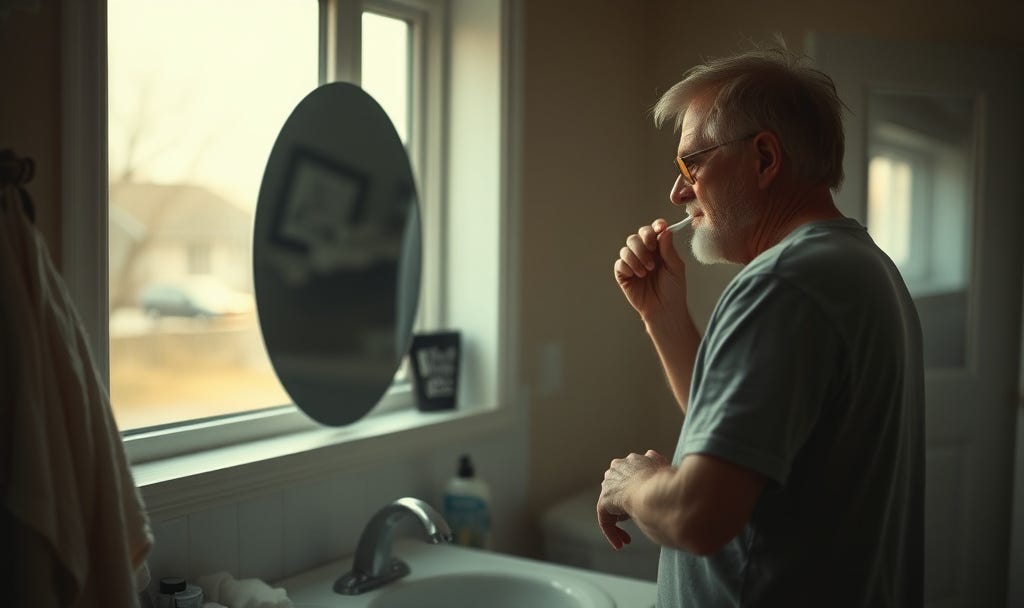
This reflection grows out of the same stream as You Don’t Have to Like It to Pay Attention: Cynthia Bourgeault’s work with Practicing Living Presence, read through Kabir Helminski’s Living Presence, and that whole stubborn Sufi insistence that attention is not just a mental function but a spiritual hinge. One of the things that becomes painfully obvious once you begin trying to practice this in ordinary life is that most of us do not lose presence in grand moral crises. We lose it in the bathroom, in the grocery store, in the car, in the ten seconds between one task and the next. The soul does not usually leak out through some dramatic wound. It slips quietly out the back door while we are brushing our teeth and thinking about revenge.
The Small Vanishings
What makes this hard to catch is that the disappearance is rarely dramatic. You are standing at the sink, doing the most unimpressive task in human history, and then suddenly you are no longer there. The hand is still moving. The toothbrush is still doing its little prison scrub. But inwardly you are in a courtroom, or an old conversation, or a fantasy where everyone finally understands your brilliance and regrets their previous stupidity. Attention has been hijacked, and because this happens all day long, the mind treats it as normal.
That is part of the problem. We think wandering is harmless because it is common. We think because everyone lives like a haunted Roomba, bumping from task to task while mentally elsewhere, that this must simply be what a human mind does. But the deeper traditions have always said no. This is not freedom. This is sleep with errands.
How Attention Gets Stolen
Helminski’s point is not merely that attention wanders. It is that attention gets captured by what attracts or repels us, and the ego then mistakes this reactivity for choice. That means the issue is not just distraction in the generic sense. The issue is that our attention is usually moved by appetite, irritation, fantasy, fear, vanity, and unfinished inner theater. Something in us is always ready to lunge.
You see this in embarrassingly ordinary places. You are running errands and somebody cuts you off in the parking lot. Now the body is in one place, but inwardly you are writing a thesis on the collapse of civilization. Or you are folding laundry and suddenly remembering an insult from three years ago with the emotional freshness of a live broadcast. Or you are brushing your teeth and by the fourth tooth you are no longer in the bathroom at all. You are in some imaginary future where you have finally explained yourself correctly.
The mind is a talented escape artist. Give it a sink and it will build a portal.
The Witness Does Not Scream
The good news is that the inner witness does not need to arrive as some heroic spiritual personality. It does not need robes. It does not need incense. It does not need a soundtrack that sounds like monks mating with synthesizers. It begins much more quietly than that.
It begins the moment you notice.
That is all.
Not fixing. Not scolding. Not launching a self-improvement campaign because you have once again failed to remain luminously present while buying toothpaste. Just noticing. “Ah. I’m gone.” That moment matters because the instant you see the wandering, you are no longer completely fused with it. Something in you has stepped half an inch back. That half inch is sacred territory.
Why Gentleness Matters
Most people ruin the practice right there by turning the witness into a hall monitor. They notice they are gone and immediately begin the familiar inner sermon. “Why am I like this? Why can’t I stay present? I should be better at this by now.” Which is just another form of leaving. Now you are no longer lost in fantasy or irritation. You are lost in self-judgment. Same building. Different room.
The witness is not a critic. It is a simple, steady seeing. It does not panic when attention slips. It does not make your wandering into evidence for the prosecution. It just notices, and then invites a return. Very gently. The whole movement is closer to turning your face back toward the moment than it is to beating yourself into compliance.
That matters because harshness is still ego. It still believes force is the answer. Presence usually grows better in honesty than in violence.
Ordinary Life Is the Training Ground
This is why the real practice does not happen only in formally spiritual moments. It happens while brushing your teeth, yes, but also while walking into the post office, waiting at a red light, listening to somebody tell a long story when your personality would strongly prefer to flee the country, and standing in line while every cell in your body demands stimulation.
These ordinary moments are not a distraction from the work. They are the work.
The kitchen is where you find out whether attention can stay put without being bribed. The grocery store is where you discover whether your peace depends on no one being annoying. The commute is where you learn whether your interior life belongs to presence or to grievance. The little vanishings of the day are not proof that you are failing. They are where the mechanism becomes visible.
And once it becomes visible, it can no longer run the whole monastery unchecked.
Catching Yourself in the Act
What starts to change over time is not that you never disappear. It is that you begin to catch the movement sooner. At first, you notice three minutes later that you have been lost in some fantasy argument while loading the dishwasher. Then maybe thirty seconds later. Then in the middle of the spiral itself. Then, once in a while, right at the moment attention starts to slip toward the back door.
That is not a small thing. That is the strengthening of inner life.
Because the point is not to create some rigid state where you never drift, never react, never lose the thread. The point is to build familiarity with the one in you that can notice without collapsing. The one that can return. The one that can remain a little more stable while the rest of you performs its usual vaudeville.
Coming Back Without Romance
There is nothing glamorous about this. Nobody gets to post a mystical selfie because they returned to the present while standing in line at Walgreens. This is deeply unsexy work. Which is probably one reason it is real.
But over time, this simple practice of noticing and returning begins to do something substantial. It weakens the automatic trance. It gives the witness more substance. It teaches attention that it does not have to obey every impulse, every irritation, every fantasy with a megaphone. It lets you inhabit the ordinary without constantly fleeing it.
And then once in a while, in the middle of something completely unimpressive, you are just there. Really there. Not performing presence. Not narrating it. Not being pleased with yourself for having achieved it.
Just there.
Which turns out to be a far greater miracle than most of us were trained to look for.
Keep the Scrolls Unrolling
The Virgin Monk Boy Scrolls is a free publication.
If these words steady you, challenge you, make you laugh, or help you breathe deeper, here are three simple ways to support the work.
Share the Scrolls
Passing a link forward is how more wandering souls stumble into the monastery. Word of mouth is the whole engine.
Become a Supporting Member
Paid members unlock the Virgin Monk Boy Book Of Hours, Whispers from the Silence, and the ability to start threads and share their own Substacks in the private chat.
Tip with a coffee
A one time gift of holy caffeine that fuels both the monk and the Magdalene movement. ☕🔥

Your presence alone already helps.
Your support keeps the lantern lit for everyone else.
Follow (or troll) Virgin Monk Boy
Recommended Reading
(As an Amazon Associate, I earn from qualifying purchases. These recommendations support the scrolls at no extra cost to you.)
Living Presence: A Sufi Way to Mindfulness & the Essential Self by Kabir Helminski
Great post. I laughed out loud at the line "Give it a sink and it will build a portal."
Have you ever read books by Keith Giles? I am currently in the middle of his "The Gospel of Mary and the Lost Gospel of of Truth" and it is really fascinating and moving. It brings your writing to mind for sure.
Are you in my bathroom today? “brushing our teeth and thinking about revenge. Where I get stuck in a loop is wondering what needs to be completed, or addressed. I suppose the answer is to actually get present to what I am feeling and trust life will show me.