
Christianity Had Survived in the Holy Land for 1,800 Years. Then the Missionaries Arrived.
How Western Protestant missions weakened indigenous churches, imported sectarian conflict, and transformed Christianity from a local faith into a symbol of foreign power

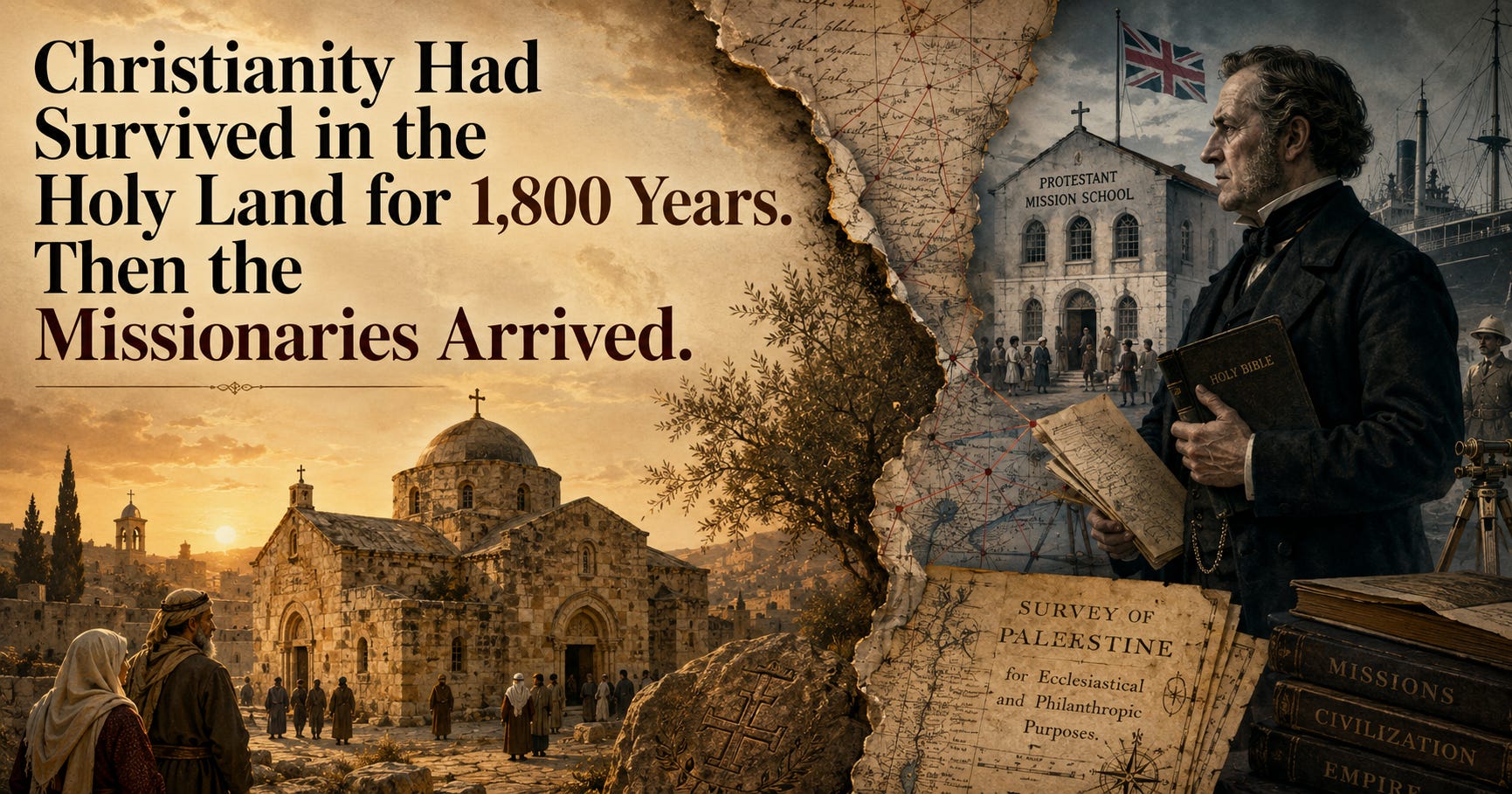
I was inspired to write this after watching Christian nationalists repeatedly complain that Muslims refuse to assimilate, warn of an Islamic takeover, and insist that Islam destroyed Christianity in the Holy Land. The history tells a very different story. Indigenous Christianity survived there for more than a thousand years under Muslim rule. What truly weakened and displaced it was the arrival of Western missionaries, colonial powers, and political projects that treated the Holy Land as something to reclaim rather than a living society already inhabited by Christians and Muslims.
When Western Protestant missionaries began arriving in the Holy Land during the nineteenth century, they spoke as though they were bringing Christianity back to its birthplace.
They arrived carrying Bibles, tracts, schoolbooks and the enormous confidence of people who had never considered that the Christians already living there might understand their own faith perfectly well.
Christianity had not disappeared from Palestine. It had survived Roman persecution, Byzantine politics, the Persian invasion, the Islamic conquest, the Crusades, the Mamluks and centuries of Ottoman rule. Palestinian Christians had guarded churches, preserved liturgies, maintained monasteries and continued worshipping in the places associated with the life of Jesus.
Then Europeans arrived to explain Christianity to them.
They Did Not Discover an Empty Biblical Stage
The first organized American Protestant mission to Palestine was commissioned in 1819, when Levi Parsons and Pliny Fisk were sent by the American Board of Commissioners for Foreign Missions. Parsons entered Jerusalem in 1821. British missionary organizations followed, and their presence became substantially more powerful during the 1840s and 1850s.
The Anglo-Prussian Protestant bishopric was created in Jerusalem in 1841. Samuel Gobat became its second bishop in 1846. Christ Church was consecrated in 1849, and the Ottoman government formally recognized Protestants as a separate religious community in 1850. So 1850 was not the beginning, but it was roughly when scattered missionary efforts became an organized institutional presence backed by European influence.
The missionaries looked at Palestine and saw a biblical landscape waiting to be reclaimed. They rarely saw the living society in front of them on its own terms.
The Holy Land became a kind of theological theme park in the Western imagination. Its Arab inhabitants were reduced to background scenery. The land mattered because Abraham had walked there, David had ruled there and Jesus had taught there. The people actually living there were treated as custodians who had somehow misplaced the instruction manual.
Their Main Target Was Not Muslims
One of the most revealing facts about the early Protestant missions is that they did not concentrate primarily on converting Palestine’s Muslim majority.
The London Society for Promoting Christianity among the Jews naturally concentrated on Jews. The Church Missionary Society was consumed by its rivalry with Catholicism and what it considered the corrupt practices of the ancient Eastern churches. Its reports spoke of awakening the supposedly sleeping Syrian and Greek churches. Islam received surprisingly little attention.
Historian Laura Robson found that these early Protestant organizations drew their converts and local connections almost exclusively from Christian and Jewish communities. They presented themselves not primarily as an alternative to Islam, but as an alternative to Catholicism, Orthodoxy and the ancient liturgical Christianity of the region.
Under Bishop Gobat, the mission deliberately focused on local Orthodox and Catholic Christians. During his tenure, forty-two Anglican schools opened. Ottoman restrictions made direct evangelism among Muslims difficult, but that was not the only reason for this strategy. European evangelical Protestantism defined itself through opposition to Catholic sacraments, Orthodox traditions, icons, priests, monasteries and liturgical worship.
The missionaries had come to the land of the apostles and somehow concluded that the churches descended from the apostolic age were practicing Christianity incorrectly.
“Saving” Christians From Christianity
Western missionaries were often openly disgusted by indigenous Christian worship.
They described the Church of the Holy Sepulchre, Christianity’s most important sacred site, as a nest of superstition, filth and ritual excess. The incense, icons, chanting, vestments, processions and ancient ceremonies that connected Palestinian Christians to generations before them looked foreign to Protestants accustomed to white walls, wooden pews and sermons.
This was more than a disagreement about worship style. The missionaries believed they possessed a purer Christianity than the people whose families had been Christian for centuries.
Schools became one of their most effective tools. Education was offered free or at heavily subsidized rates. Mission institutions provided language instruction, medical care, employment and connections to European consulates. For poor families, these could be powerful incentives.
By the late nineteenth century, even Anglican leaders were admitting what had happened. The Archbishop of Canterbury criticized earlier tactics that had made conversion economically attractive to poor Christians and drawn children away from their parents’ churches.
The issue was not that schools, hospitals or printing presses were bad. Many improved people’s lives, expanded literacy and produced important Arab intellectuals.
The problem was that help often arrived wrapped in contempt. Education came with the suggestion that your grandparents’ faith was backward. Medical assistance came from institutions competing for your religious loyalty. Foreign protection could elevate one Christian community over another. Material survival and spiritual allegiance became entangled.
Missionary Competition Became Communal Conflict
The result was not a great wave of Muslim conversions. It was increased rivalry among Christians.
Gobat’s attempts to recruit Orthodox and Catholic children provoked furious resistance. In 1852, a Catholic crowd attacked a Protestant school in Nazareth, damaging the building and injuring a missionary. The following year, Orthodox protesters attacked the Protestant mission house in Nablus during worship, forcing the congregation to flee.
Catholics opened schools opposite Protestant schools. Missionaries accused Catholic clergy of intimidating families. Protestant Bibles were publicly burned. Orthodox authorities threatened sanctions against members who associated with Anglican institutions.
The Western missionaries had not created every disagreement among Christians, but they industrialized those disagreements.
Ancient religious identities that had existed within a shared local culture became connected to competing foreign powers. France claimed Catholic interests. Russia claimed Orthodox interests. Britain and Prussia promoted Protestant institutions. Churches were no longer merely churches. They became extensions of consulates, imperial rivalries and European political strategy.
A Palestinian Christian’s denominational identity could now affect where his children attended school, where he received medical treatment, which foreign government might protect him and what economic opportunities were available.
That is how theological difference becomes sectarian infrastructure.
Christianity Arrived With a Flag Behind It
Missionary Christianity also helped change how Muslims perceived their Christian neighbors.
For centuries, Palestinian Christians had been Arabic-speaking members of the same towns, villages, markets and extended social world as Muslims. They were not European foreigners. They were Palestinians who happened to be Christian.
But Western intervention began attaching Christianity to European privilege and political intrusion.
The British consulate’s protection of mission institutions was understood as a way to expand British influence against France, Russia and the Ottoman government. The Protestant bishopric itself was discussed in geopolitical terms. British leaders did not simply want a church in Jerusalem. They wanted a British religious foothold in the eastern Mediterranean.
The fusion of religion and empire became unmistakable with the Palestine Exploration Fund, founded in 1865. Presented as an archaeological and scholarly organization, it was deeply shaped by evangelical assumptions. Its projects concentrated heavily on ancient Israel, while Ottoman and Arab history was treated as an irrelevant interruption.
At the Fund’s opening meeting, the Archbishop of York announced, “This country of Palestine belongs to you and to me. It is essentially ours.”
The Fund’s surveys supported biblical research, but its maps were also supplied to British intelligence. Scripture, archaeology and military strategy were becoming parts of the same project.
The message to the indigenous population was difficult to miss: Europeans considered Palestine theirs because they had read about it in the Bible.
The Land Became More Important Than Its Christians
This Western Christian imagination adored the Holy Land while remaining strangely indifferent to Holy Land Christians.
It loved ancient Christians, preferably dead ones. Apostles, martyrs and Church Fathers were wonderful. Living Arab Christians were inconvenient. They spoke Arabic, shared customs with Muslims and practiced forms of Christianity that Protestants had spent centuries condemning.
The indigenous Christian was therefore rewritten as either an ignorant victim awaiting Protestant rescue or an obstacle standing between Western Christians and the biblical landscape they believed belonged to them.
That mindset did not preserve Palestinian Christianity. It weakened its institutions, divided its communities and connected its public image to foreign political power.
When resentment toward European intervention grew, local Christians could be treated as representatives of the West even when they had never asked Europeans to represent them. The missionary could eventually return to London, Boston or Berlin. The Palestinian Christian remained behind to live with the suspicion the missionary had helped create.
Christianity Survived Muslim Rule. Its Destruction Is a Modern Western Story
There is one historical fact that modern Christian Islamophobes never seem prepared to explain.
Christianity survived in the Holy Land continuously for nearly two thousand years. For roughly thirteen of those centuries, Palestinian Christians lived under successive Muslim governments.
They did not disappear.
The Greek Orthodox Patriarchate remained. Armenian, Syriac, Coptic, Ethiopian and Catholic communities remained. Monasteries continued operating. Pilgrims continued arriving. Bells continued ringing. Liturgies continued being celebrated in Jerusalem, Bethlehem, Nazareth and villages throughout Palestine.
When British troops entered Jerusalem in 1917, they did not discover a land where Christianity had been outlawed or driven underground. They found ancient Christian communities that had remained rooted there through centuries of Arab, Mamluk and Ottoman Muslim rule.
Ottoman records from 1878 counted more than 43,000 Christians in the districts that would later form Mandatory Palestine. These were not recently arrived European missionaries. They were indigenous Arabic-speaking Christians belonging largely to churches that had existed in the region since antiquity.
That alone dismantles the popular claim that Christianity simply cannot survive in a Muslim-majority society.
It survived there for more than a millennium.
What it could not survive was the modern political order imposed by Western powers.
The demographic destruction of Palestinian Christianity did not occur during the early Islamic conquest. It did not occur during the centuries of Ottoman government. It occurred after European empires began treating Palestine as their religious inheritance and its indigenous population as an obstacle.
British rule brought the Balfour Declaration, the machinery of the Mandate and official support for establishing a “Jewish national home” in a country whose existing population was overwhelmingly Palestinian Arab. Christian and Muslim Palestinians recognized that they faced the same political threat. That is why they formed Muslim-Christian Associations together across Palestine after the British occupation.
Then came 1948.
The Nakba did not distinguish between Muslim and Christian Palestinians. Towns were emptied, villages were destroyed, property was seized and families were scattered into refugee communities throughout the region.
Historian Bernard Sabella estimated that approximately 50,000 Palestinian Christians were displaced during the 1948 war. That represented roughly 35 percent of the entire Christian population of Palestine. In other words, more than a third of Palestine’s indigenous Christians were uprooted in a single modern catastrophe.
The Greek Orthodox Patriarchate reported afterward that it was facing a severe financial crisis because of the events following the end of the British Mandate, while simultaneously attempting to care for refugees driven from areas controlled by the new Israeli state.
The decline continued through occupation, land confiscation, economic strangulation, walls, checkpoints, residency restrictions and the steady pressure placed upon Palestinian life.
Bethlehem was approximately 85 percent Christian in 1948. By the time a United Nations special rapporteur examined the situation six decades later, Christians represented only around 15 percent of the city. The same report identified Israeli permits, checkpoints and the separation barrier as restrictions affecting Palestinian Christians’ ability to travel and reach their places of worship.
This does not mean Western missionaries single-handedly caused the Nakba or every later act of displacement. It means they participated in the larger process that transformed Palestine from a living Arab society into a Western religious project.
They taught Europeans to imagine the Holy Land without its actual inhabitants. They portrayed Muslim rule as an interruption in a story that properly belonged to Western Christians and biblical Israel. They helped transform Christianity from the indigenous faith of Palestinian families into an ideological claim made by foreign governments.
The missionaries arrived first with schools, Bibles and archaeological surveys. The empire followed with maps, declarations and soldiers.
Then the indigenous Christians began disappearing.
This is the part omitted whenever Western Christians claim that Muslims are inherently incapable of tolerating Christianity. The Christians of Palestine survived caliphates, sultanates and nearly four centuries of Ottoman Muslim government. Their churches, monasteries and communities remained embedded in the land.
Their catastrophic displacement began under a British Christian empire and accelerated under a modern nationalist project born largely in Europe, enabled by Britain and protected by Western power.
The indigenous Christian presence was not destroyed because Palestinian Muslims suddenly decided that Christians could no longer live beside them. Muslims and Christians were displaced together. They became refugees together. They resisted colonial rule together. To this day, Palestinian Christians describe the occupation, loss of land, economic pressure and restrictions upon movement as central threats to their continued existence.
So the next time someone announces that Christians cannot survive under Muslim rule, point them toward the birthplace of Christianity.
Christianity survived there under Muslim rule for approximately thirteen centuries.
It was the arrival of the modern West that nearly finished it off.
Christianity Did Not Need to Be Brought Back
Western Protestant missionaries did not single-handedly destroy Christianity in the Holy Land. Christianity survives there today because indigenous Christians continue refusing to disappear.
But the missionaries helped damage the social world in which that Christianity had survived.
They arrived claiming to revive the church, then competed against its oldest communities. They claimed to bring unity, then built rival schools and institutions around denominational allegiance. They claimed to preach a spiritual gospel, then traveled beneath the protection of expanding empires. They claimed the Holy Land belonged to the Bible, then behaved as though the people living upon it were trespassers.
The deepest irony is that Christianity had survived in Palestine precisely because it had become indigenous. It spoke the language of the people. It belonged to families, villages, local saints, ancient sanctuaries and patterns of coexistence developed over generations.
Western missionaries did not find Christianity dying in the Holy Land.
They found a Christianity they did not recognize, mistook their unfamiliarity for its corruption, and began dismantling the very thing they claimed to save.
Keep the Scrolls Unrolling
The Virgin Monk Boy Scrolls is a free publication.
If these words steady you, challenge you, make you laugh, or help you breathe deeper, here are three simple ways to support the work.
Share the Scrolls
Passing a link forward is how more wandering souls stumble into the monastery. Word of mouth is the whole engine.
Become a Supporting Member
Paid members unlock the Virgin Monk Boy Book Of Hours, Whispers from the Silence, and the ability to start threads and share their own Substacks in the private chat.
Tip with a coffee
A one time gift of holy caffeine that fuels both the monk and the Magdalene movement. ☕🔥

Your presence alone already helps.
Your support keeps the lantern lit for everyone else.
This is a powerful and necessary reframe. The idea that Western missionaries were not the saviors of a dying faith but the agents of its demographic and cultural collapse in its ancestral homeland is a truth that has been largely buried by triumphalist church history.
What strikes me most is the distinction between "church membership" and "indigenous rootedness." A community can lose its numerical majority and still survive as a living tradition. But when the transmission of the faith is severed from family lineage and sacred land when it becomes a portable theology rather than a lived inheritance, something fundamental is lost.
The irony is profound: the very forces that sought to "save" Christianity in the Holy Land may have accelerated its disappearance as an indigenous phenomenon. The question I am left with is: can a tradition survive when it is no longer tied to a specific people and place? Or does it become something else entirely, a universal message without a living body?