
The Forgotten Authority of Women in Early Islam
How Aisha preserved over 2,000 hadith and helped shape Islamic scholarship while many women in medieval Europe still lacked basic property rights

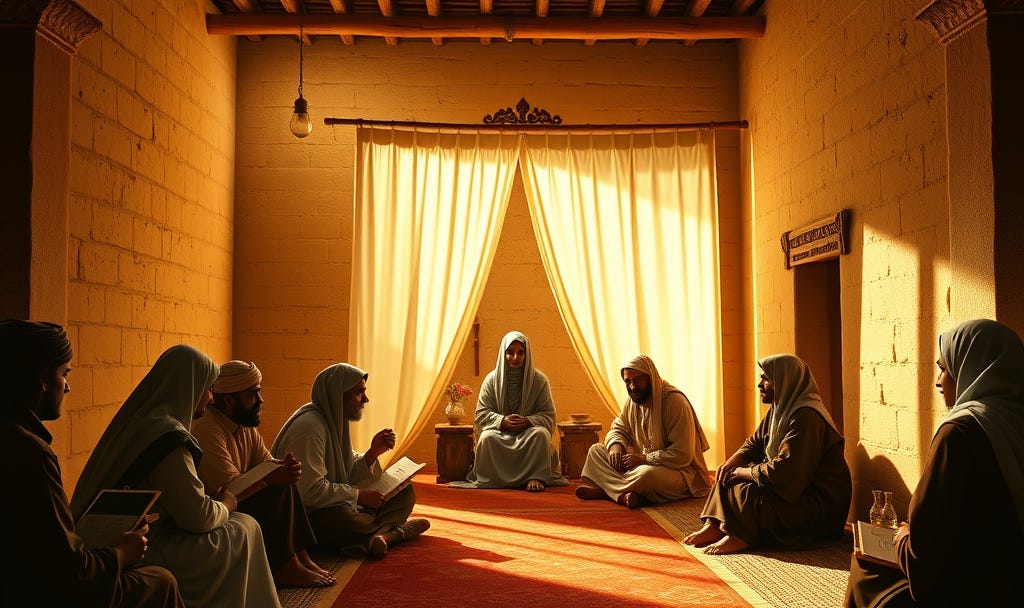
Spend a few minutes in the comment sections arguing about Islam and women and you will hear a very confident story repeated over and over again. According to the internet version of history, women in early Islam were silent, powerless, and invisible.
The problem with that story is simple.
The historical sources refuse to cooperate.
When you actually read the early record, something inconvenient appears almost immediately: some of the most important intellectual authorities in early Islam were women.
The clearest example is Aisha bint Abi Bakr, remembered by Muslims as Mother of the Believers.
That title alone has inspired novels and historical retellings. One particularly vivid example is Mother of the Believers: A Novel of the Birth of Islam by Kamran Pasha, which imagines Aisha narrating the dramatic years surrounding the birth of the Muslim community and the death of the Prophet.
But the historical Aisha does not need embellishment to be remarkable.
When Muhammad died, Aisha did not fade politely into the background as a symbolic widow. She became one of the most important scholarly voices in the early Muslim community. Over the course of her life she transmitted more than 2,000 hadith, reports describing the sayings and daily practices of the Prophet. Later jurists and theologians leaned heavily on those reports as they tried to understand how Muhammad actually lived and how Muslims were supposed to follow his example.
This was not honorary respect.
People came to her because she knew things they didn’t.
Aisha had lived inside the Prophet’s household. She had seen the ordinary rhythms of his life, the quiet moments that never make it into speeches. When questions arose about how the Prophet prayed, fasted, spoke, or treated the people around him, Aisha often had the most direct knowledge available.
In very practical terms, one of the people responsible for preserving the intellectual memory of Islam was a woman.
When Aisha Corrected the Men
Aisha also had another habit that modern commentators tend to forget.
She argued.
Early Islamic sources preserve several moments where she openly challenged interpretations offered by other companions. One example involves Abu Hurayra. When he reported that someone who woke in a state of ritual impurity could not continue a fast, Aisha pushed back. She explained that the Prophet himself had sometimes awakened in that condition and still completed the fast.
Her correction mattered because she knew the reality of the Prophet’s household life firsthand.
Another dispute involved a report repeated by Ibn Umar claiming that the dead are punished because their relatives weep for them. Aisha rejected the interpretation. The Qur’an, she reminded them, clearly teaches that no soul bears the burden of another. According to her explanation, the Prophet had been referring to a particular funeral he witnessed rather than establishing some sweeping theological rule.
She was just as blunt in another famous exchange. Some companions had begun repeating a report claiming that women, dogs, and donkeys interrupt a man’s prayer if they pass in front of him. Aisha’s response was not subtle. She reminded them that she herself had often been lying in front of the Prophet while he prayed and that her presence had never interrupted anything.
These moments tell us something important.
Aisha was not merely passing along traditions like a recorder.
She was interpreting them, debating them, and occasionally correcting the conclusions of the men around her.
Women Teaching the Tradition
And Aisha was not some strange exception.
Women participated actively in the transmission of knowledge during the early centuries of Islam. They taught hadith, hosted study circles, and passed chains of learning to later generations. Male scholars traveled to study with them. Some of the most respected jurists and historians in the Islamic world received their certification to transmit hadith through female teachers.
The historical record preserves the names of hundreds of these women.
Their classes took place in mosques, in homes, and in informal gatherings where students sat cross-legged and copied notes. Their students included some of the most influential scholars of the medieval Muslim world.
In other words, the intellectual life of Islam was never as exclusively male as modern polemics like to pretend.
Legal Changes in Seventh-Century Arabia
To understand why this happened, you have to remember the world Muhammad was operating in.
Seventh-century Arabia was a tribal society where inheritance usually flowed through male lines and women’s legal standing was often precarious. The Qur’an altered that landscape in several important ways. Women were granted defined shares of inheritance. They could own property in their own name. Their marriage dowry belonged to them rather than to their families. Marriage itself was framed as a contract that required the woman’s consent.
Did this instantly create a modern egalitarian society?
Of course not.
History doesn’t move that way.
But within the context of Late Antiquity, these reforms represented a significant shift in women’s legal standing.
Muhammad’s personal behavior reinforced the same pattern. Early sources record him consulting his wives on matters affecting the community. During the tense negotiations surrounding the Treaty of Hudaybiyyah, his wife Umm Salama offered advice on how to calm a moment of crisis among his followers. Muhammad followed her suggestion, and the situation settled.
Aisha and the Storm After Uthman
History rarely unfolds like a clean lecture.
More often it looks like a family argument that spilled into the street.
In the year 656, the third caliph, Uthman ibn Affan, was assassinated after months of political unrest. His death sent shockwaves through the Muslim world and left the community scrambling to restore order. Soon afterward Ali ibn Abi Talib was recognized as the new caliph.
Everyone agreed on one thing: Uthman’s murder demanded justice.
What divided people was the question of timing.
Some companions believed the killers had to be punished immediately. Among those voices were Aisha and two respected companions of the Prophet, Talha ibn Ubaydullah and Zubayr ibn al-Awwam.
Ali faced a very different problem. The political situation was volatile, and the factions involved in the uprising were still active. Moving too quickly risked tearing the fragile unity of the young Muslim state apart.
The disagreement eventually led to a confrontation near Basra that history remembers as the Battle of the Camel.
Aisha addressed supporters from a howdah mounted on a camel in the center of the battlefield. Fighters rallied around the animal because it symbolized the leadership of her side.
When the camel was finally brought down, the battle ended.
What happened next matters just as much as the battle itself.
Ali did not treat Aisha as an enemy to be humiliated. Instead he treated her with respect, arranged for her safe escort, and sent her back to Medina under protection. There she returned to what she had always done best: teaching, answering legal questions, and transmitting the hadith that would shape generations of Islamic scholarship.
A Surprising Historical Comparison
When historians zoom out and compare civilizations, another detail appears that tends to surprise modern readers.
Scholars such as Karen Armstrong have pointed out that women living under early Islamic law often possessed clearer property rights than many women in medieval Christian Europe. In large parts of Europe, a married woman’s property was absorbed into the legal authority of her husband.
Under Islamic law, a woman retained ownership of her property and her dowry.
That doesn’t mean any historical society was perfect. It simply puts the timeline of legal rights back into its proper order.
A Different Model in the Teachings of Jesus
For comparison, Jesus elevated women primarily through spiritual inclusion rather than legal reform.
The Gospels show him teaching women openly, defending them against public humiliation, and welcoming them among his followers. Mary Magdalene appears in the resurrection narratives as the first witness to the risen Christ and the one entrusted with announcing the news to the other disciples.
Jesus was not establishing a governing society or writing legal codes.
Muhammad, by contrast, was leading a rapidly expanding community that required law, governance, and institutions. In that setting the reforms associated with his leadership produced a scholarly culture in which figures like Aisha could emerge as major authorities.
The Quiet Truth the Memes Ignore
Which brings us back to a historical reality that tends to ruin modern talking points.
The intellectual foundations of Islam were not built by men alone.
They were preserved, interpreted, debated, and taught by women.
One of the most important voices in that process was Aisha, who transmitted thousands of reports about the life of the Prophet and helped shape how generations of Muslims understood his example. Many of the teachings Muslims know about the Prophet’s daily life and character come through her scholarship.
That fact sits awkwardly beside some modern narratives.
Over the last century, ultra-conservative interpretations of Islam, particularly those promoted and funded by Saudi Arabia, have often pushed a far narrower vision of women’s public and intellectual roles. In many places that ideology overshadowed the much older history of female scholarship that existed in the classical Islamic world.
The irony is hard to miss.
A civilization whose early centuries included women teaching hadith to leading scholars is now often described as if women never held intellectual authority at all.
But the early record refuses to disappear.
Long before modern culture wars, Aisha was debating legal questions, correcting male scholars, transmitting thousands of prophetic traditions, and shaping the intellectual foundations of Islam itself.
And once you see that clearly, the memes start to look very small.
Help This Work Continue
If this reflection deepened something for you, share it with someone who is hungry for a contemplative path rooted in love rather than fear. Word of mouth is how this work grows.
If you want to support more writing like this, consider becoming a paid subscriber or leaving a tip. Your support keeps the research, reading, and long-form essays coming.

Beautiful! 🤩
I was today years old…
Women are truly Amazing 🥰💕
Brother V, thank you very much for your teachings, they’ve been a blessing to me — a gift from God.✨