

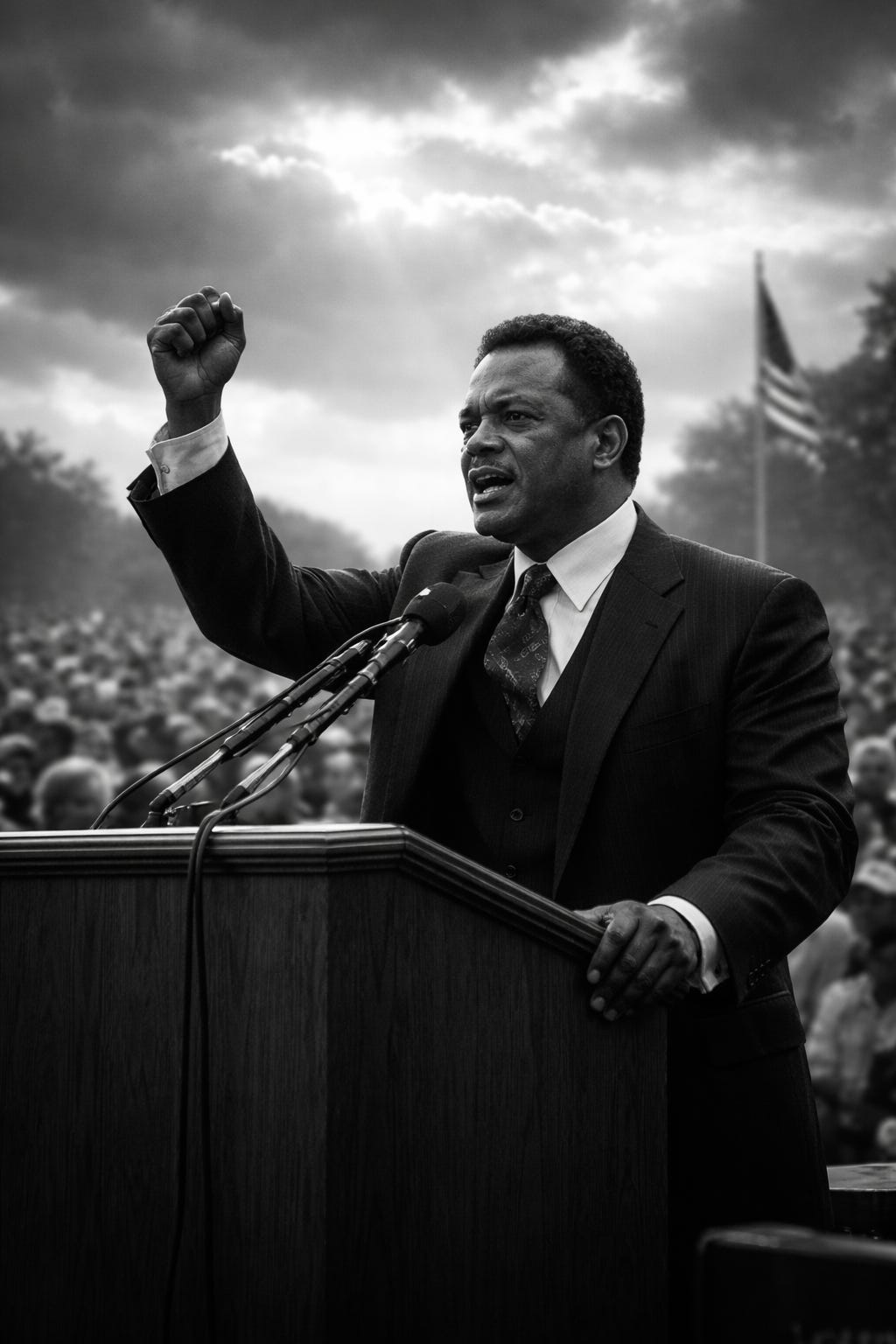
Some men wait for consensus before they speak.
Rev. Jesse Jackson never did.
Born into segregation in 1941 South Carolina, he stepped into a nation that preached liberty while practicing exclusion. He marched beside Dr. Martin Luther King Jr. not as a spectator but as a participant in the most dangerous moral argument of the twentieth century: that democracy must include the people it historically ignored.
When King was assassinated, many wondered whether the movement would fracture.
Jackson did not fracture. He organized.
Operation PUSH. The Rainbow Coalition. Not a slogan. A strategy. He dared to say that Black voters, poor white farmers, union workers, immigrants, and the urban unemployed were not rivals for crumbs but partners in shaping policy. That suggestion alone disrupted a political system that functions best when citizens are suspicious of one another.
Then he ran for president. Twice.
In 1984 and 1988, before it was fashionable to speak of historic firsts, he built a campaign that expanded the electorate and forced the Democratic Party to reckon with its margins. In 1988 he won eleven contests. Millions voted. The coalition widened.
And as always, widening makes some people nervous.
When a preacher demands fair hiring, voting access, and economic justice, he becomes “too loud.” When policies quietly narrow access, restrict ballots, or protect concentrated power, that is described as “responsible governance.”
It is remarkable how the language of moderation is often reserved for those who prefer the status quo undisturbed.
Jackson disturbed it.
He pressured corporations to diversify executive leadership. He advocated sanctions against apartheid South Africa when neutrality was still the safer posture. He negotiated hostages home. He registered voters in neighborhoods long dismissed as politically irrelevant.
He treated democracy as participatory, not decorative.
Was he controversial? Of course. Anyone who moves the center of gravity creates friction. But controversy is often the receipt you receive for challenging entrenched comfort.
Rev. Jesse Jackson belongs to a generation that believed moral language should lead policy, not trail it. That protest and ballot access are extensions of one another. That hope is not sentimental but structural.
He refused to let the circle shrink.
In an era where voting rights are debated like optional accessories and economic justice is caricatured as excess, his life stands as a reminder: democracy expands only when someone insists that it must.
The monk bows to the preacher who kept insisting.
May we inherit his stamina.
May we resist the temptation to trade courage for quiet.
May we remember that inclusion is not radical. It is foundational.
Down here we have William Barber II, whose was most influenced by King, but who operates like Jackson. The HKonJ (Historic Thousands on Jones Street, named for the street in Raleigh, NC where the legislature building is) is a callback to the Rainbow Coalition. Rev. Barber began the Moral Monday protests c. 2012 after Republicans gained single party control of state government with the election of Pat McCrory as governor (only the second Republican governor in about a century). He was awarded the Order of the Long Leaf Pine by McCrony's predecessor Bev Perdue in 2010, and despite chronic medical issues, continues to lead from the front. He's 22 years Jackson's junior, so expect continued great things from him -- keeping hope alive.